Español
 English
 Français
 Português
 Deutsch
 Italiano
FCC genehmigt SpaceX den Einsatz von bis zu einer Million Satelliten mit KI-Chips: Die Revolution der orbitalen Rechenzentren
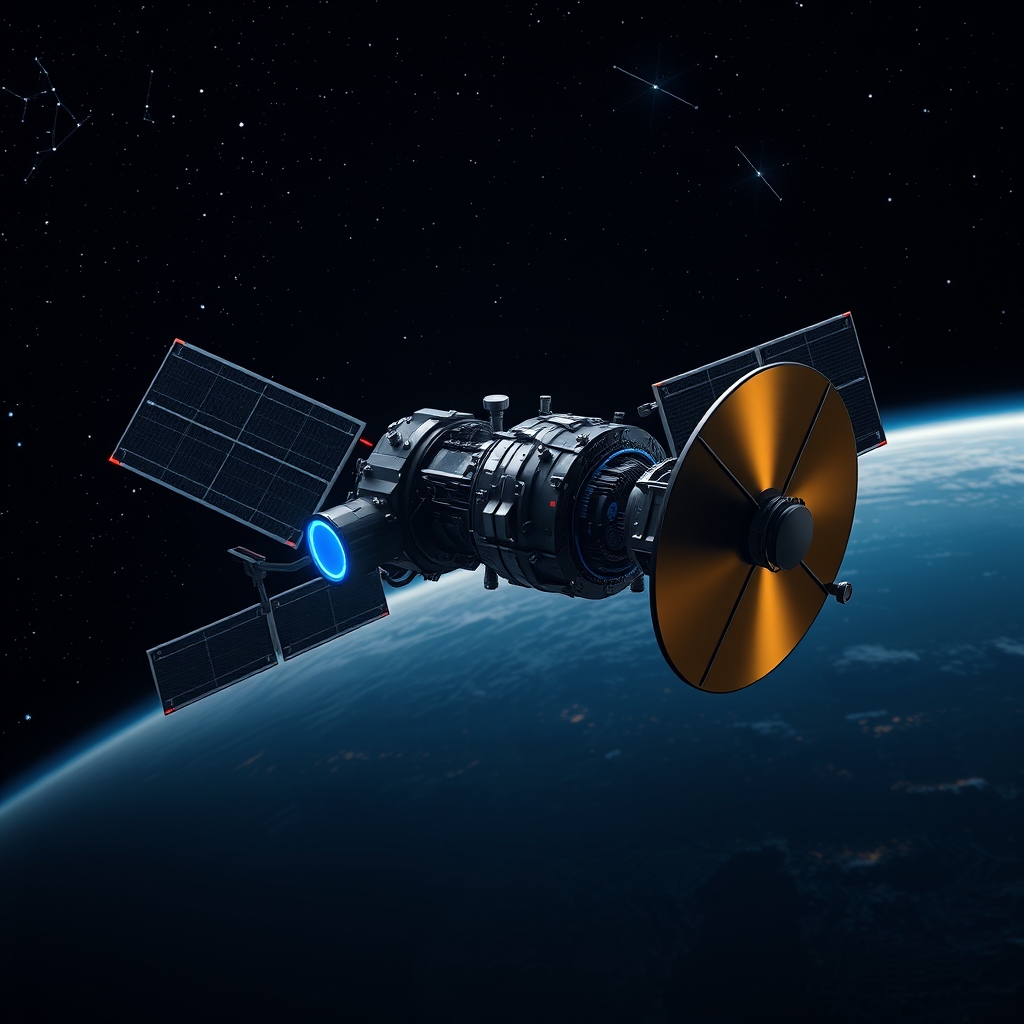 KI-generiert
1. Context and Highlights
On Wednesday, the FCC issued final authorization for SpaceX to deploy up to one million satellites equipped with AI chips under the "Starmind" initiative. This decision marks the first formal approval of a large-scale orbital data center project in the United States. The authorization includes the allocation of spectrum in the Ka and Ku bands, the definition of orbital debris mitigation standards, and the requirement for performance reports from the onboard processing modules.
The announcement comes at a time when Google, Blue Origin, and other players in the space sector are exploring similar architectures, suggesting the gestation of a distributed computing ecosystem outside the Earth's atmosphere. The stakeholders are cloud infrastructure operators, AI service providers, spectrum regulators, and governments seeking to secure technological sovereignty in space.
2. In-depth Technical Analysis
The core of the Starmind project is the "Starlink-AI" class satellites, a variant of the existing Starlink constellation but with a dedicated processing architecture. Each unit incorporates a next-generation AI ASIC, developed in collaboration with semiconductor manufacturers that have not been publicly disclosed. The chip is optimized for large-scale model inference, with support for mixed-precision tensors (FP16/INT8) and 16 GB of HBM2e memory, allowing the execution of inferences with up to 1 trillion parameters without the need for data exchange with Earth.
From an interconnection perspective, the satellites use high-speed laser links (up to 10 Gbps) to form a low-latency mesh network. The routing architecture is based on an adaptive routing protocol that prioritizes critical AI data flows, reducing latency variability to less than 30 ms between adjacent nodes. This approach allows AI models to run in a distributed manner, with weight fragmentation and parallel computation across multiple satellites.
The process of loading models into orbit is carried out through a secure supply chain based on elliptic curve cryptography and hardware signatures. The models are retrained on the ground and transmitted to the satellites via Ka-band links, where integrity is verified using SHA-3 hash tests before activation. The ability to retrain models in orbit is limited by bandwidth availability and by FCC policy, which requires that any firmware update be approved through a security review process. Regarding thermal management, the satellites employ high-emissivity radiators and phase-change materials (PCM) to dissipate the heat generated by the AI chips, which can reach up to 150 W of continuous power consumption. The energy architecture combines high-efficiency solar panels (30% conversion) with high-density lithium-ion batteries, ensuring 24 hours of operational autonomy even during prolonged eclipses. The massive deployment poses collision and debris management challenges. The FCC mandates that each satellite be equipped with an autonomous maneuvering system based on low-power plasma thrusters, capable of executing avoidance maneuvers in less than 5 seconds. Furthermore, the satellites must comply with the "deorbit within 25 years" regulation, which implies end-of-life planning that includes the deactivation of AI modules and the reduction of the orbit to 200 km for a controlled re-entry. From a security perspective, the AI modules include trusted enclaves based on trusted execution technology (TEE) that isolate inference code from the rest of the operating system. The enclaves are signed by SpaceX and by the FCC's certification authority, which reduces the attack surface against possible attempts to manipulate models or extract confidential data. Finally, the software architecture relies on a specialized real-time operating system (RTOS), with support for lightweight containers (similar to Docker but optimized for low-latency environments). This approach allows deploying multiple inference instances in parallel, facilitating horizontal scalability without compromising node stability.
3. Industry Impact and Market Repercussions
The FCC's authorization positions SpaceX as a pioneer in creating space-based AI infrastructure, which could shift part of the computational load from terrestrial data centers. Cloud providers that depend on minimal latency for critical applications (for example, autonomous vehicles, telemedicine in remote areas, and real-time data analysis for defense) will find in satellites an additional layer of redundancy and proximity to the end user.
Market analysts anticipate that the availability of processing capacity in orbit will generate a new category of services called "AI-as-a-Satellite". Service contracts could be structured under subscription models based on "inference costs per million tokens" and "data transmission costs". Since the FCC has not published specific rates, providers will have to negotiate spectrum usage and constellation access agreements with SpaceX.
The project also affects the semiconductor supply chain. The demand for AI ASICs for space environments will require manufacturing processes with radiation tolerance, which could boost investment in specialized foundries and chip hardening tests. Companies such as Nvidia, AMD, and AI ASIC manufacturers could see an opportunity to offer "space-hardened" versions of their products. In the regulatory sphere, the approval sets a precedent for future applications for satellite constellations with computing capacity. Other players, such as Google (with its "TerraCompute" project) and Blue Origin (with "Orbital Cloud"), will have to submit debris mitigation and data security plans that meet FCC criteria. Competition could accelerate the standardization of intersatellite communication protocols and interoperable AI model formats. From the investors' perspective, the authorization reduces regulatory uncertainty and opens the door to funding rounds for startups developing AI orchestration software in space. Venture capital funds specialized in space technology and AI could redirect capital towards projects that integrate both areas, which in turn will increase pressure on traditional data center providers to offer hybrid solutions.
4. Market Perspectives
Industry analysts agree that the key to Starmind's success lies in the ability to offer latencies below 50 ms for critical inferences, something that terrestrial infrastructure cannot always guarantee in regions with limited connectivity. The combination of high-speed laser links and edge orbital processing allows data to be processed close to the source, reducing the need for long-distance transmission.
Cybersecurity experts emphasize the importance of trusted enclaves and end-to-end cryptography. They point out that, although the hardware architecture is designed to be radiation-resistant, the attack surface shifts towards the software supply chain and update protocols. They recommend the implementation of open code audits and key revocation mechanisms in case of compromises.
Telecommunications strategists highlight that the allocation of spectrum in the Ka and Ku bands is a limited resource and that congestion in these bands could affect service quality. They propose the adoption of dynamic spectrum sharing techniques and AI-based interference management to optimize the use of available bandwidth. From a sustainability perspective, orbital debris management specialists warn that the introduction of one million satellites with computing capacity will increase the density of objects in low Earth orbit (LEO). They recommend coordination with the Space Debris Office and the adoption of international deorbiting standards to avoid the accumulation of debris that could trigger the Kessler effect. Financial analysts suggest that cloud operators who do not adopt an integration strategy with space infrastructure could lose market share in sectors where latency is a critical factor. They recommend evaluating strategic alliances with SpaceX or investing in the internal development of orbital computing capabilities.
5. Future Outlook
According to the schedule presented by SpaceX, the first phase of Starlink-AI satellite deployment will begin in the second quarter of 2027, with a pilot fleet of 5,000 units intended for real-time workload testing. The expansion phase, which will bring the constellation to 100,000 satellites, is scheduled for 2029, while the goal of one million satellites is projected for 2032, provided that debris and spectrum mitigation requirements are met.
On the 2035 horizon, the combined orbital processing capacity is expected to reach several exa-FLOPs, allowing the execution of AI models with several trillion parameters without relying on terrestrial infrastructure. The convergence of space quantum computing and model compression algorithms could further reduce bandwidth requirements for result transmission.
Analysts predict that by 2038, at least 15% of the global AI inference load will be executed in orbital environments, driven by environmental monitoring, disaster management, and emergency communications applications. The adoption of open standards for model serialization (for example, ONNX) will facilitate interoperability between different constellations and hardware providers. Finally, international regulation will likely evolve to include a framework for space AI governance, with the participation of the International Telecommunication Union (ITU) and the United Nations Office for Outer Space Affairs (UNOOSA). This framework will seek to balance innovation with the safety of the orbital environment and the protection of sensitive data.
6. Summary & Assessment
The FCC's authorization to SpaceX represents a turning point in AI computing architecture. Chief Technology Officers and infrastructure managers must evaluate the incorporation of orbital capabilities as an option for operational continuity and latency reduction. The immediate priority is to establish alliances with spectrum providers and radiation-resistant ASIC manufacturers, as well as to design software architectures that leverage distributed execution on satellites.
In parallel, it is essential to implement end-to-end security policies, firmware audits, and orbital debris mitigation plans. The combination of these imperatives will ensure that the adoption of space data centers is sustainable, secure, and aligned with long-term business objectives.