Español
 English
 Français
 Português
 Deutsch
 Italiano
How to Build a Private, Offline, and Auditable Local LLM System: Guide to Ben Auffarth's Workshop
 AI-generated
Sending confidential contracts, patient records, or financial ledgers to an external AI API is not just a latency or monthly billing issue: in regulated industries it is an immediate compliance blocker. When data sovereignty rules, privacy mandates, or air-gapped environments forbid a single token from leaving your corporate network, the engineering question shifts from which cloud endpoint scores highest to how to operate a private, deterministic, and auditable language system on your own hardware.
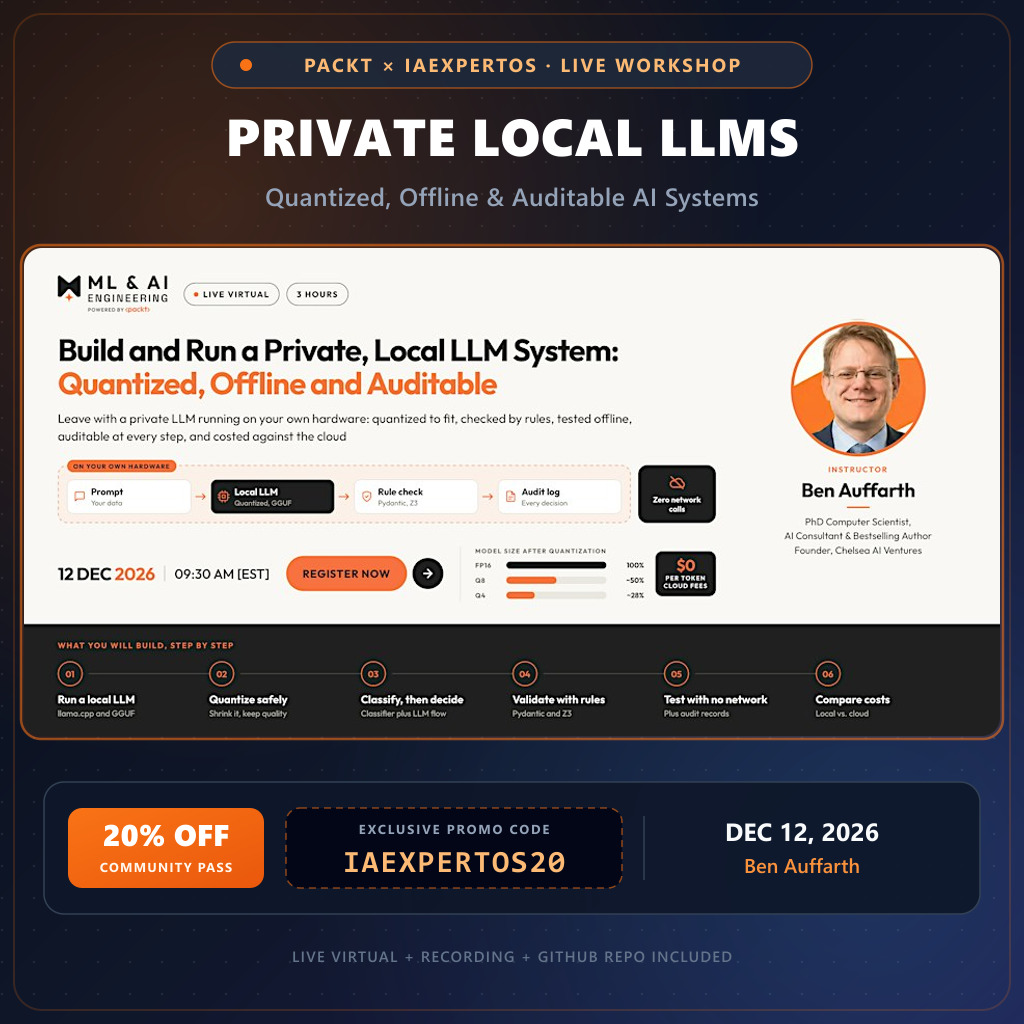
Running a quantized model locally on a laptop is straightforward in a prototype, but turning it into a production system that survives a security and compliance audit requires rigorous engineering discipline. On December 12, 2026, Ben Auffarth—PhD computer scientist, founder of Chelsea AI Ventures, and bestselling Packt author of Generative AI with LangChain and Artificial Intelligence with Python Cookbook—will lead the live 3-hour Packt workshop Build and Run a Private, Local LLM System: Quantized, Offline and Auditable.
Why an ungoverned local LLM is still a production risk
Many teams assume that replacing an external HTTP call with a local binary automatically solves reliability and governance. In practice, four critical failure modes surface as soon as the system handles real workloads:
- Silent quantization drift: Compressing model weights down to 4-bit or 5-bit GGUF formats slashes memory requirements, yet it can quietly degrade schema adherence or edge-case accuracy unless measured statistically.
- CPU latency bottlenecks: Routing every single request through a generative model on CPU wastes compute and slows down throughput when a fast classifier could resolve routine cases in milliseconds.
- Probabilistic outputs vs. business invariants: Valid JSON syntax does not guarantee that an automated decision respects legal, financial, or operational rules.
- Missing cryptographic audit trails: If an auditor asks why the system approved or rejected a record three months ago, plain text logs without exact model hashes and replayable decision records fall short.
Core architecture: CPU inference, llama.cpp, GGUF, and hybrid routing
To deploy private AI systems without dedicated GPUs or external API keys, this workshop builds directly on CPU inference using llama.cpp and GGUF models. Removing the dependency on specialized accelerators enables predictable local execution on standard servers or developer laptops.
Rather than forcing the language model to handle every incoming query, the architecture introduces intelligent hybrid decision routing:
- Fast front-line classifier: A lightweight classifier handles straightforward, high-volume cases in milliseconds, reserving CPU cycles for genuinely ambiguous inputs.
- Selective local LLM escalation: Complex cases are routed to the quantized local model for deeper reasoning.
- Structured validation and formal constraints: Model outputs are constrained to fixed schemas with Python and Pydantic and verified against deterministic business rules using the Z3 solver, triggering safe fallback paths whenever a constraint is violated.
Quantization benchmarks and statistical release gates
Deciding whether a smaller, quantized model is safe to ship should never rely on eyeballing five sample prompts. The workshop establishes a quantitative evaluation pipeline against a ground-truth dataset:
- Quantized variant comparison: Measuring accuracy, inference latency, and CPU utilization side by side across quantization levels.
- Wilson score confidence intervals: Computing honest statistical bounds on model accuracy so teams avoid false confidence on finite test sets.
- Automated release gates: Pass/fail deployment thresholds that block underperforming quantized builds before they reach production.
Zero-network verification, SHA-256 manifests, and real cost modeling
In high-assurance sectors—such as finance, healthcare, defense, or critical infrastructure—claiming a system is offline is not enough; you must prove it continuously in automated tests. The architecture enforces this using socket-blocking pytest suites and Docker containers running with networking completely disabled.
Every model output is tied to a SHA-256 manifest and a replayable decision record, allowing teams to trace exactly which model artifact produced each decision. You will also compare cost per million decisions between local CPU deployment and hosted APIs, alongside a practical framework for choosing between hosted, contractual region, private cloud, on-premise, and air-gapped topologies.
Deterministic validation with Pydantic + Z3 and the Wilson release gate
In an auditable system, a quantized model never has the final say without formal verification. First, Pydantic enforces the structural JSON contract returned by llama.cpp; then, the Z3 SMT solver proves that the proposed values satisfy hard business invariants before any downstream action executes.
from pydantic import BaseModel, Field
from z3 import Solver, Real, Bool, Implies, sat
class CreditDecision(BaseModel):
    amount_eur: float = Field(gt=0)
    risk_score: float = Field(ge=0.0, le=1.0)
    approved: bool
def verify_policy(d: CreditDecision) -> bool:
    s = Solver()
    amt, risk, ok = Real("amt"), Real("risk"), Bool("ok")
    s.add(amt == d.amount_eur, risk == d.risk_score, ok == d.approved)
    s.add(Implies(ok, risk <= 0.35))
    s.add(Implies(amt > 50000, risk <= 0.20))
    return s.check() == sat
When comparing a 4-bit quantized build (such as Q4_K_M) against Q8_0, the Wilson score lower bound prevents shipping a model that only looked accurate due to a small evaluation sample:
In practical engineering terms: p̂ is your observed pass rate on the ground-truth dataset, n is the total number of evaluated cases, and z is the confidence multiplier (1.96 for 95% confidence). If L drops below your release gate threshold (for example, 0.94), the pipeline automatically blocks deployment.
What you get from Ben Auffarth's live workshop
During the 3-hour live session on Saturday, December 12, 2026 (14:30 UTC / 09:30 EST), you only need basic Python and command-line skills—no GPU, API keys, or internet connection are required during the exercises. Attendees receive the complete runnable GitHub repository, lifetime HD recording access, slide deck, cost sheet, production checklist, and an official Packt certificate of completion.