
 Español
 English
 Français
 Português
 Deutsch
 Italiano
120ft Secures Angel Funding to Build Autonomous Microfactories Operated by Humanoid Robots
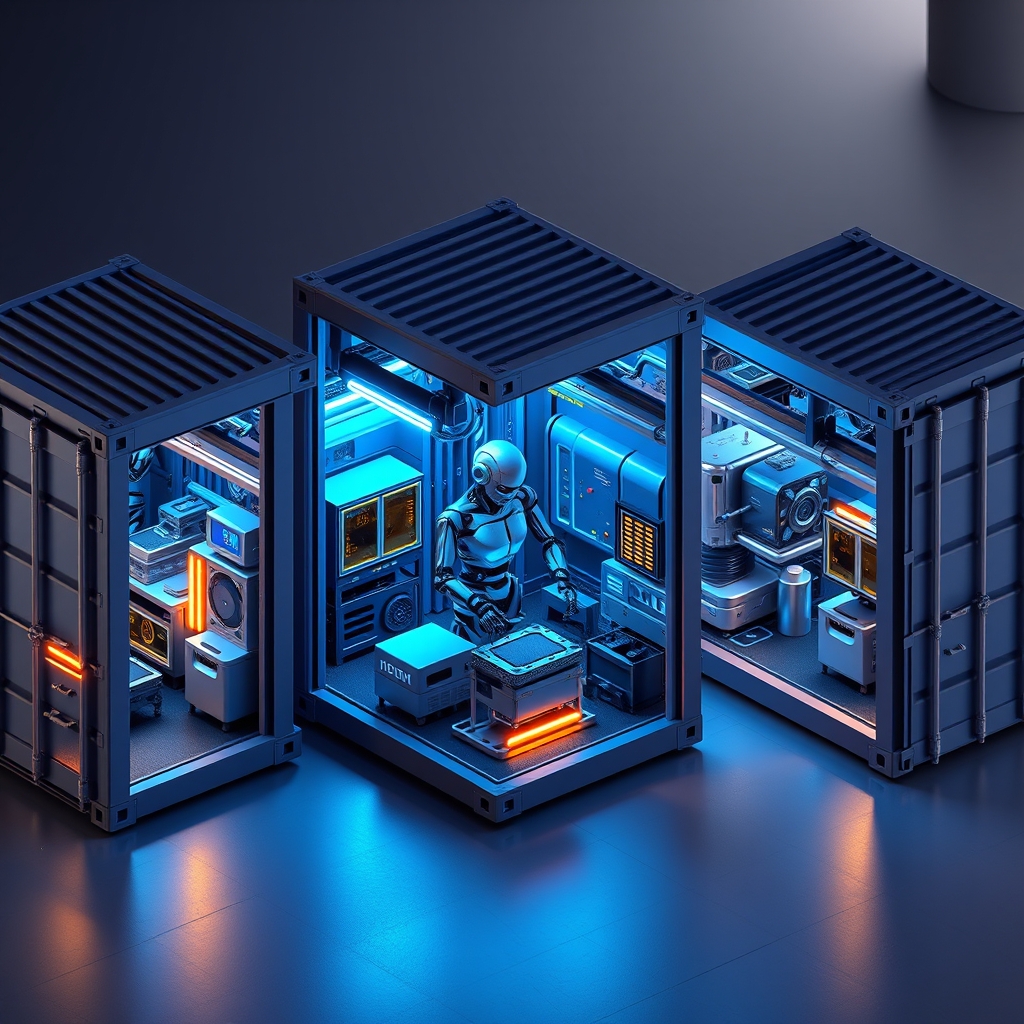 AI-generated
1. Context and Key Points
Industrial automation is advancing toward a fully decentralized paradigm with the emergence of business models based on autonomous modular infrastructure. In this context, Swedish robotics startup 120ft Factory AB has announced the closing of an initial angel funding round worth 576,000 euros (644,000 dollars). This capital injection, backed by a consortium of 22 private investors, aims primarily to accelerate the development and deployment of autonomous microfactories operated entirely by humanoid robots, eliminating traditional barriers to large‑scale manufacturing.
The core of the innovation proposed by 120ft lies in its physical architectural design: miniaturized production facilities that fit exactly inside three standard 40‑foot maritime containers. The company's name derives precisely from the combined length of these three containers. Far from traditional schemes of acquiring heavy machinery or industrial warehouses, this infrastructure‑as‑a‑service approach posits that customers never purchase the physical facilities or the robots, but rather acquire production capacity on demand and directly at the point of need. This strategic move resonates deeply in a technological ecosystem where advances in agentic artificial intelligence and general‑purpose robotics, with platforms converging with advanced multimodal control architectures, enable the management of complex physical environments with minimal human intervention. For the industrial sector, logistics, supply chains, and technology analysts, 120ft's model represents a litmus test for the economic viability of decentralizing physical manufacturing through autonomous robotic systems.
2. Highlighted Technical Aspects
From an engineering perspective, the design of the 120ft Factory AB poses monumental challenges in terms of integration density, thermal management, energy autonomy, and multi‑robot coordination in confined spaces. A standard 40‑foot shipping container provides approximate dimensions of 12 meters in length, 2.4 meters in width, and 2.6 meters in height. Connecting three of these structures linearly or in an optimized parallel configuration provides a highly restricted usable operational volume compared with a conventional manufacturing plant. In this limited space, humanoid robots must coexist with automated material‑handling systems, computer‑vision quality control, and high‑precision assembly stations.
Choosing humanoid robots as the primary workforce addresses operational flexibility. Unlike traditional SCARA‑type or six‑axis articulated robotic arms, which are rigidly anchored to specific assembly lines for monotonous tasks, humanoids possess the necessary versatility to interact with tools designed for humans, adapt to unforeseen variations in components, and reconfigure their behavior by updating their neural control policies. The operational control system of these micro‑factories relies on robust software architectures that integrate real‑time spatial perception, trajectory planning, and execution of complex manipulation tasks. Although the specific hardware details of the robots and the underlying foundational AI models are kept under the startup’s commercial confidentiality, the industry acknowledges that such deployments require millimetric synchronization between edge local sensors and motion‑control algorithms based on reinforcement learning and imitation learning. Internal supply‑chain management within this micro‑space represents another key technical milestone. The introduction of raw materials and the extraction of finished products must be automated through internal transport systems that do not interfere with the mobility of the humanoid robots. Space optimization mandates extreme vertical design and the use of automated intermediate buffer warehouses within the container structures themselves. Furthermore, robustness against mechanical and software failures is critical. Because these installations are fully autonomous and may be deployed in remote locations far from on‑site technical support centers, remote diagnostic systems, partial self‑repair capability, and redundancy in power and connectivity systems are non‑negotiable design imperatives for 120ft.
3. Impact on the Industry and Market Implications
The launch of 120ft Factory AB with this initial funding arrives at a time of deep transformation for global manufacturing. International supply chains have shown chronic systemic vulnerability to geopolitical crises, pandemics, and drastic fluctuations in maritime transport costs. The concept of decentralized micro‑factories directly tackles this issue by bringing production closer to the end consumer or regional assembly point.
For companies across sectors, from automotive and consumer electronics to medical technology, the 120ft business model eliminates the risk of capital‑intensive investment (CapEx) associated with building and equipping new plants. By opting for an operating model based on operational expenses (OpEx) where the client pays for production capacity or per unit manufactured, access to advanced manufacturing is democratized for mid‑size firms that previously could not afford large‑scale robotic automation.
| Analysis Dimension | Traditional Industrial Factory | Autonomous Micro‑Factory (120ft) |
|---|---|---|
| Financial Model | High CapEx (Land, building, and equipment acquisition). | Low CapEx / High OpEx (On‑demand production service). |
| Spatial Footprint | Large industrial spaces (thousands of square meters). | Trilogy of 40‑foot shipping containers (high density). |
| Workforce | Mixed (Human operators and fixed industrial robots). | 100% autonomous humanoid robots. |
| Flexibility and Reconfiguration | Low (requires physical line redesign and costly re‑engineering). | High (software updates and control policies for the humanoids). |
| Strategic Location | Peripheral industrial zones or countries with low labor costs. | Decentralized, located at the exact point of demand or consumption. |
The impact on the labor market is also worthy of analysis. While replacing human operators with humanoid robots in closed environments reduces reliance on local labor for routine and hazardous tasks, operating these micro‑factories will create new demand for highly skilled profiles in remote supervision of robotic fleets, reliability engineering of autonomous systems, and industrial cybersecurity.
Likewise, traditional suppliers of industrial machinery and automation are watching this development closely. If the 120ft model shows commercial traction at scale, it will force robotics and systems‑integration giants to rethink their product offerings, shifting from oversized, static solutions toward modular, mobile architectures based on agentic artificial intelligence.
4. Market Perspectives
Industrial sector analysts and advanced robotics experts agree that the success of 120ft will depend not only on the dexterity of humanoid robots in manipulating objects within closed environments, but also on the long‑term reliability of the hardware under continuous operating conditions. The actuators, joints, and vision systems of humanoids suffer from mechanical wear, and managing predictive maintenance in an autonomous container is a first‑order technical challenge.
From a strategic standpoint, the size of the initial funding round, 576,000 euros, indicates that 120ft Factory AB is in a concept validation and advanced prototype development phase. This amount is modest compared to the macro venture capital funds financing major humanoid robot manufacturers worldwide, suggesting that the Swedish startup is adopting a lean development approach, integrating commercially available hardware and focusing its own resources on the development of orchestration software and the modular integration of the containers. Technical consensus recommends that potential industrial clients evaluate these emerging solutions through a hybrid risk management lens. The decentralization of production via microfactories offers unprecedented agility in the face of logistical disruptions, but requires rigorous analysis of intellectual property, the security of manufacturing data transmitted to the cloud, and the regulatory certification of products manufactured in non‑traditional environments. The strategy of not selling the hardware, but rather operating the service, aligns the incentives of 120ft with those of its clients: the microfactory only generates revenue if it is productive, efficient, and maintains the required quality standards. This alignment reduces the psychological barriers to technology adoption for cautious operations directors regarding investment in advanced robotics.
5. Next Steps
The timeline for the consolidation of autonomous micro‑factories operated by humanoids spans several critical phases of technological and commercial maturation over the coming years:
- Prototype and Pilot Testing Phase (Short‑Term): Validation in controlled environments of the synchronization between the three containers and the humanoid robots, focusing on light assembly tasks and automated quality control.
- Initial Commercial Deployment (Mid‑Term): Installation of the first operational units with selected strategic partners, operating under supervised service contracts to measure energy efficiency, MTBF (mean time between failures) of the robots, and adaptability to changes in production requirements.
- Scalability and Fleet Standardization (Long‑Term): Evolution toward an interconnected network of micro‑factories managed through centralized artificial intelligence platforms, capable of autonomously redistributing workloads across different geographic locations.
Industry projections suggest that as the production costs of humanoid hardware components decrease and the maturity of agentic control models increases, the 120‑ft modular format could serve as a template for high‑technology manufacturing in sectors where delivery speed and customization outweigh traditional economies of scale.
6. Conclusion and Assessment
The emergence of 120ft Factory AB with its proposal of autonomous micro‑factories in maritime containers operated by humanoid robots marks a significant milestone in the convergence between general‑purpose robotics and decentralized industrial infrastructure. Although the initial financing round of €576,000 represents a modest financial starting point by deep‑tech sector standards, the conceptual boldness of the business model directly targets the structural weaknesses of traditional global supply chains.
For business leaders and chief operating officers, the message is clear: automation is no longer exclusively synonymous with large industrial plants and rigid assembly lines. Flexibility, modularity, and the ability to locate production exactly where demand arises are shaping up as the key competitive vectors of the coming decade. Organizations that begin to explore and understand the impact of manufacturing based on autonomous micro‑factories will be better positioned to navigate an industrial environment characterized by uncertainty and a constant need for operational agility.



