Español
 English
 Français
 Português
 Deutsch
 Italiano
Apple's AI Proposal: Success or Failure Hinges on its Privacy Promise
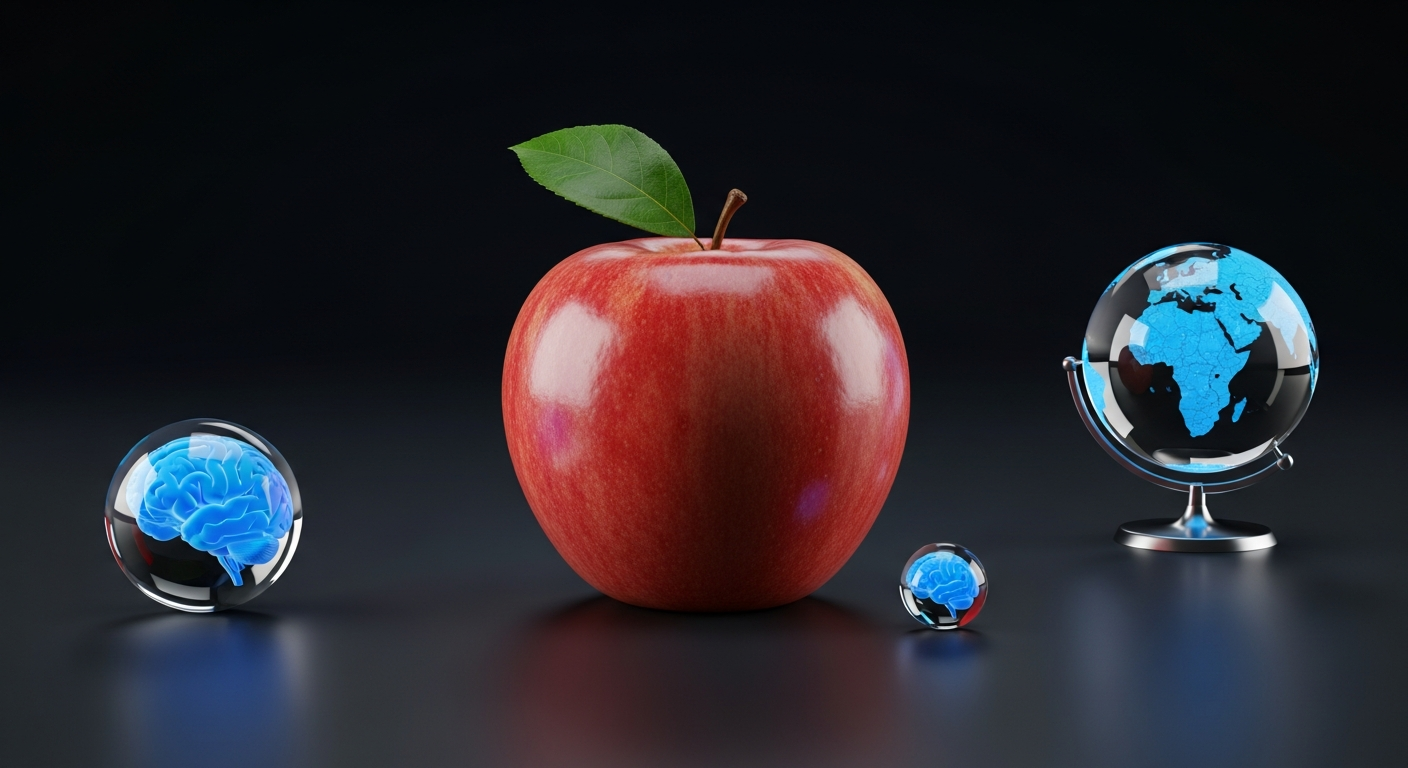 AI-generated
1. Executive Summary
Apple's Worldwide Developers Conference (WWDC) this year, held on June 8, 2026, confirmed expectations: artificial intelligence was the central focus. In a predictable strategic move, Apple addressed its late entry into the AI field not as a disadvantage, but as an opportunity to differentiate itself. Its main argument is that, unlike its competitors, Apple has taken the necessary time to develop AI that prioritizes user privacy above all else. This "private by design AI" is the cornerstone of its proposal, a bold attempt to capitalize on growing public concern about data security and the ethical use of AI.
Apple's promise of AI that is intrinsically more private than its rivals' is not just a marketing slogan; it is a fundamental bet that will define its position in the technological landscape of the next decade. In a world where large language models (LLMs) and generative AI systems are trained on vast amounts of personal data, Apple's proposal to process most requests on-device and, when necessary, in a "Secure Private Cloud" (Private Cloud Compute or PCC) with cryptographic guarantees, represents a paradigm shift. The success or failure of this strategy will not only impact Apple's hardware and software sales but could also redefine privacy expectations across the entire AI industry.
This report delves into the technical aspects, market implications, and strategic perspectives of Apple's AI proposal. We will analyze the viability of its privacy claims, the potential impact on competition and the developer ecosystem, and the challenges Apple must overcome to maintain the trust of users and regulators. The central question is whether privacy, as a key differentiator, can be the engine that propels Apple to the forefront of the AI revolution, or if the inherent complexities of modern AI will make this promise unsustainable in the long term.
2. Deep Technical Analysis
Apple's AI strategy, dubbed "Apple Intelligence," rests on two fundamental technological pillars: on-device processing and the Secure Private Cloud (Private Cloud Compute, PCC). On-device processing is made possible by the architecture of its A-series and M-series chips, which incorporate increasingly powerful Neural Engines. These engines allow for the execution of considerably sized AI models directly on the iPhone, iPad, or Mac, handling tasks such as text generation, image editing, audio transcription, and Siri personalization without data leaving the device. This inherently eliminates the risk of data exposure in transit or on third-party servers, a key point in Apple's privacy narrative.
However, not all AI tasks can be executed efficiently or effectively on-device due to computational power limitations or model size. This is where PCC comes into play. Apple has designed a server infrastructure based on its own M-series chips, which, according to the company, offers an unprecedented level of security and privacy. When an AI request requires more power than the device can offer, it is sent to the PCC. The key to the PCC's privacy promise lies in its design: Apple states that data sent to the cloud is end-to-end encrypted and that PCC servers are designed not to persistently store user data. Furthermore, "cryptographic attestations" are used to verify that PCC servers are running only Apple's public software, without malicious or tracking code.
This approach contrasts sharply with that of other tech giants. For example, models from OpenAI (GPT-5.5), Google (Gemini 3.5 Flash), and Anthropic (Claude 4.8 Opus) often rely on centralized data collection and processing to improve their models. Although these companies have implemented privacy measures, Apple's architecture seeks to minimize reliance on the company itself. The idea is that even Apple cannot access user data in the PCC in a way that links it to an individual identity. This is achieved through techniques such as federated learning and differential privacy, where models are trained with aggregated and anonymized data, and individual contributions are obfuscated to protect identity.
The implementation of differential privacy is crucial. Instead of sending raw data, devices send statistical "noise" which, when aggregated with the noise from millions of other devices, allows for pattern identification without revealing specific user information. These embeddings are retrained periodically to improve models without compromising privacy. Furthermore, the deep integration of Apple Intelligence with the operating system (iOS 18, iPadOS 18, macOS Sequoia) allows for a contextual understanding of the user without needing to send that information to the cloud. For example, Siri can understand the context of a conversation or an open application to respond more relevantly, all processed locally.
Transparency is another vital technical component. Apple has promised that the code for its Secure Private Cloud will be auditable by external experts, an unprecedented measure for a company of its size and usual secrecy. This is an implicit recognition that trust in privacy cannot be based solely on the company's word, but requires independent verification. The ability of Apple's chips to efficiently run complex models also reduces latency and improves user experience, which is a secondary benefit of its device-centric approach.
In summary, the technical architecture of Apple Intelligence is a combination of powerful on-device hardware, differential privacy algorithms, and a cloud infrastructure designed with "zero-trust" principles in mind. The promise is that users will gain the benefits of advanced AI without sacrificing their privacy, a balance that has so far been difficult for most industry players to achieve.
3. Industry Impact and Market Implications
Apple's bet on privacy in AI has the potential to generate seismic waves across the entire tech industry. For years, the dominant business model in AI has been "data for services," where users surrender their information in exchange for advanced functionalities. Apple is directly challenging this paradigm, which could force other tech giants like Google, Meta, and Microsoft to re-evaluate their own AI privacy strategies. If consumers respond positively to Apple's proposal, the pressure for competitors to adopt more privacy-centric architectures, such as on-device processing and private cloud computing, will increase exponentially. This could lead to a "privacy arms race" in AI, ultimately benefiting users.
From a market perspective, Apple's differentiation could strengthen its closed ecosystem. Users who already value Apple's privacy and security will find in Apple Intelligence another reason to remain within its "walled garden." This could attract new privacy-conscious users who have so far been reluctant to adopt generative AI due to concerns about data collection. In the enterprise segment, where data security is paramount, Apple's proposal could be particularly attractive, opening new opportunities for the adoption of Apple devices in corporate environments that handle sensitive information.
Regulatory implications are equally significant. With frameworks like GDPR in Europe, CCPA in California, and growing global AI legislation, Apple's stance could establish a new de facto standard for privacy in AI. Regulators might view Apple's approach as a model to follow, potentially influencing the drafting of future laws and guidelines. This, in turn, could create a more complex environment for companies that do not prioritize privacy, facing higher compliance costs and potential penalties.
For the developer ecosystem, the integration of Apple Intelligence into Apple's SDK presents both opportunities and challenges. Developers will be able to leverage on-device and PCC AI capabilities to create smarter, more personalized applications, with the privacy assurance offered by the platform. However, they will also have to adhere to Apple's strict privacy guidelines, which could limit certain types of data collection or business models based on user data monetization. This could encourage innovation in alternative business models that do not rely on the exploitation of personal data.
Finally, Apple's strategy could influence public perception of AI. By positioning AI as a tool that can be both powerful and private, Apple seeks to demystify and destigmatize the technology, fostering greater trust and adoption. If successful, they could shift the narrative of AI from being a threat to privacy to being an enabler of user experience, with integrated safeguards. This is a long-term strategic move that aims to shape the ethical and technological direction of AI globally.
4. Expert Perspectives and Strategic Analysis
Industry analysts and privacy experts have received Apple's AI proposal with a mix of cautious optimism and pragmatic skepticism. On one hand, there is general recognition that Apple's focus on privacy is a brilliant strategic move, resonating with growing consumer concerns. "Apple is playing its strongest card: trust," suggests a data security analyst. "In a market where AI is perceived as a data vacuum cleaner, Apple's promise to keep information on-device or in a verifiable cloud is a powerful differentiator." Apple's ability to control both hardware and software gives it a unique advantage to implement these privacy safeguards comprehensively, something other companies with more fragmented ecosystems find much more difficult.
However, skepticism arises from the inherent complexity of AI and the history of privacy promises in technology. The Private Cloud Compute (PCC), while theoretically robust, still requires a level of trust in Apple. Although the company has promised external audits and cryptographic attestations, the complete verification that "not even Apple can see your data" is a monumental technical and trust challenge. Cryptography experts point out that while attestations can verify the software running on servers, the possibility of zero-day vulnerabilities or social engineering always exists. "Absolute privacy is an ideal, not a reality in complex systems," comments a security researcher. "Apple has taken significant steps, but constant vigilance and total transparency will be crucial to uphold that promise."
Strategically, Apple's decision to prioritize privacy over deployment speed or the raw capability of its AI models is a risky but calculated gamble. While competitors like Google and OpenAI have been launching increasingly larger and more capable models, Apple has opted for a more conservative approach, focused on deep integration and security. This could mean that, initially, Apple Intelligence's capabilities may not be as "spectacular" as those of its rivals in certain performance metrics. However, if user trust becomes the decisive factor for mass AI adoption, Apple's strategy could pay off in the long run.
Another point of analysis is how Apple will manage the tension between privacy and personalization. AI is more useful the more it knows the user. Apple claims it can achieve deep personalization without compromising privacy, using on-device processing and federated learning. However, the effectiveness of these techniques in matching personalization based on centralized data remains to be seen. Siri's ability to understand personal context without sending data to the cloud is a key example, but the depth of that understanding and its evolution will depend on the sophistication of on-device models and how they are privately retrained.
Ultimately, the credibility of Apple's privacy promise will rest on its impeccable execution and its continuous commitment to transparency. Any slip-up, any vulnerability, or any indication that user data is not as secure as promised, could undermine years of brand building and trust. The company must be prepared to undergo constant scrutiny and independent audits to validate its claims, transforming "trust" into "verification."
5. Future Roadmap and Predictions
Apple's future roadmap in the AI domain will be marked by the expansion and refinement of its privacy infrastructure. The company is expected to invest massively in the scalability of its Private Cloud Compute (PCC), increasing its processing capacity and distributing its data centers to reduce global latency. The continuous improvement of A and M series chips will be fundamental, as each new generation must offer more powerful neural engines to keep as much AI processing as possible on-device, thereby reducing reliance on the PCC and reinforcing the promise of privacy.
Regarding Apple Intelligence capabilities, we foresee a gradual but constant evolution. Initially, functions will focus on improving productivity, creativity, and communication, integrating more deeply into native applications such as Mail, Messages, Photos, and Pages. As models are retrained and optimized, we are likely to see an expansion into more complex tasks, such as code generation, research assistance, and advanced multimedia content creation, always under the umbrella of privacy. Interaction with Siri will be a key area of development, transforming it from a reactive assistant to a proactive and contextual one, capable of anticipating user needs without compromising personal information.
A key prediction is that Apple will seek to establish its privacy approach as an industry standard. This could manifest through active participation in standardization bodies, the publication of research on differential privacy and secure computation, and the promotion of its AI design principles. We are likely to see Apple lobbying regulators to adopt frameworks that reward privacy-centric AI architectures, which could create a more favorable environment for its own business model and a more challenging one for its competitors who rely on massive data collection.
Finally, third-party adoption will be a critical indicator of success. Apple will need to convince developers that building on Apple Intelligence is not only secure for users but also beneficial for their businesses. This could involve creating new tools and APIs that facilitate the integration of private AI into third-party applications, as well as promoting business models that do not rely on data monetization. If Apple succeeds in building a vibrant private AI ecosystem, it could solidify its position as a leader in the next era of computing.
6. Conclusion: Strategic Imperatives
Apple's AI proposition, firmly anchored in its promise of privacy, represents one of the company's boldest strategic bets in years. In a technological landscape increasingly dominated by artificial intelligence, differentiation through privacy is not just a marketing tactic, but a fundamental imperative for Apple. Its success will depend not only on the technical sophistication of Apple Intelligence, but, crucially, on its ability to maintain and verify its commitment to user privacy. Any failure in this regard could erode the trust it has taken decades to build and which is the foundation of its brand.
To ensure success, Apple must adhere to several strategic imperatives. First, absolute transparency regarding the operation of its Private Cloud Compute and its privacy mechanisms is non-negotiable. Independent audits and the publication of technical details must be an ongoing practice, not a one-time event. Second, the company must actively educate consumers about the benefits and safeguards of its AI approach, demystifying the technology and building a clear understanding of how their information is protected. Third, Apple must continue to innovate in hardware and software to ensure that most AI processing can be performed on-device, minimizing the need to send data to the cloud.
Ultimately, the AI era is redefining the relationship between technology and the user. Apple has the opportunity to lead this redefinition, demonstrating that AI can be powerful, personal, and, above all, private. If it succeeds in fulfilling its promise, it will not only secure its own future in AI, but will also set a vital precedent for the entire industry, driving a future where innovation and ethics coexist. The cost of not doing so, however, would be the loss of user trust, an invaluable asset that no amount of artificial intelligence could recover.