
 Español
 English
 Français
 Português
 Deutsch
 Italiano
Boston Dynamics Adds Wheels to the Atlas Humanoid to Test Whole-Body Control
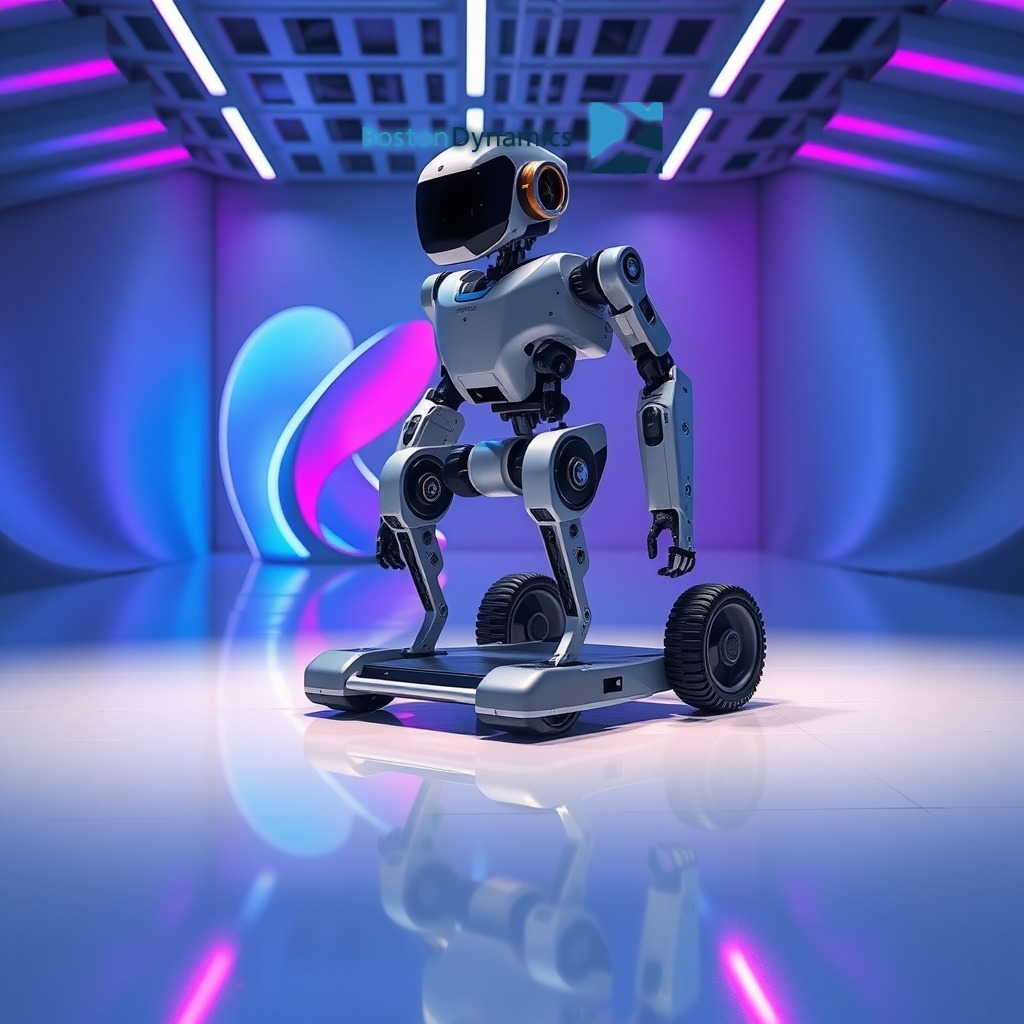 AI-generated
1. Executive Summary
In the current landscape of advanced robotics, the evolution of mobile systems transcends the traditional dichotomy between bipedal form factors and conventional wheeled platforms. Boston Dynamics' strategic decision to incorporate wheels into its iconic Atlas humanoid represents a methodological turning point. Far from being a mere aesthetic experiment or a concession to operational simplicity, this integration seeks to push the limits of whole-body control through the convergence of classical kinematics and state-of-the-art reinforcement learning. The initiative demonstrates that the manipulation dexterity of a humanoid torso can be merged with the energy efficiency and travel speed of a wheeled chassis without sacrificing spatial versatility.
For the manufacturing industry and complex logistics environments, this move redefines expectations for return on investment and operational deployment. Pure bipedal robots offer unmatched adaptability in environments designed for humans, but they carry severe penalties in terms of energy consumption, mechanical wear, and trajectory planning complexity. By equipping Atlas with a wheeled base managed under a unified paradigm of integral control, Boston Dynamics directly attacks the bottleneck of industrial autonomy. The result is a hybrid system capable of transitioning fluidly between wheeled traction for long stretches and complex manipulation in restricted spaces. This technical analysis report examines the underlying architectures that enable this transformation, evaluating the economic impact on global supply chains and projecting the technological roadmap for the coming years. Chief technology officers and automation engineers will find in this analysis a rigorous dissection of the trade-offs between traditional mechanical design and neural reinforcement learning policies applied to high-power-density physical hardware.
2. In-depth technical analysis
Exclusive Tech Deals on Amazon
The core of the innovation behind the wheeled Atlas lies in overcoming the classic hierarchical decomposition in robotics. Traditionally, navigation, balance stabilization, and arm manipulation operated in decoupled control loops, coordinated by a top-level planning layer that often suffered from latency and stochastic friction. With the introduction of wheels on a humanoid chassis, kinematic complexity increases exponentially: the system ceases to be an inverted pendulum subject only to impact forces on the feet and becomes an over-actuated wheeled system with redundant degrees of freedom in the torso and upper limbs.
To solve this challenge, Boston Dynamics engineers have implemented architectures that fuse model-based predictive control with reinforcement learning policies trained through massive-scale simulation. Classic motor control provides deterministic safety guarantees and management of hard physical constraints, such as torque limits in hydraulic or electric actuators and current saturation. Simultaneously, reinforcement learning neural networks process high-dimensional sensory streams to discover emergent body coordination behaviors that hand-written analytical algorithms cannot anticipate.
| Control Dimension | Classic Model-Based Control | Reinforcement Learning (RL) | Hybrid Architecture (Wheeled Atlas) |
|---|---|---|---|
| Loop latency | Very low (rigid milliseconds) | Medium (inference-dependent) | Low in critical layer, adaptive in high |
| Terrain adaptability | Limited to precise analytical models | High tolerance to disturbances | Maximum (wheeled traction + body posture) |
| Energy consumption | Optimized via inverse kinematics | Prone to initial inefficient behaviors | Optimized by lower rolling cost |
| Safety guarantees | Highly deterministic | Stochastic (requires control barriers) | Rigorously bounded by safety layers |
The integration of wheels radically modifies the ground reaction force dynamics. In a bipedal humanoid, each step involves a flight phase and a discontinuous impact that generates high-frequency disturbances in inertial sensors and actuators. Wheeled locomotion introduces a continuous ground contact regime, which drastically reduces mechanical vibration peaks and extends the service life of transmission components. However, this transfers the control challenge to angular momentum: the robot must coordinate wheel acceleration with torso swaying and arm movement to prevent tipping during sharp, high-speed turns.
From a hardware perspective, the system leverages the high power density developed for the electric and hydraulic iterations of Atlas. Actuators must respond with millisecond precision to compensate for centrifugal forces and terrain irregularities through instantaneous reconfiguration of the center of mass. Synchronization between wheel odometry and body state estimation is executed via advanced sensor fusion algorithms that process data from multiple inertial measurement units and stereoscopic vision systems in real time. Training these whole-body control policies requires massive simulation infrastructure. Before deploying any weights to the physical Atlas hardware, models undergo millions of hours of virtual simulation in environments that mimic rigid contact physics, variable ground friction, and actuator latency. This simulation-to-real transfer process minimizes the risk of catastrophic damage to expensive physical prototypes during initial experimental phases. The choice to incorporate wheels into a humanoid form factor also raises thermal and energy management considerations. The additional traction motors and processing circuits required to run control neural networks at the edge increase the thermal load on the chassis. Efficient management of current flow between the limbs' hydraulic or electric actuators and the wheel motors is a determining factor in ensuring commercially viable operational autonomy in production plants. Ultimately, this approach demonstrates that advanced robotics does not seek to replicate human biology dogmatically, but rather to extract key functional principles of anthropomorphic design, such as the ability to reach objects at different heights or interact with standard tools, combining them with the mechanical superiority of wheels when the task allows.
3. Industry impact and market implications
Boston Dynamics' move alters the competitive roadmap for the commercial humanoid robot sector. To date, the dominant market narrative had been polarized between proponents of pure bipedal systems, which promised universal adaptability in any human infrastructure, and manufacturers of AGVs (automated guided vehicles) and AMRs (autonomous mobile robots), limited to navigation on flat floors and passive transport tasks.
The convergence of both technologies into a single wheeled humanoid platform drastically reduces the barriers to industrial adoption. Manufacturing companies and logistics operators have been reluctant to deploy bipedal humanoids due to the high cost per unit, limited battery autonomy, and operational risks arising from accidental falls in high-density human environments. A wheeled robot offers greater inherent static stability, which lowers liability insurance requirements and reduces downtime for corrective maintenance. The economics of fleets in smart warehouses will undergo a profound revision. Operating costs associated with deploying mobile robots benefit from the elimination of the need to modify existing infrastructure with magnetic beacons or specialized laser mapping on elevated planes. By maintaining the upper body of a humanoid, the robot can interact with standard shelving, operate control panels designed for human operators, and manipulate containers without requiring dedicated robotic workstations. At the component supply chain level, this development stimulates demand for high-precision actuators, high-torque brushless motors, and low-power embedded computing systems. Semiconductor manufacturers specializing in control model inference at the edge find in these types of platforms a high-value-added market, where thermal reliability and resistance to harsh industrial environments are indispensable requirements. Competitive pressure now shifts toward other players in the humanoid robotics sector, forcing them to reconsider the rigidity of their bipedal architectures. Companies that prioritize modularity and mechanical flexibility over strict anatomical fidelity will gain commercial traction in market segments where travel speed and energy efficiency take precedence over the ability to climb spiral staircases. Likewise, providers of simulation software and robotics development platforms will experience an increase in demand for tools capable of modeling complex hybrid systems of wheels and articulated limbs. The ability to validate whole-body control algorithms in virtual environments before physical deployment is becoming the operational standard for mitigating financial risks in large-scale automation projects.
4. Expert perspectives and strategic analysis
Industry analysts agree that Boston Dynamics' decision to equip Atlas with wheels reflects a pragmatic maturity in commercial robotics engineering. The pursuit of pure bipedal locomotion in all industrial scenarios is increasingly perceived as a premature optimization exercise in the face of the real return-on-investment demands of corporate clients.
From an engineering strategy standpoint, the primary recommendation for robotic system developers is to adopt an agnostic approach regarding the locomotion effector. Control architectures based on reinforcement learning must be designed from their inception to support modular configurations, allowing for switching between wheeled, quadrupedal, or bipedal bases according to the specific requirements of the client deployment without the need to rewrite the upper task-planning layers. Industrial safety experts point out that the introduction of hybrid platforms requires updating regulatory frameworks for human-robot interaction. A wheeled humanoid that combines the manipulation agility of an articulated torso with the travel speed of a motorized platform presents kinetic energy profiles different from those of traditional mobile robots or slow bipeds. Emergency stop protocols and perimeter proximity sensors must be calibrated to anticipate braking trajectories that depend as much on the chassis mass as on the dynamic posture of the arms. In the realm of venture capital investment and corporate financing, this milestone redirects the focus toward companies capable of demonstrating systemic integration and operational reliability in real production environments, distancing them from those that rely exclusively on choreographed laboratory demonstrations. Long-term commercial viability will depend on reducing the total cost of ownership (TCO), a goal to which wheeled locomotion contributes directly by minimizing mechanical wear. Strategic guidelines for CTOs of large industrial corporations suggest maintaining a flexible stance on the acquisition of automation fleets. Instead of betting exclusively on homogeneous fleets of guided vehicles or bipedal humanoids, the optimal trend points toward heterogeneous fleets managed by centralized orchestration systems, where hybrid wheeled humanoids act as high-versatility nodes at critical workflow intersections. Finally, the academic and research community sees this platform as an exceptional testbed for solving fundamental problems of optimal control in systems with non-holonomic constraints and extreme kinematic redundancy, ensuring that applied research continues to fuel the development of highly competitive commercial products.
5. Future roadmap and predictions
The evolution of hybrid wheeled humanoids will follow a predictable trajectory marked by milestones in software integration and field deployment over the coming years. Short term (2026 - 2027): Controlled pilot phases and algorithmic refinement
During this period, wheeled Atlas prototypes will be deployed in controlled industrial environments, such as automotive plants and advanced distribution centers, focusing on repetitive material handling tasks and heavy load transfers. The primary engineering focus will be to refine the policies for fluid transitions between rolling mode and stationary manipulation maneuvers in confined spaces. Medium term (2027 - 2029): Commercial scaling and modular standardization
The commercialization of mass-production versions aimed at high-density logistics is expected. Software architectures will evolve toward open development frameworks where third parties will be able to train specialized behaviors on top of base whole-body control policies. The integration of large language models and vision-language-action models at the edge will allow these robots to interpret complex verbal instructions and execute dynamic logistics tasks without manual programming. Long term (2029 and beyond): Convergence toward universal autonomy and ubiquitous fleets By the end of the decade, humanoid robots with hybrid locomotion capabilities will be ubiquitously integrated into commercial and service infrastructures. The distinction between mobile transport robots and articulated manipulators will dissolve completely in favor of adaptive platforms capable of reconfiguring their physical and kinematic profile according to the nature of the assigned mission.
6. Conclusion: Strategic imperatives
The incorporation of wheels into the Atlas humanoid by Boston Dynamics marks a milestone of maturity in the robotics industry, demonstrating that operational efficiency and commercial pragmatism must prevail over morphological dogmatism. By merging classic motor control with whole-body reinforcement learning, the company has set a new performance standard for industrial locomotion and manipulation.
For technology leaders, the lesson is clear: success in advanced automation requires hybrid and flexible control architectures that optimize energy and stability without sacrificing the versatility of the human form. Organizations that adopt these modular platforms early will gain decisive competitive advantages in logistics efficiency and operational cost reduction. Immediate actions for engineering and operations directors should focus on auditing their current facility infrastructure to assess compatibility with hybrid mobile platforms, redefining operational safety protocols for high-kinetic-speed systems, and establishing strategic alliances with advanced robotics providers that prioritize industrial reliability and software robustness over marketing demonstrations.