
 Español
 English
 Français
 Português
 Deutsch
 Italiano
Boston Dynamics and Google DeepMind: Spot's Cognitive Awakening
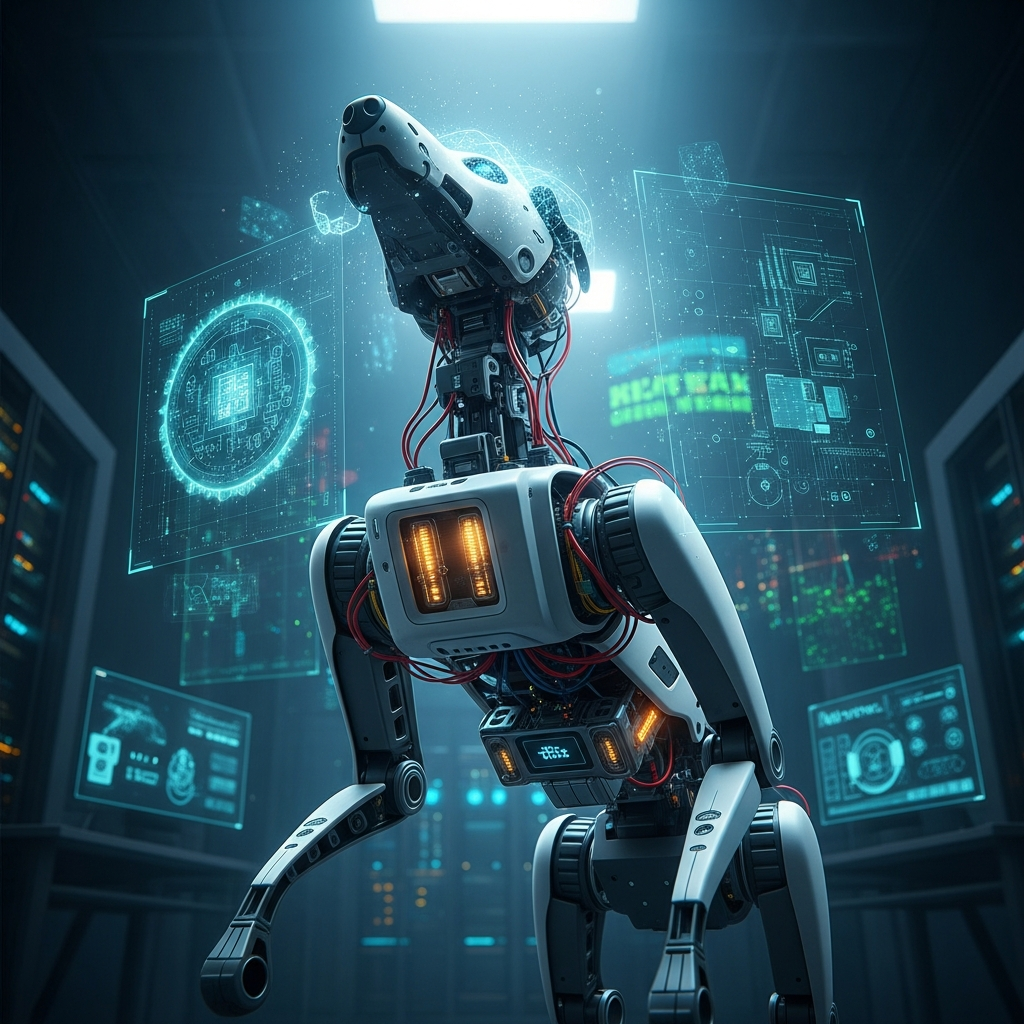
The Evolution of Intelligence: From Rigid Programming to Autonomous Reasoning
For decades, robotics has lived under a fascinating and often frustrating paradox. We have been able to build machines with astonishing physical agility, capable of performing backflips or navigating rugged terrain with almost animal-like grace. However, these technical feats were limited by an invisible barrier: the fragility of code. Traditionally, for a robot to perform a task, an engineer had to foresee every variable and write explicit instructions for every movement. If the environment changed even slightly, the system collapsed. Today, that limitation has begun to fade.
The recent collaboration between Boston Dynamics and Google DeepMind represents a fundamental paradigm shift. By integrating large-scale language models (LLM) and advanced vision systems into the iconic quadruped robot Spot, the companies have achieved what once seemed like science fiction: providing a machine with the ability to reason about its environment and execute tasks based on natural language instructions, without the need for specific prior programming for each scenario.
The Meeting of Two Giants: Synergy between Hardware and Digital Brain
Boston Dynamics has consolidated its position as the undisputed leader in robotic hardware. Its Spot robot is a marvel of mechanical engineering, capable of moving through industrial environments where wheels fail. With thousands of units already commercially deployed in sectors such as mining, energy, and construction, the physical platform is robust and reliable. However, until now, Spot was an executor, not a thinker.
This is where Google DeepMind comes in. Google's artificial intelligence division has led research in what is called "Embodied AI." The goal of this discipline is to take artificial intelligence out of servers and screens to give it a physical presence in the material world. By merging DeepMind's logical reasoning models with Spot's physical prowess, both companies have created a cybernetic organism that can interpret context, understand object semantics, and make decisions in real-time.
What does it really mean for a robot to be able to reason?
Reasoning in a robotic context does not imply that the robot has consciousness, but rather that it possesses the ability to break down an ambiguous instruction into a series of logical and physical actions. For example, if a conventional Spot were asked to "go find the nearest expired fire extinguisher," the robot wouldn't know where to start unless it had an exact map and a database of every object. With the new DeepMind integration, Spot can visually analyze its environment, identify what a fire extinguisher is, approach it to read the label using computer vision, process the date, and determine if it meets the requested criteria.
This process requires deep integration between sensory perception and linguistic reasoning. The robot must understand spatial concepts, relationships between objects, and, most importantly, it must be able to correct its course of action if it encounters an unexpected obstacle, all while maintaining a constant dialogue between its digital "brain" and its mechanical limbs.
Embodied AI: The Bridge between the Digital and the Physical
Embodied AI is the most advanced battlefield in technology today. For years, language models like GPT-4 or Gemini have demonstrated an amazing ability to manipulate textual and visual information. However, the physical world is infinitely more complex than a digital dataset. Gravity, friction, variable lighting, and the unpredictability of human beings present challenges that cannot be resolved with data processing alone.
Google DeepMind's implementation on Spot uses vision-language-action (VLA) models. These models allow the robot to translate a verbal instruction directly into motor commands. What makes this advancement "premium" and disruptive is the elimination of intermediate code translation layers. We are witnessing the democratization of robotic control: now, any operator in an industrial plant could interact with a highly complex robot using the same language they would use with a human coworker.
Commercial Applications and the Value of Cognitive Autonomy
The question many ask is: does this have real commercial value or is it simply a laboratory experiment? The answer lies in operational efficiency. In critical industries, downtime or inspection errors can cost millions of dollars. A robot that can reason drastically reduces setup time and increases the versatility of the existing fleet.
- Dynamic Autonomous Inspection: Spot can patrol a facility and, if it detects something unusual (like a puddle of liquid), it can reason whether it is harmless water or a dangerous chemical leak based on context and sensors, taking immediate corrective action.
- Logistics in Unstructured Environments: Unlike automated warehouses where everything is in its place, the real world is chaotic. A reasoning robot can navigate a construction site, identify forgotten tools, and return them to their place without detailed instructions.
- Enhanced Human-Robot Interaction: In emergency situations, the ability to give quick, verbal commands is vital. A robot that understands "help that person" or "block that entrance" without needing to program coordinates is an unprecedented safety tool.
Overcoming the Fragility of Traditional Code
The great achievement of this collaboration is having overcome what Boston Dynamics calls "system fragility." In the past, if a robot encountered a closed door that should have been open, it would stop and issue an error. The new Spot, powered by DeepMind's AI, can reason: "The door is closed, I will look for an alternative route or ask for permission to open it." This operational resilience is what will finally allow robots to leave controlled environments and fully integrate into daily life and global workflows.
The Future of Spot and Cutting-Edge Robotics
This is just the beginning of an era where intelligence and mobility converge definitively. Boston Dynamics has already hinted that these reasoning capabilities will extend to other models, including the new all-electric Atlas. The long-term vision is to create machines that not only help us with dangerous or repetitive tasks but act as intelligent partners capable of understanding our intentions and the world around us.
The combination of Boston Dynamics' physical mastery and Google DeepMind's cognitive excellence has set a new gold standard in the industry. We are no longer talking about machines that mimic life, but systems that are beginning to understand it. Robotics has ceased to be a matter of mechanical engineering to become a discipline of total cognitive synthesis.
Conclusion: A New Paradigm for Humanity
The fact that Spot can reason is not just a technical achievement; it is a testament to human potential to overcome barriers that seemed insurmountable. By providing robots with the ability to understand and process the world with logic similar to our own, we are opening the door to unprecedented productivity and a new form of technological coexistence. The era of the robot as a simple tool has ended; the era of the robot as an intelligent and autonomous agent has begun.