Español
 English
 Français
 Português
 Deutsch
 Italiano
CHPE and the Chip War: Why New York’s Power Grid Defines the Future of AI
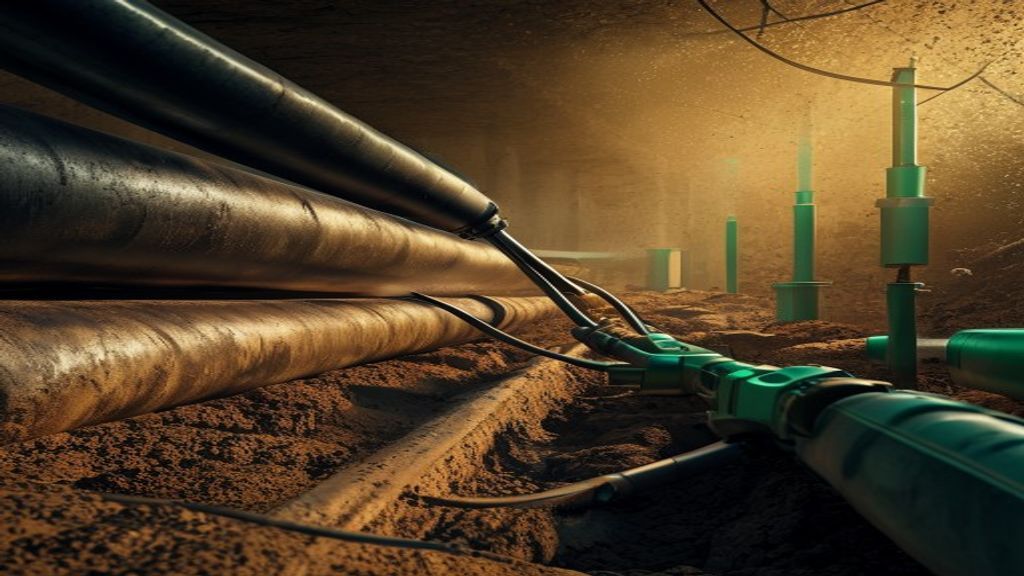 AI-generated
1. The Context: A Heat Wave and an Underground Cable
On July 3, 2026, New York State imported a record amount of electricity from Canada to avoid blackouts during a heat wave. That data point is not a climate anecdote; it is an X-ray of structural dependence. The Champlain Hudson Power Express (CHPE) project, a 545 km HVDC transmission line with 1,250 MW capacity, is the centerpiece of the state's energy strategy. Its goal: to bring clean hydroelectricity from Quebec to New York City. Its reality: environmental litigation, right-of-way issues, and a completion horizon slipping toward 2028.
In parallel, the U.S. government has toughened its rhetoric on export restrictions for semiconductors and AI systems to China. The current administration states that national security requires cutting China's access to the high-performance chips needed to train frontier models like DeepSeek-V4-Pro or Qwen 3.7-Max. Both narratives, the fragility of the grid and the technology war, converge on a single point: physical infrastructure is the new battlefield of artificial intelligence. This analysis is aimed at CTOs, technology policy makers, infrastructure investors, and analysts who need to understand how energy and semiconductors are reshaping the innovation landscape.
2. Technical Analysis: The Grid Bottleneck and the GPU Bottleneck
The CHPE uses HVDC technology from Hitachi Energy (formerly ABB) to convert the alternating current from Hydro-Québec's plants into direct current at ±320 kV. The cable, buried under Lake Champlain and the Hudson River, is designed to deliver 1,250 MW, enough for one million homes. The problem is not the cable's engineering, but its integration with New York's 60 Hz AC grid, which already operates at the limit of its capacity. NYISO transient stability studies indicate that, without new converter substations in Queens and Westchester, the massive injection of HVDC power could cause frequency and voltage oscillations capable of tripping protection systems and triggering cascading blackouts.
On the AI front, the situation is symmetrical. Current frontier models, OpenAI's GPT-5.6 (Sol, Terra, Luna), Anthropic's Claude Opus 4.8, or DeepSeek-V4-Pro, require clusters with tens of thousands of NVIDIA H100 or B200 GPUs. Each cluster consumes between 30 and 50 MW continuously for weeks or months of training. Inference, though less intensive, demands robust, low-latency energy infrastructure. The U.S. threat to cut off chip supply to China not only affects companies like DeepSeek or Alibaba (Qwen 3.7-Max), but also forces Chinese hyperscalers to rely on domestic chips like Huawei's Ascend 910C or those developed by SMIC. These chips have significantly lower performance per watt, increasing energy cost per inference and reducing competitiveness. The interconnection is direct: without a robust electrical grid, scaling AI infrastructure is impossible. The CHPE, if completed, would provide the clean, stable energy needed by data centers in upstate New York, where Google and Microsoft are already building new facilities. If the project stalls, the U.S. competitive advantage in AI could be compromised by the simple lack of affordable and reliable electricity.
3. Industry Impact: The Cost of Uncertainty
The delay of the CHPE has direct consequences for the data center market. Major operators, Equinix, Digital Realty, AWS, Azure, GCP, have been purchasing land and connection rights in upstate New York, anticipating the arrival of cheap hydroelectric power from Quebec. If the CHPE is delayed by two or three years, these projects will be forced to resort to natural gas or intermittent renewables (solar, wind), increasing operating costs by 20% to 40%, according to industry estimates.
In the AI market, sanctions are creating a forced "dual sourcing" effect. Companies like Tencent (MiMo-V2-Pro) and Baidu (ERNIE 4.5) are accelerating investments in domestic chips, but the performance gap remains significant. Leaked internal benchmarks suggest that Huawei's Ascend 910C offers approximately 60% of the performance of NVIDIA's H100 on language model training tasks, and consumes 30% more energy per task. This translates into a higher total cost of ownership (TCO) for Chinese operators, which could slow the pace of innovation in models like DeepSeek-V4-Pro or GLM-5.2. For investors, the situation is a double-edged sword. Energy infrastructure companies in the U.S. (NextEra Energy, Dominion Energy) are emerging as direct beneficiaries of data center demand. On the other hand, Chinese technology companies that rely on hardware imported through gray channels face existential risk. Regulatory volatility is the new systemic risk factor in the sector.
HVDC technology, once a niche for long-distance projects, is becoming a standard for connecting offshore wind farms and data centers. Siemens Energy and Hitachi Energy are seeing record order backlogs. However, the lack of skilled labor to install and maintain these systems is creating supply chain bottlenecks, which in turn delays projects like the CHPE.4. Strategic Perspectives: Between Litigation and Fragmentation
The technical consensus among energy sector analysts is that the CHPE is a "too big to fail" project, but its political viability is increasingly uncertain. Lawsuits filed by local environmental groups, arguing that the cable laying will damage the Hudson River ecosystem, have been dismissed in lower courts, but appeals continue. Additionally, opposition from some upstate counties, which fear losing tax revenue if Canadian energy reduces demand for their own gas plants, is gaining political traction.
In the AI arena, geopolitical strategists point out that the U.S. threat to cut off chip supply to China is, in part, a negotiating tactic. The U.S. administration knows that a total ban would accelerate Chinese self-sufficiency, as already happened with memory semiconductors and solar panels. However, domestic pressure to show a tough stance toward Beijing, especially in an election year, makes it politically difficult to back down. The analysts' recommendation is for global technology companies to diversify their chip and energy supply chains, investing in data centers in regions with renewable energy surpluses, such as the Nordic countries or Canada. A less discussed but equally relevant perspective is the impact on open-source software. Models like Meta's Llama 4 (with its 10 million token context) or Google's Gemma 4 (optimized for edge computing) are tools that allow developers worldwide, including those in China, to build AI applications without relying on U.S. hyperscalers. If sanctions tighten, we are likely to see a boom in open-weight model development in China, trained on domestic hardware and optimized for energy efficiency. This could further fragment the global AI ecosystem, creating two incompatible technological spheres. From an investment standpoint, the recommendation is clear: bet on energy and transmission infrastructure as the next major technology cycle. Venture capital funds are already moving capital toward grid orchestration software startups and companies developing long-duration batteries to stabilize the grid. Energy is the new oil, and AI is the engine that consumes it.
5. Roadmap: Scenarios for the Next 24 Months
For the next 12 to 24 months, the most likely scenario is as follows:
- Q4 2026 - Q1 2027: The CHPE will face a new round of judicial appeals. The project is likely to receive final approval conditional on the implementation of additional environmental mitigation measures, delaying its completion until late 2028 (versus the original 2026 target).
- Q2 2027: The U.S. will announce a new round of restrictions on AI chip exports to China, focusing on high-bandwidth memory (HBM) GPUs and EDA chip design tools. China will respond by accelerating its semiconductor program, investing an additional $50 billion in R&D.
- 2028: The first large-scale data center powered exclusively by the CHPE will begin operations in Ulster County, New York. It will be operated by a consortium of Google and Microsoft, housing GPU clusters to train next-generation models.
- 2029: China will launch its own frontier language model trained entirely on domestic chips (Ascend 920C). Performance will be comparable to GPT-5.6 on mathematical reasoning and coding tasks, but inferior in creativity and natural language generation.
The boldest prediction is that energy scarcity in mature markets (U.S., Europe) will drive a wave of "AI migration" toward regions with energy surpluses, such as the Middle East (Saudi Arabia, United Arab Emirates) and Southeast Asia (Malaysia, Indonesia). These countries will become the new AI computing hubs, attracting investments from hyperscalers and governments.
6. Conclusion: Two Sides of the Same Coin
The intersection between energy transmission and the technological war for AI defines the new geopolitical and economic landscape. For technology leaders and policymakers, the conclusions are unavoidable. First, energy infrastructure is a critical enabler of AI sovereignty. Without a modern, reliable, and scalable power grid, no country can maintain a competitive advantage in artificial intelligence. Second, unilateral sanctions against China are accelerating the fragmentation of the global AI ecosystem, which in the long term could harm all players by reducing collaboration and knowledge sharing.
The immediate action for CTOs and infrastructure directors is twofold: assess the energy dependency of their data centers and diversify supply sources, and prepare contingency plans for a "two technology spheres" scenario where access to AI hardware and software is restricted by national borders. For investors, the recommendation is clear: energy is the new semiconductor. Companies that master the generation, transmission, and storage of clean electricity will be the suppliers of the next industrial revolution. Ultimately, the fate of the CHPE and Chinese AI are not separate stories. They are two sides of the same coin: the struggle for control over the critical resources of the 21st century. Energy and data are the new oil and steel, and whoever controls their flow will dictate the terms of global technological progress.