
 Español
 English
 Français
 Português
 Deutsch
 Italiano
Data Center Revolution: Mueon Raises $65 Million to Redesign AI Server Racks and Increase Compute Density
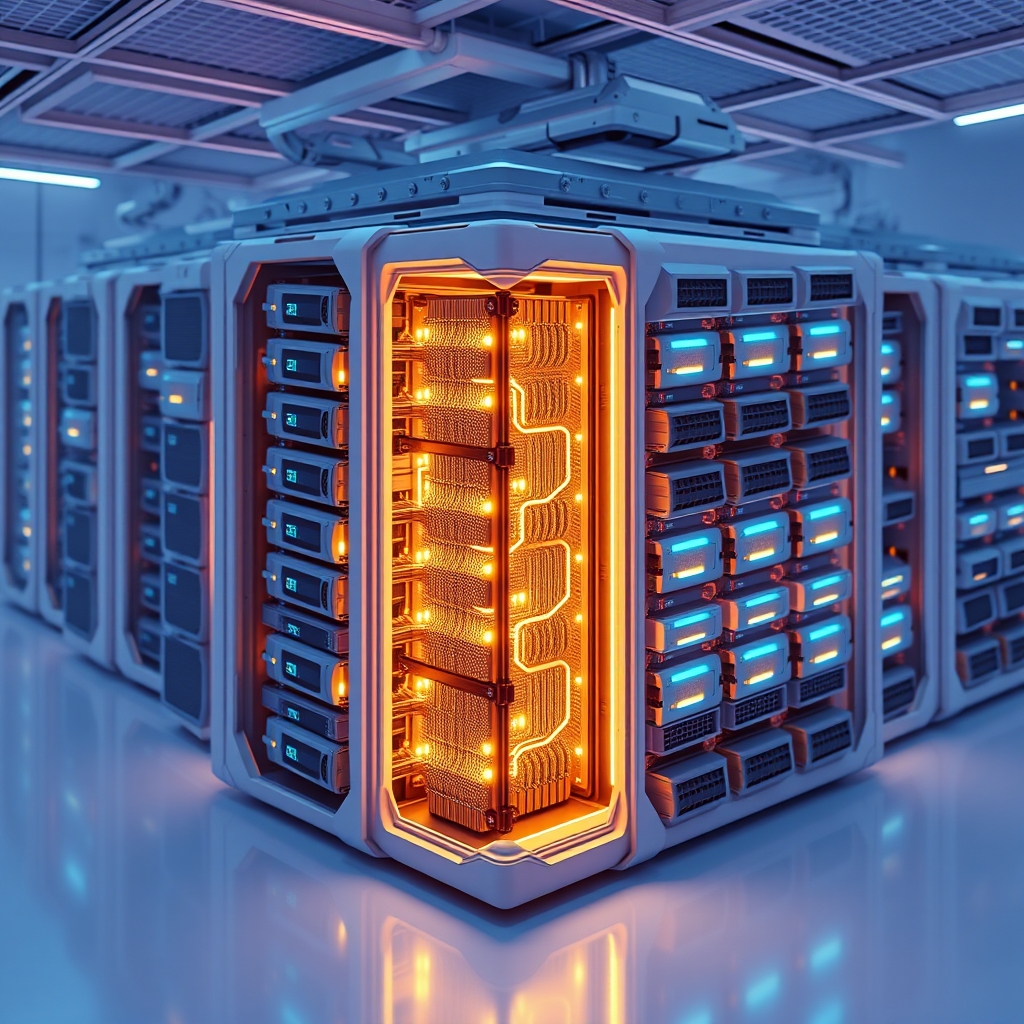 AI-generated
The rapid scale-out of massive training and inference clusters has pushed data center infrastructure to its electromechanical limits. Against this backdrop, Portland-based startup Mueon has closed a $65 million funding round led by Maverick Silicon with strategic participation from Intel, aiming to redesign the internal topology of AI server racks from the ground up.
Mueon's core architecture reconfigures the physical layout of compute subsystems to substantially multiply effective density within the same floor footprint. By optimizing internal interconnect pathways and curbing resistive losses, the startup targets up to an order of magnitude increase in compute capacity per rack, contingent on empirical validation across production environments.
1. In-Depth Technical Analysis
Conventional 19- and 21-inch standardized rack architectures, conceived for horizontal modularity and front-to-back airflow, are fundamentally ill-equipped for thermal densities exceeding 40 to 100 kW per cabinet in modern accelerator clusters. Sustained tensor processing workloads require far tighter physical integration between power delivery stages, cooling loops, and high-speed interconnect backplanes.
Mueon addresses this constraint by replacing the legacy stack of discrete chassis with a cohesive internal architecture. Rather than routing signals across sprawling cable bundles between independent trays, spatial layout reorganizes power supplies, busbars, and compute modules to drastically minimize physical trace lengths for PCIe and high-speed fabrics, minimizing signal degradation and parasitic power draw.
On the thermodynamic front, eliminating internal cable clutter and mechanically aligning components reduces static resistance to fluid circulation. This enables direct-to-chip or immersion cooling manifolds to operate with lower pressure drops, maintaining optimal semiconductor junction temperatures under heavy, continuous training workloads without triggering thermal throttling.
2. Industry and Market Impact
Hyperscalers currently operate under a strict physical bottleneck: constrained electrical substation capacity in metropolitan hubs and limited physical footprint in existing facilities. With lead times for new utility grid interconnections stretching to three to five years in major global data center clusters, maximizing compute density within existing square footage represents the primary viable expansion path.
The $65 million round led by Maverick Silicon highlights venture capital's focus on structural physical hardware solutions to alleviate this gridlock. Intel's backing provides critical industrial leverage: for semiconductor designers, ensuring the availability of advanced rack ecosystems capable of powering and cooling dense chip packages without forcing costly datacenter retrofits is essential for sustaining hardware deployment cycles.
Nevertheless, commercial adoption will confront practical deployment barriers. Enterprise and colocation facilities adhere to strict floor-loading weight limits, N+1 power redundancy standards, and field-service protocols that mandate hot-swappable modules. Mueon must demonstrate that its radical density gains do not compromise operational maintainability or mechanical reliability under continuous production stresses.
3. Strategic Analysis and Market Outlook
The evolution of AI hardware is transforming the server rack from a passive metal chassis into a tightly integrated, monolithic computational and thermodynamic engine. Just as advanced packaging integrated High Bandwidth Memory directly onto silicon interposers, rack architecture is converging toward holistic co-design where mechanical structures, coolant flow paths, and copper or optical buses form an indivisible system.
For infrastructure directors and facility operators, this paradigm shift dictates clear strategic priorities:
- Structural and thermal auditing: Evaluate raised-floor weight tolerances and secondary cooling distribution loops to verify whether facilities can handle concentrated mass and extreme volumetric heat loads.
- Vendor lock-in mitigation: Mandate open electrical and mechanical interfaces that accommodate accelerators from multiple silicon vendors, ensuring proprietary rack topologies do not constrain long-term procurement.
- Lifecycle TCO modeling: Balance the capital expenditure premium of high-density custom cabinets against substantial savings in real estate lease costs and power usage effectiveness (PUE).
The intersection of specialized venture capital and veteran semiconductor manufacturers confirms that the next horizon of AI efficiency will not rely solely on nanometer lithography, but on the thermodynamic and spatial efficiency engineered into every cubic centimeter of the data center.
4. Roadmap and Operational Deployment
Transitioning from functional prototypes to commercial deployments will require Mueon to clear rigorous mechanical, thermal, and electromagnetic compatibility certifications. The near-term focus will center on validating thermal resilience under prolonged stress testing in tier-four testbeds with selected hyperscalers, ensuring electrical busbar reliability and high-speed signal integrity under peak load swings.
In subsequent deployment phases, the company must establish volume manufacturing agreements with global original design manufacturers (ODMs) and harmonize interfaces with closed-loop liquid cooling infrastructure. Long-term commercial success will depend on whether operators can integrate these high-density pods into existing white space without commissioning disruptive, capital-intensive facility retrofits.
5. Conclusion and Technical Assessment
Mueon's ultimate market viability hinges on validating under continuous production workloads that micromechanical rack reorganization can dissipate extreme thermal densities without degrading high-speed interconnect integrity. Sustaining these density claims in tier-one facilities would mark the definitive obsolescence of generic rack chassis in favor of tightly coupled, thermoelectric compute pods.



