Español
 English
 Français
 Português
 Deutsch
 Italiano
How to Build Autonomous AI Research Agents with LangGraph: The Comprehensive Guide to Alessandro Negro's Masterclass
 AI-generated
At the frontier of applied artificial intelligence, innovative organizations have moved far beyond standard conversational chatbots. Enterprise engineering and strategic teams no longer require simple prompt-wrappers that return superficial summaries; they demand autonomous AI research agents capable of decomposing multifaceted hypotheses, formulating multi-phased investigation plans, cross-referencing dozens of technical publications, and delivering comprehensive executive briefs with verifiable source provenance.
However, granting operational autonomy to language models in deep research workflows presents a severe engineering challenge. Without structured state machine orchestration, autonomous agents inevitably fall into repetitive retrieval loops, bloat their context windows with irrelevant tokens, hallucinate across contradictory findings, and consume budgets on redundant queries.
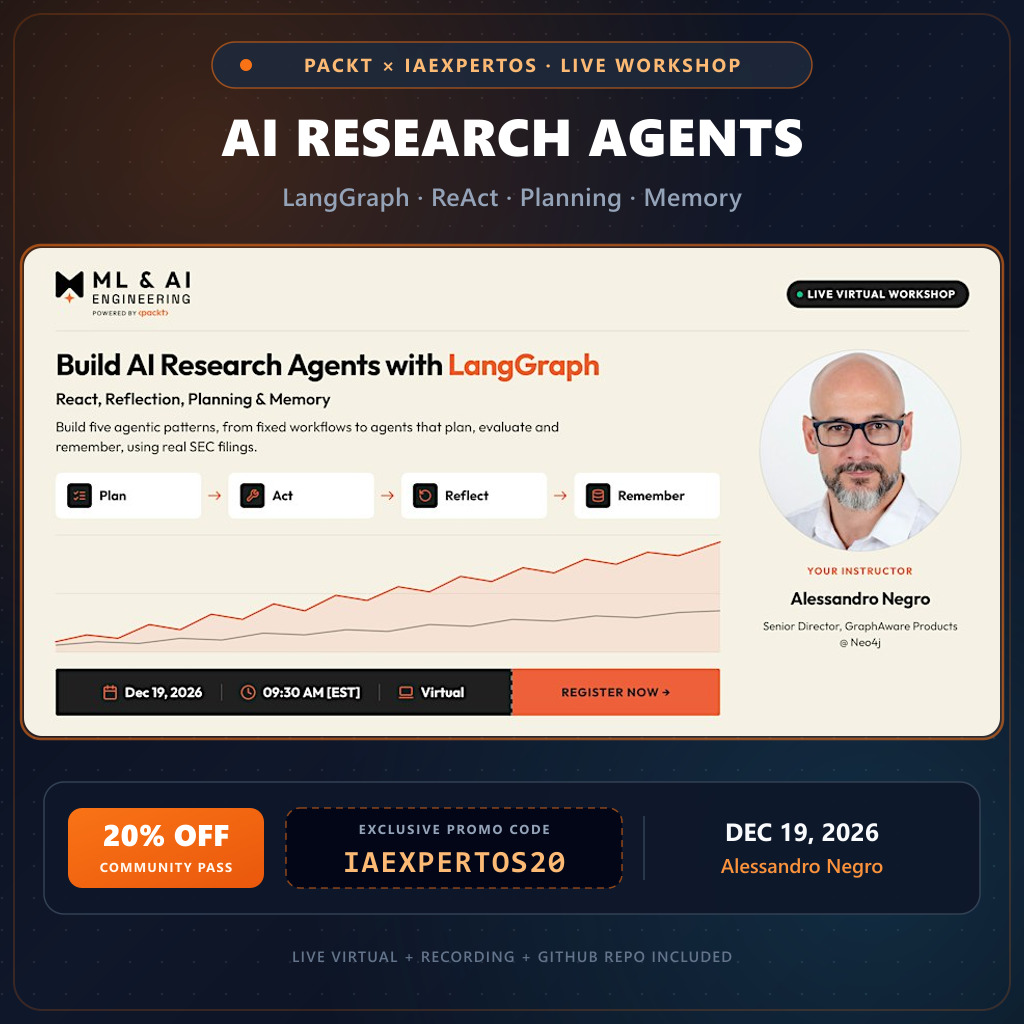
To bridge this critical capability gap, premier technology publisher Packt is presenting the live technical masterclass on December 19, 2026: "Build AI Research Agents with LangGraph: ReAct, Planning and Memory", conducted by Alessandro Negro, Chief AI Officer at GraphAware, globally celebrated authority on Graph Machine Learning, and acclaimed author for Packt and Manning.
Furthermore, the entire IAExpertos community receives an exclusive partnership benefit: a 20% discount with promo code IAEXPERTOS20, bringing standard Eventbrite registration from $215.25 USD down to just $172.20 USD.
In this guide, we break down in clear, business-driven terms the core methodologies taught in this live workshop and explain why mastering autonomous research agent engineering is a career-defining asset.
1. The ReAct Framework Explained Simply: Reasoning Before Action
Standard prompting forces models to output immediate answers without dedicated intermediate calculation. This hasty execution often leads to shallow generalizations or outright hallucinations.
The ReAct (Reasoning and Acting) framework, introduced in seminal AI research, changes this dynamic by compelling the agent to deliberate explicitly before executing external operations:
- Internal Thought: The agent inspects its objective and reasons: "To verify whether this hardware architecture scales efficiently, I first need to determine its reported memory bandwidth and power consumption limits".
- Targeted Action: Based on this reasoning, the agent invokes a specialized tool to retrieve exact empirical data (e.g., querying arXiv or an enterprise patent repository).
- Factual Observation: The external environment returns verifiable data, which the agent analyzes before formulating its next logical step.
Golden Rule of Autonomous Agents:
An agent that acts without prior reasoning commits irrecoverable errors; an agent that combines deliberate thought traces with targeted actions (ReAct) investigates with the rigor of a professional human analyst.
2. Hierarchical Planning: Decomposing Complex Problems into Actionable Milestones
Exclusive Tech Deals on Amazon
When an investigation requires analyzing hundreds of dense documents across academic, regulatory, or financial domains, an elementary ReAct loop can wander off course without an overarching governance layer.
In Alessandro Negro's masterclass, you will learn how to implement the Plan-and-Solve hierarchical topology, which distributes responsibilities across specialized agent roles:
- Lead Research Planner: Evaluates the high-level inquiry and generates a Directed Acyclic Graph (DAG) of sequential and parallel research milestones, determining prerequisite dependencies before triggering expensive retrieval tools.
- Specialized Worker Retrievers: Receive atomic, well-defined tasks and execute focused ReAct loops across specific document corpora (scientific databases, regulatory disclosures, or codebases).
- Critic & Dynamic Replanner: Continuously assesses whether accumulated evidence meets strict sufficiency thresholds. If new data contradicts an initial premise, the critic dynamically mutates the task plan to explore alternative inquiry paths.
Intuitive Formula for Factual Synthesis Fidelity:
Reliability Ratio = Number of Grounded Claims divided by Total Generated Claims
An agent-generated report is only considered production-ready for executive decision-making when its factual fidelity reaches 100%, proving that zero claims or numerical figures were fabricated.
3. Multi-Tiered Memory Hierarchy: Preventing Loops and Context Saturation
Treating all acquired research findings as an ever-growing block of chat history causes severe cognitive degradation, forcing models to lose track of central objectives.
High-performance research agent systems segregate memory across three specialized operational strata:
- Working Memory (Scratchpad): The ephemeral state of the active task. It retains only the parameters of the immediate step and is cleared upon task completion to keep the model's attention window sharp and focused.
- Episodic Memory: A chronological ledger of all actions taken, dead-ends identified, and discarded hypotheses. This prevents the agent from redundantly querying sources that have already yielded inconclusive results.
- Semantic Memory: A vector or knowledge graph database where corroborated facts, verified benchmarks, and core definitions discovered during the investigation are stored permanently for cross-stage retrieval.
4. Real-World Corporate Blueprints Developed in the Masterclass
Alessandro Negro will guide attendees through hands-on implementation blueprints designed for high-value enterprise applications:
- Competitive Intelligence and Technology Scouting: Agents that continuously monitor patent filings, conference preprints, and open-source repositories to generate strategic briefs on emerging industry shifts.
- Due Diligence and Investment Analysis: Autonomous systems that analyze hundreds of pages of financial disclosures, sustainability reports, and regulatory filings to surface hidden operational risks.
- Medical and Scientific Literature Review: Specialized assistants capable of synthesizing clinical trials and pharmacology papers to cross-reference drug interactions with complete citation provenance.
5. Strategic Governance and Reliability Considerations for Technical Leaders
For Chief Technology Officers, heads of innovation, and R&D leads, deploying research agents requires strict safeguards to guarantee the empirical integrity of generated deliverables:
- Citation Provenance and Verification Chains: Build pipelines that strictly require every paragraph in the final synthesis to link directly to verified source context chunks.
- Loop Containment and Spend Caps: Establish deterministic execution bounds in LangGraph to prevent agents from consuming computing budgets on futile inquiry vectors.
- Enterprise Knowledge Integration: Connect research agents securely to internal proprietary data lakes while maintaining strict data governance boundaries.
6. Masterclass Structure: 4 Hands-On Technical Modules
The intensive session is divided into four practical, progressive modules:
- Module 1 (LangGraph State Machine Fundamentals): Building cyclic graphs with custom state schemas, reducer operations, and conditional edges to control execution flow.
- Module 2 (Advanced ReAct Deliberation Loops): Structuring explicit thought traces, integrating retrieval tools, and configuring automated hallucination guardrails.
- Module 3 (Hierarchical Plan-and-Solve Topologies): Implementing decoupled planner-worker-critic architectures with dynamic runtime replanning capabilities.
- Module 4 (Multi-Tiered Memory & Automated Synthesis): Deploying episodic scratchpads to eliminate circular retrieval and synthesizing structured reports with verifiable source citations.
7. Quantifiable Business Impact of Autonomous Research Capabilities
Investing in autonomous research agents transforms enterprise knowledge workflows by delivering clear operational efficiencies:
- 10x Faster Analysis Cycles: Complex competitive audits that previously consumed weeks of manual reading and synthesis are completed in hours, freeing expert staff to focus on strategic decisions.
- Exhaustive Knowledge Coverage: Unlike human analysts who can only review a handful of papers due to time constraints, agents systematically scan dozens of publications, surfacing non-obvious correlations.
- Uncompromised Auditability: Executive leadership receives comprehensive reports where every recommendation is backed by permanent, verifiable source context.
8. Why Learning with Alessandro Negro Delivers Exceptional Value
Chief AI Officer at GraphAware, Alessandro Negro is celebrated globally for his ability to bridge theoretical computer science and production-grade software architectures.
- Author of Authoritative Textbooks: Author of seminal books on graph machine learning and generative AI for leading publishers such as Manning and Packt.
- Hands-on Labs and Complete Source Code: Participate in a live interactive session, discuss architectural hurdles with the instructor, and gain permanent access to implementation repositories.
- Exclusive IAExpertos Partnership Benefit: Use promo code IAEXPERTOS20 to save $43.05 USD off standard Eventbrite pricing, securing premier training for just $172.20 USD instead of $215.25 USD.
9. Conclusion and How to Secure Your Seat
The future of artificial intelligence is rapidly advancing beyond simple chatbots toward autonomous agents capable of independent research, rigorous reasoning, and verifiable knowledge synthesis.
Packt's "Build AI Research Agents with LangGraph: ReAct, Planning and Memory" live masterclass on December 19 is the definitive program for mastering these cutting-edge capabilities. Live seats are limited to preserve interactive discussion. Secure your registration today with your exclusive 20% discount.