Español
 English
 Français
 Português
 Deutsch
 Italiano
How to Engineer Reliable, Cloud-Connected AI Applications: The Comprehensive Guide to Anas Riad's Masterclass
 AI-generated
Throughout the enterprise rush to implement generative artificial intelligence, engineering teams repeatedly confront the "brittle pipeline syndrome": constructing a straightforward sequence of prompts using a language model looks deceptively simple, but the moment that application must connect to a production database, invoke an external API, or recover from a momentary network glitch, the entire pipeline crashes, leaving users with cryptic failure messages.
The operational standard of 2026 demands retiring naive, linear pipelines. Forward-thinking organizations require Stateful Agent Graphs, structured as resilient state machines capable of autonomous error recovery, persistent session memory across interactions, and standardized, cryptographically secure tool connectivity powered by the industry's new unifier: Anthropic's Model Context Protocol (MCP).
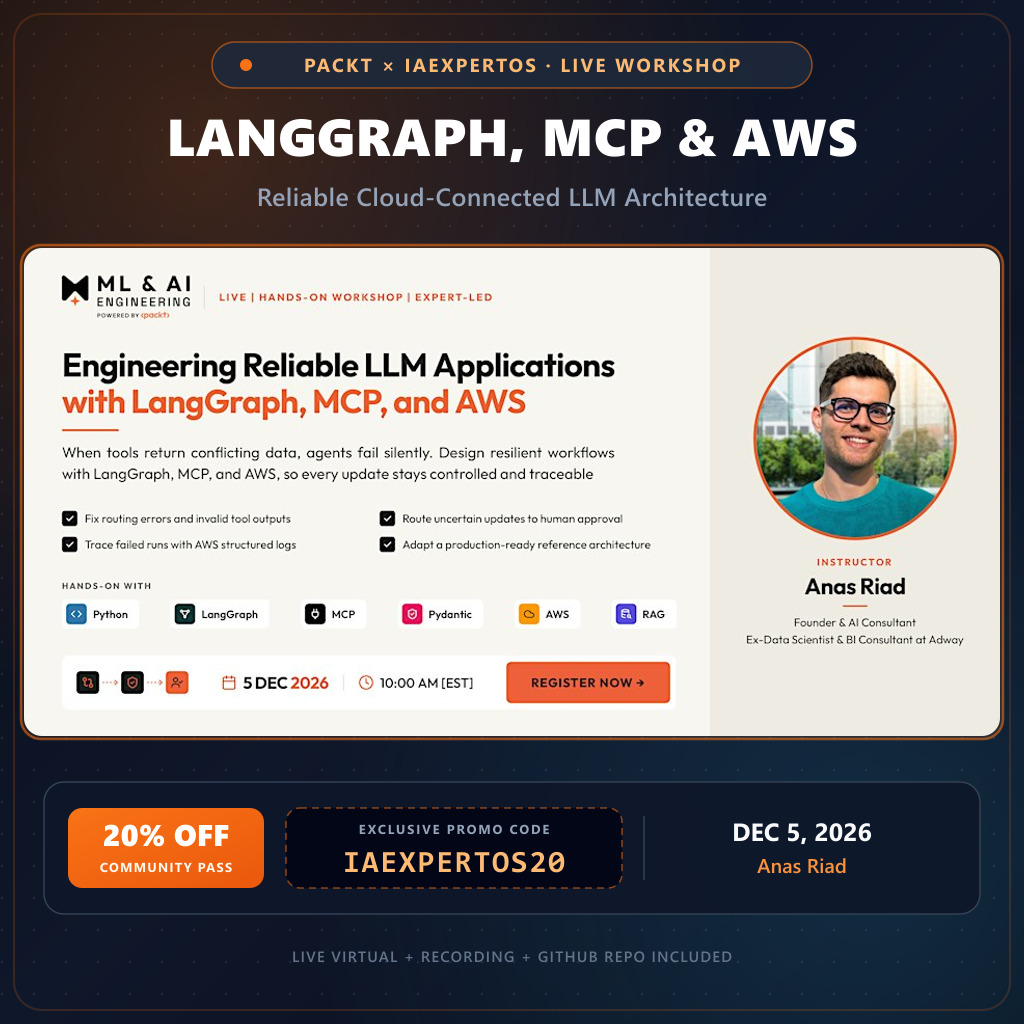
To provide engineers with production-tested blueprints for designing these resilient systems and deploying them cost-effectively on Amazon Web Services (AWS), premier technology publisher Packt is hosting the live technical masterclass on December 5, 2026: "Engineering Reliable LLM Applications with LangGraph, MCP and AWS", led by Anas Riad, Senior Machine Learning Engineer and celebrated cloud AI solutions architect.
Furthermore, the entire IAExpertos community enjoys an exclusive professional benefit: a direct 20% discount using promotional code IAEXPERTOS20, reducing standard Eventbrite registration from $183.23 USD down to just $146.58 USD.
In this guide, we break down in clear, business-driven terms the core competencies taught in this intensive training and explain why mastering stateful agent orchestration and cloud deployment is the most sought-after skill set in enterprise AI today.
1. Retiring Fragile Chains: Why Enterprise AI Demands LangGraph State Machines
During the initial wave of generative AI adoption, developers chained operations in rigid, unidirectional pipelines: a user asked a question, a model generated a SQL query, and a script executed it. If the database took slightly longer to respond or the model outputted a minor formatting flaw, the entire application failed catastrophically.
LangGraph fundamentally alters this architecture by modeling applications not as brittle lines, but as intelligent decision maps (cyclic state machines):
- Immutable, Versioned State: All conversational context, pending tool operations, and intermediate validation results are stored in a typed, protected structure passed predictably across system nodes.
- Dynamic Decision Points (Conditional Routing): When an external tool call encounters an error, the system does not crash; it evaluates the failure in real time and automatically determines whether to retry the operation, explore an alternative path, or escalate to human assistance.
- Durable Persistence & Time Travel: Every state transition is recorded. If network connectivity drops, the application seamlessly resumes from the exact historical checkpoint, enabling engineers to audit precisely why an agent chose a specific path.
Golden Rule of Agentic Architecture:
A linear pipeline presumes nothing will ever break; a state graph presumes everything will eventually break and predefines exactly how to recover without interrupting business operations.
2. Model Context Protocol (MCP): The Universal Standard for Agent Tooling
Exclusive Tech Deals on Amazon
Until recently, connecting a language model to corporate software was an engineering nightmare: every relational database, payment gateway, and customer CRM required custom, bespoke adapters, creating fragile codebases and massive maintenance overhead.
Anthropic's Model Context Protocol (MCP) has resolved this fragmentation by establishing an open, universal standard:
- Universal Client-Server Architecture: Allows any LLM application to communicate with tools and data repositories through a secure, standardized JSON-RPC protocol.
- Strictly Typed Tools: Clear functional interfaces (such as checking ERP inventory or initiating secure transactions) that models invoke without inventing invalid arguments.
- Protected Resources: Read-only access to corporate documentation, database schemas, and compliance guidelines, preserving necessary security boundaries.
Enterprise Impact of MCP:
With MCP, a tool connector developed once can be securely utilized by any agent or model across the entire organization, compressing integration timelines from weeks down to minutes.
3. Elastic AWS Serverless Deployment: Maximum Availability with Zero Idle Cost
Building an intelligent agent provides zero commercial value if hosting it incurs prohibitive cloud bills or if the infrastructure fails under sudden user traffic surges.
In this masterclass, Anas Riad demonstrates how to deploy stateful agent topologies onto Amazon Web Services (AWS) using modern serverless primitives:
- AWS Lambda (Serverless Compute): Powers fast API routing and synchronous state validation. You pay zero server costs during idle periods; billing is calculated purely on the exact milliseconds during which queries are processed.
- AWS ECS Fargate: Houses persistent MCP servers and long-running agent reasoning processes, eliminating timeout constraints while securing direct VPC access to internal databases.
- Amazon DynamoDB: Serves as the ultra-fast state checkpointer, guaranteeing single-digit millisecond read and write latency at any scale.
Intuitive Retry Reliability Formula:
System Failure Risk = (Individual Tool Failure Probability) raised to the Number of Retries
If an external API has a 5% baseline chance of a transient failure, configuring 3 automated retry attempts within a LangGraph edge reduces overall failure risk to just 0.0125%.
4. Real-World Corporate Blueprints Addressed in the Masterclass
The curriculum structured by Anas Riad focuses on solving recurring operational challenges:
- Automated Enterprise Support & Incident Response: Designing agents that safely interact with internal ticketing platforms, query historical incident logs, and trigger automated diagnostics without risk of unauthorized actions.
- Secure Financial Analytics and Data Extraction: Interfacing agents with relational databases via MCP to resolve complex executive queries without exposing raw database credentials.
- Internal Developer Knowledge Engines: Building interactive assistants that index cloud infrastructure configurations and internal architecture guides to streamline developer onboarding.
5. Strategic Governance, Compliance, and Observability for Tech Leaders
For engineering leaders responsible for mission-critical software, operating AI agents in the cloud requires clear observability and strict compliance guardrails:
- Distributed Tracing and Latency Attribution: Learn how to integrate OpenTelemetry and AWS CloudWatch across individual LangGraph nodes, allowing teams to pin down exactly whether slow response times originate from external APIs, model inference latency, or database reads.
- Token Budget Controls and Spend Guardrails: Establish automated circuit breakers that prevent runaway loops from generating unexpected API charges, capping maximum token consumption per thread while maintaining responsive user experiences.
- Enterprise Security and IAM Governance: Configure fine-grained AWS Identity and Access Management (IAM) roles and VPC endpoints so that agents and MCP servers access company resources under the principle of least privilege, meeting stringent enterprise compliance standards.
Mastering these governance controls enables technical directors to scale AI initiatives across departments with complete institutional confidence.
6. Curriculum Breakdown: The 4 Hands-On Technical Modules
To guarantee that every attendee walks away with functional, production-ready code, the masterclass is organized into four modular labs:
- Module 1 (Stateful Agent Architecture): Designing custom state schemas, reducer operations, and conditional edges in LangGraph to replace rigid chains with resilient state machines.
- Module 2 (Model Context Protocol Implementation): Building custom MCP servers in Python, declaring strict JSON schemas, and securely exposing enterprise tools and resources.
- Module 3 (State Persistence & Time Travel): Configuring Amazon DynamoDB checkpointers to persist conversation threads, audit decision trees, and replay historical states.
- Module 4 (Serverless AWS Deployment): Packaging applications with Docker, deploying to AWS Lambda and ECS Fargate, and configuring API Gateway routes.
7. Strategic ROI and Professional Advantages of Attending with Anas Riad
Anas Riad brings deep experience as a Senior Machine Learning Engineer specializing in cloud-native AI infrastructures. Having guided multinational organizations in transitioning fragile internal prototypes into high-availability systems, his guidance delivers immediate engineering value.
- Current, Production-Grade Knowledge: Learn the protocols and design patterns defining enterprise software in 2026, avoiding deprecated libraries.
- Practical Code Labs & Direct Interaction: Engage directly with the instructor during live Q&A, follow hands-on implementation modules, and retain lifetime access to source code repositories.
- Exclusive IAExpertos Partnership Benefit: Use promo code IAEXPERTOS20 to save $36.65 USD off standard Eventbrite tuition, securing premier training for just $146.58 USD instead of $183.23 USD.
8. Conclusion and How to Reserve Your Seat
The distinction between a casual technical experiment and a defensible enterprise software product lies in architectural reliability. Mastering LangGraph, the Model Context Protocol, and AWS cloud deployment equips you with the exact technical profile technology companies are prioritizing today.
Packt's "Engineering Reliable LLM Applications with LangGraph, MCP and AWS" live masterclass on December 5 is your direct path to mastering production-grade agentic engineering. Live registration is strictly capped to foster quality discussion. Secure your seat today with your exclusive 20% discount.