
 Español
 English
 Français
 Português
 Deutsch
 Italiano
How to Deploy Machine Learning Models to Production Without Failures: The Definitive Guide to Hadelin de Ponteves' Masterclass
 AI-generated
A troubling paradox pervades the modern technology industry: enterprise organizations invest millions of dollars hiring data science teams and training cutting-edge machine learning models, yet more than 80% of those models never reach operational production. Even among the small fraction that successfully launch, more than half suffer silent performance degradation, catastrophic accuracy drops, and unexpected cloud overhead within their initial weeks in live environments.
The root cause of this systemic failure does not lie in algorithmic mathematics or a lack of individual talent. The fundamental disconnect is that prototyping a model in an isolated experimental sandbox (such as a Jupyter notebook) is entirely different from integrating it into resilient enterprise software that must serve thousands of real-time queries per second under strict service level agreements (SLAs).
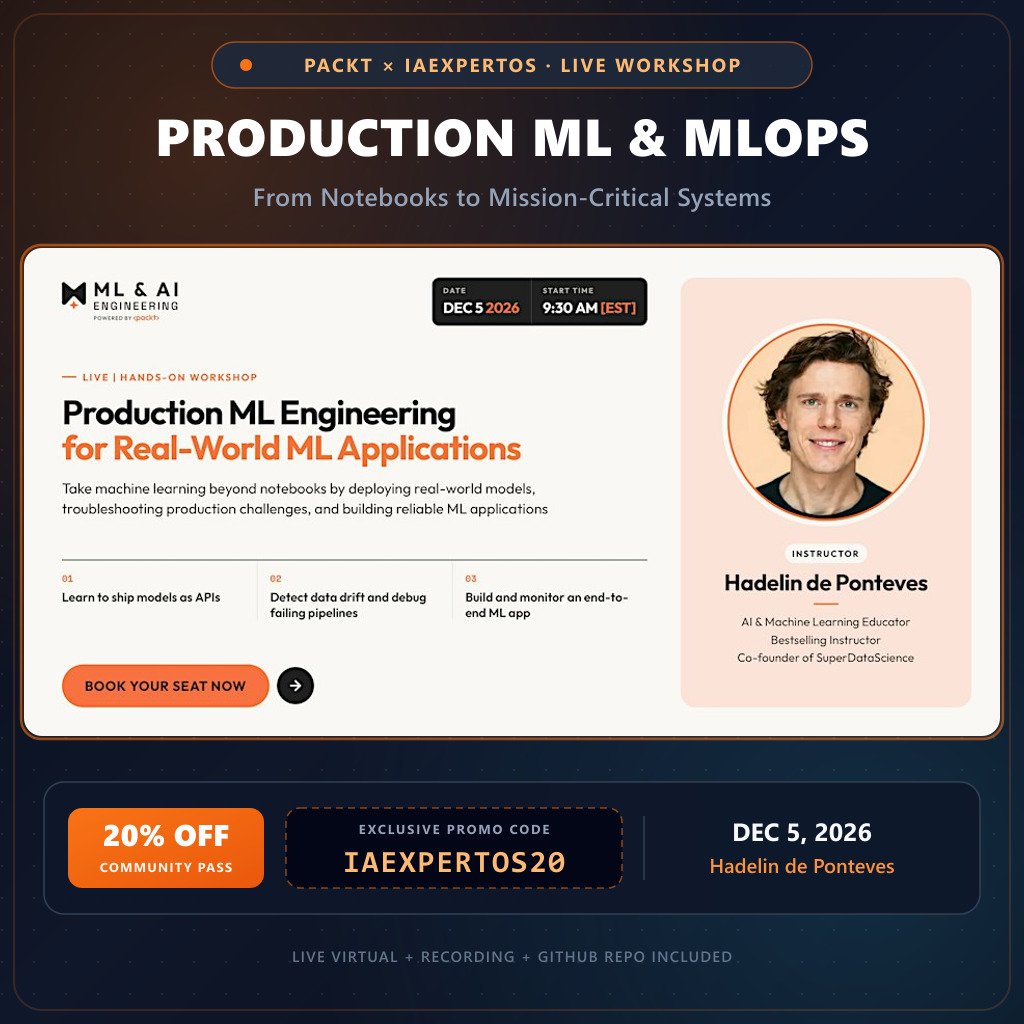
To resolve this critical industry bottleneck, leading technology publisher Packt is presenting the premier live interactive masterclass on December 5, 2026: "Production ML Engineering for Real-World ML Applications", conducted by Hadelin de Ponteves, one of the world's most influential educators in applied artificial intelligence and bestselling author with more than 2.5 million engineers trained globally.
Furthermore, readers and members of the IAExpertos community receive an exclusive benefit: a 20% discount applied automatically with promo code IAEXPERTOS20, bringing standard Eventbrite registration from $215.25 USD down to just $172.20 USD.
In this guide, we explore in clear, business-driven terms the core pillars taught in this intensive training and explain why mastering production ML engineering is essential for senior developers, data scientists, and technical leaders seeking to deliver true enterprise ROI.
1. The Hidden Technical Debt: Why a Model in a Notebook Is Not a Software Product
When a data science team celebrates achieving a 95% validation accuracy on historical data, the actual systems engineering effort has only just begun. As demonstrated in Google's landmark research on machine learning technical debt, the model code itself represents less than 5% of the total production ecosystem. The remaining 95% consists of complex infrastructure:
- Environment and Dependency Drift: Code that runs seamlessly on a local machine frequently conflicts with cloud server libraries and compiled C++ dependencies during real-time serving.
- Training-Serving Skew: Discrepancies between how batch data was prepared during training and how live streaming data arrives from web or mobile applications, leading to flawed inferences from day one.
- Traditional Monitoring Blind Spots: Standard server health checks (such as CPU utilization and fast HTTP 200 response codes) fail completely to notice when a model begins outputting nonsensical predictions because underlying user behavior has shifted.
Production Golden Rule:
A machine learning model that responds in 10 milliseconds but outputs erroneous predictions is vastly more hazardous than a crashed server, because it silently damages business operations while appearing healthy.
2. The Silent Threats: Data Drift and Concept Drift Explained Simply
Exclusive Tech Deals on Amazon
Machine learning algorithms do not degrade through physical friction, yet they inevitably deteriorate due to continuous real-world changes that engineers must monitor and control:
- Data Drift (Covariate Shift): Occurs when the statistical characteristics of the incoming data change over time. For example, if a loan approval model was trained on historical data with 1% interest rates, and the macroeconomic environment shifts to 5% interest rates, the model encounters input distributions it was never designed to evaluate.
- Concept Drift: Occurs when the fundamental relationship between input variables and target outcomes transforms. For instance, during major economic disruptions, consumer purchasing patterns can invert within days; a retail demand forecasting model relying on previous years' historical sales will immediately produce erroneous forecasts.
Intuitive Population Stability Index (PSI) Metric:
Shift Alert Level = Sum of [ (Current Population % - Baseline Population %) x Natural Log Difference ]
In plain and actionable terms:
- PSI under 0.10 indicates stable customer behavior with no required intervention.
- PSI between 0.10 and 0.25 indicates moderate distributional change requiring focused inspection.
- PSI exceeding 0.25 flags critical drift, mandating immediate automated retraining or safe heuristic fallback routing.
In Hadelin de Ponteves' workshop, you will learn how to configure automated telemetry pipelines that track these indicators continuously, notifying engineering teams long before accuracy loss affects company revenue.
3. Bulletproof Deployment Strategies: Moving Beyond Risky Overwrites
In traditional web development, deploying an updated application is generally a clean, reversible process. In machine learning, replacing an existing production model with a new release across 100% of live traffic at once is a high-risk gamble that can trigger severe outages if unforeseen edge cases arise.
In this masterclass, you will master the two premier deployment methodologies used by leading technology companies:
- Shadow Deployment: The newly trained candidate model receives a live copy of incoming production traffic in the background, but its outputs are logged internally rather than returned to end users. This allows engineers to verify latency, throughput, and memory consumption under genuine production load without any risk to the customer experience.
- Progressive Canary Releases: Once candidate stability is proven in shadow mode, traffic is gradually redirected: routing 1% to 5% of users initially, verifying business KPIs, and progressively expanding the allocation to 25%, 50%, and finally 100%.
Essential Safety Architecture:
Every production serving pipeline must feature an automated Circuit Breaker that instantly reverts traffic to the proven baseline model the moment unexpected latency spikes or error thresholds are breached.
4. Continuous Retraining and Real-World Corporate Blueprints
A common misconception is treating a machine learning model as a static, one-time artifact. The true value of a production ML engineer lies in designing automated, continuous retraining loops that keep models consistently synchronized with real-world shifts:
- E-Commerce and Recommendation Engines: Updating catalog embeddings and customer preference vectors in real time to optimize conversion rates without overwhelming cluster compute capacity.
- Fraud Detection in Financial Services: Rapidly adapting predictive models to emerging adversarial attack vectors, keeping fraud rates low while minimizing false positives for legitimate customers.
- Industrial Predictive Maintenance: Analyzing industrial telemetry to anticipate hardware failures and schedule maintenance before catastrophic production line halts occur.
You will learn how to integrate structured human review workflows (Human-in-the-Loop) so that automated model updates pass explicit quality gates before reaching customers.
5. Strategic Engineering Considerations for Tech Leads and Engineering Managers
For engineering leaders responsible for mission-critical software, deploying machine learning systems involves operational risk governance and sustainable resource allocation:
- Managing Cloud Costs and Compute Resource Allocation: Implementing automated model compression, quantization, and auto-scaling inference endpoints ensures that operating expenses scale linearly with user traffic rather than exploding exponentially.
- Reproducibility and Auditability: Establishing unified metadata registries and versioned data snapshots enables development teams to trace any historical model output back to the exact training dataset, configuration parameters, and code commit that produced it.
- Decoupled Architecture for Seamless Upgrades: Designing clean API boundaries between the inference engine and user-facing microservices allows engineering organizations to swap underlying model architectures with zero downtime.
Adopting these strategic architectural patterns insulates organizations against vendor lock-in, reduces infrastructure costs, and empowers teams to maintain continuous high availability.
6. Why Learning Production ML Engineering with Hadelin de Ponteves Delivers High Career ROI
Hadelin de Ponteves is widely recognized as one of the premier instructors in artificial intelligence. As co-founder of Bluelife AI, he has guided Fortune 500 enterprises in implementing production-grade ML and deep reinforcement learning systems that drive measurable commercial value.
- Pragmatic, Jargon-Free Pedagogy: Hadelin is renowned for demystifying technical complexities, replacing convoluted academic abstractions with clear, memorable software patterns that you can apply immediately.
- Direct Interactive Learning: Join a live, hands-on session where you can engage directly with the instructor, solve architectural bottlenecks specific to your company, and retain permanent access to source code repositories.
- Exclusive IAExpertos Partnership Rate: Using discount code IAEXPERTOS20, you save $43.05 USD off standard Eventbrite pricing, securing premier international training for just $172.20 USD.
7. Conclusion and How to Secure Your Seat
The future of enterprise artificial intelligence belongs not to those who merely build prototypes in notebooks, but to engineers who understand how to keep models performing reliably, safely, and cost-effectively in production.
Packt's "Production ML Engineering for Real-World ML Applications" live masterclass on December 5 is the most focused, practical pathway to mastering these essential skills. Live seats are limited to preserve high-quality instructor interaction. Secure your registration today with your exclusive 20% discount and take your engineering capabilities to the next level.