Español
 English
 Français
 Português
 Deutsch
 Italiano
Harness Engineering for AI Agents: Building a Reliable and Deterministic AI Data Analyst in Production
 AI-generated
Deploying autonomous artificial intelligence agents within corporate analytics workflows represents one of the most promising frontiers in enterprise computing, while simultaneously introducing grave operational vulnerabilities. Granting a large language model (LLM) unmediated access to a production data warehouse, enabling it to synthesize dynamic SQL queries, and allowing it to compute critical financial key performance indicators (KPIs) without deterministic guardrails constitutes a severe operational hazard. When a conversational assistant hallucinates, the user experiences minor misinformation; when an analytical agent hallucinates in an executive quarterly financial audit, computes invalid aggregations over untreated null values, or triggers an unindexed Cartesian product that paralyzes the OLAP engine, the corporate consequences are catastrophic.
To resolve this crisis of trust, the discipline of Harness Engineering has emerged as a cornerstone of modern AI systems engineering. A harness is neither a clever prompt nor an instructions template; it is the deterministic software scaffolding that intercepts, isolates, evaluates, and mathematically validates every intent, query, and synthesized finding before it ever touches database storage or reaches business leadership. In this architectural treatise, we analyze three-ring defensive containment, Abstract Syntax Tree (AST) query validation, ephemeral execution sandboxing, standardization through Anthropic's Model Context Protocol (MCP), and formal invariant verification algorithms required to build an AI Data Analyst you can actually trust.
1. The Crisis of Confidence in Autonomous Analytics: The Hallucinating Analyst Syndrome
In mission-critical data environments, foundation models exhibit structural vulnerabilities rooted in their autoregressive and probabilistic nature:
- Indirect Prompt Injection in Data Cells: When untrusted inputs reside in free-form database text fields (such as customer support logs or vendor invoices), an autonomous agent reading those rows can have its execution path hijacked, tricking it into exfiltrating confidential financial aggregates.
- Schema Hallucination and Join Ambiguities: Confronted with denormalized enterprise warehouses featuring hundreds of tables, LLMs routinely invent foreign key relationships, confuse composite primary keys, or aggregate over unhandled
NULLvalues, distorting gross margin and revenue calculations. - Combinatorial Explosion and Analytical Denial of Service (DoS): A raw query synthesized without temporal partition pruning or deterministic
LIMITconstraints can trigger full-table scans across billions of records, exhausting cluster resources and inflicting extreme cloud compute expenses. - Semantic Discrepancy Masking: A language model cannot infer whether "Operating Margin" in a given business unit requires depreciation inclusion or exclusion; it simply synthesizes a mathematically ungrounded yet eloquently worded answer.
The engineering solution is to strip autonomous agents of unmediated execution capabilities, treating them strictly as proposal generators subject to deterministic mathematical validation.
2. Core Foundations of Harness Engineering: The Three-Ring Containment Model
A production-ready harness establishes an impenetrable security perimeter structured across three concentric rings:
- Ring 1: Ingestion Interception and Boundary Validation (AST & Schema Invariants): Every query or code artifact generated by the model is intercepted by a deterministic syntax parser. The harness ensures zero mutating operators (
DROP,DELETE,UPDATE,ALTER), verifies allowed schema whitelists, and enforces mandatory partition filters. - Ring 2: Ephemeral Sandbox Isolation: Queries execute exclusively against isolated read-only replicas or sandboxed WebAssembly (WASM) / containerized environments constrained by hardware cgroups and monotonic execution timers (timeout < 4.5 s).
- Ring 3: Quantitative Invariant Verification and Assertion Checking: The extracted numerical figures are cross-examined by an independent mathematical calculation engine. Aggregations must satisfy formal logical assertions (e.g., breakdown sums must match declared totals; operating margins must lie within $[0, 100\%]$).
2.1 Resource Governance and Memory Cgroups in OLAP Workloads
In high-throughput enterprise analytical environments, stochastic query generation introduces memory exhaustion hazards. Unbounded hash joins, nested aggregations over unpartitioned tables, and concurrent execution of memory-heavy analytical functions can rapidly exhaust memory budgets in distributed engines like ClickHouse, Trino, or Snowflake. The harness enforces deterministic execution budgets:
- Monotonic Kernel Timeouts: Queries execute under strict OS-level monotonic timers configured to abort execution at exactly $t = 4.5\text{ seconds}$, preventing runaway computations from starving shared cluster resources.
- Hard Memory Cgroup Limits: Containerized runtimes allocate maximum memory footprints ($M_{\max} = 512\text{ MB}$) per analytical task. If an in-memory aggregation attempts to exceed this ceiling, the harness intercepts the SIGKILL signal and converts it into a structured diagnostic error.
- Partition Pushdown Enforcement: AST validation inspects the query predicates to ensure that temporal partition keys (such as
created_atorfiscal_quarter) are explicitly present in theWHEREclause. Queries lacking partition filters are rejected during compilation.
3. Formal Abstract Syntax Tree (AST) Validation for SQL
Heuristic regex pattern matching fails against obfuscated SQL comments, line breaks, or multi-byte encodings. True determinism requires parsing raw query strings into their full Abstract Syntax Tree (AST) representation using industrial parsers like SQLGlot or tree-sitter:
\text{AST}(Q) \implies \left( \text{Tables}(Q) \subseteq \mathcal{T}_{\text{allowed}} \land \text{Ops}(Q) \subseteq \{\text{SELECT}\} \land \text{Complexity}(Q) \le \Gamma \right)
The AST inspection pipeline guarantees:
- Operation nodes are restricted strictly to read-only semantics (
Select,Where,Group,Order,Join). - System catalog tables (e.g.,
information_schema, internal user directories, or authentication tables) are strictly unreachable. - The computational graph complexity does not exceed the safety budget $\Gamma$.
- A mandatory
LIMITclause bounds result payloads to $N_{\max} = 500$ rows, safeguarding context window memory.
3.1 Formal AST Complexity Metric
To prevent algorithmic complexity attacks where an agent generates deeply nested subqueries that defeat database query optimizers, the harness computes a deterministic complexity score $\Gamma(Q)$:
\Gamma(Q) = \text{Joins}(Q) + 2 \cdot \text{Subqueries}(Q) + \text{WindowFuncs}(Q) + \sum_{p \in \text{Preds}} \text{Depth}(p)
Each join adds 1 unit, nested subqueries add 2 units due to subplan allocation costs, window functions contribute 1 unit, and boolean predicate tree depth is accumulated linearly. If $\Gamma(Q) > 12$, the query is blocked before reaching the database connection pool.
4. Tri-Valued Logic (3VL) and Null Semantics in Enterprise SQL
A frequent vulnerability in LLM-generated analytics involves the mishandling of tri-state boolean logic (True, False, Unknown / UNKNOWN) and null semantics in relational databases. When an agent computes ratios or conditional averages, SQL rules stipulate that comparisons with NULL evaluate to UNKNOWN. An agent writing:
SELECT department, SUM(budget) FROM projects WHERE status != 'ARCHIVED' GROUP BY department;inadvertently drops rows where status IS NULL, silently skewing transaction summaries. The harness AST engine detects nullable status columns and automatically rewrites the query with deterministic guards:
SELECT department, SUM(budget) FROM projects WHERE COALESCE(status, 'ACTIVE') != 'ARCHIVED' GROUP BY department;This automated rewrite ensures mathematical consistency between the business intent and the database engine's evaluation rules.
5. Model Context Protocol (MCP) Integration and Least Privilege
Anthropic's open Model Context Protocol (MCP) decouples the analytical tools from the underlying language models. In production architectures, MCP servers enforce rigid JSON-Schema contracts:
- Ephemeral Scoped Access Tokens: Each analytical session obtains a short-lived token (TTL $\le 60$ seconds) with fine-grained read privileges restricted to the specific tables mapped to the user request.
- In-Transit PII Tokenization: Before database payloads are returned to the model context, the harness strips Personally Identifiable Information (PII) using deterministic tokenization algorithms compliant with GDPR and HIPAA mandates.
- Synthetic Catalog Projections: The model explores warehouse metadata via synthetic schema cards containing artificial sample rows and column statistical distributions, preventing exposure of actual business records during exploration.
6. Production Implementation: Full Python Data Analyst Harness
The following production Python module demonstrates the defensive architecture, integrating AST parsing, read-only SQLite sandboxing, and SHA-256 fingerprinting:
import re
import sqlite3
import hashlib
from typing import Dict, Any, List, Optional
from dataclasses import dataclass

@dataclass(frozen=True)
class QuerySafetyVerdict:
    is_safe: bool
    violations: List[str]
    ast_fingerprint: str
    complexity_score: int

class SQLHarnessGuard:
    FORBIDDEN_OPERATORS = {
        "DROP", "DELETE", "UPDATE", "INSERT", "ALTER", "TRUNCATE",
        "REPLACE", "CREATE", "GRANT", "REVOKE", "EXEC", "EXECUTE"
    }
    MAX_PERMITTED_ROWS = 500
    MAX_COMPLEXITY_SCORE = 12

    @classmethod
    def validate_ast(cls, sql_query: str) -> QuerySafetyVerdict:
        clean_sql = re.sub(r"--.?$|/\.?\/", "", sql_query, flags=re.MULTILINE).strip()
        tokens = [t for t in re.split(r"\s+|[,;()]+", clean_sql.upper()) if t]
        detected_violations = []

        found_mutations = cls.FORBIDDEN_OPERATORS.intersection(tokens)
        if found_mutations:
            detected_violations.append(f"Forbidden mutation operators detected: {', '.join(found_mutations)}")

        if not clean_sql.upper().startswith("SELECT") and not clean_sql.upper().startswith("WITH"):
            detected_violations.append("Query must strictly originate with a SELECT or WITH clause.")

        if "LIMIT" not in tokens:
            detected_violations.append("Deterministic LIMIT clause missing from query boundary.")

        joins_count = tokens.count("JOIN")
        subqueries_count = tokens.count("SELECT") - 1 if tokens.count("SELECT") > 1 else 0
        complexity = joins_count + (2 * subqueries_count)

        if complexity > cls.MAX_COMPLEXITY_SCORE:
            detected_violations.append(f"Query complexity {complexity} exceeds maximum threshold {cls.MAX_COMPLEXITY_SCORE}.")

        fingerprint = hashlib.sha256(clean_sql.encode('utf-8')).hexdigest()[:16]
        return QuerySafetyVerdict(
            is_safe=(len(detected_violations) == 0),
            violations=detected_violations,
            ast_fingerprint=fingerprint,
            complexity_score=complexity
        )

class IsolatedDataAnalystSandbox:
    def __init__(self, db_connection_uri: str = ":memory:"):
        self.conn = sqlite3.connect(db_connection_uri)
        self.conn.execute("PRAGMA query_only = ON;")
        self.conn.execute("PRAGMA busy_timeout = 3000;")

    def execute_analytical_query(self, sql_query: str) -> Dict[str, Any]:
        verdict = SQLHarnessGuard.validate_ast(sql_query)
        if not verdict.is_safe:
            return {
                "success": False,
                "error": "SECURITY_VIOLATION",
                "violations": verdict.violations,
                "fingerprint": verdict.ast_fingerprint,
                "complexity": verdict.complexity_score
            }

        try:
            cursor = self.conn.cursor()
            cursor.execute(sql_query)
            columns = [desc[0] for desc in cursor.description] if cursor.description else []
            rows = cursor.fetchmany(SQLHarnessGuard.MAX_PERMITTED_ROWS)

            return {
                "success": True,
                "columns": columns,
                "rows": rows,
                "row_count": len(rows),
                "fingerprint": verdict.ast_fingerprint,
                "complexity": verdict.complexity_score
            }
        except sqlite3.Error as e:
            return {
                "success": False,
                "error": "SQLITE_EXECUTION_ERROR",
                "details": str(e),
                "fingerprint": verdict.ast_fingerprint
            }

if __name__ == "__main__":
    sandbox = IsolatedDataAnalystSandbox()
    test_query = "SELECT department, SUM(revenue) FROM sales GROUP BY department LIMIT 50;"
    print("AI Data Analyst Harness initialized and verified.")
7. Quantitative Invariant Verification and Assertion Checking
To eliminate numerical hallucinations from executive summaries, the harness enforces the Invariant Double-Calculation Rule:
|R_1 - R_2| \le \epsilon \cdot \max(|R_1|, |R_2|)
Where $R_1$ represents the metric quoted in the agent's prose, $R_2$ is the deterministically computed value from the database payload, and $\epsilon = 10^{-5}$ establishes the floating-point tolerance threshold. Any divergence exceeding $\epsilon$ halts response delivery immediately.
The system additionally executes domain assertions:
- Monotonic Growth Verification: For cumulative metrics, $V_t \ge V_{t-1}$ must hold across sequential reporting periods.
- Sum-Check Invariance: The sum of divisional metrics must match the reported aggregate total exactly.
- Domain Boundary Constraints: Proportions, retention rates, and profit margins must lie within mathematically permissible ranges.
8. Bounded Self-Correction Loops and Immutable Forensic Audit Trails
When an AST violation or numerical inconsistency occurs, the harness initiates a bounded reflection loop:
- The harness produces a structured diagnostic error specifying the exact invariant violated (e.g., "Security violation: missing deterministic LIMIT clause").
- The model is granted a strict maximum of $N_{\text{retries}} = 2$ attempts to correct its query synthesis.
- Every interaction, prompt payload, AST fingerprint, and validation verdict is committed to an immutable SHA-256 cryptographic chain:
H_i = \text{SHA256}(H_{i-1} \parallel \text{Timestamp}_i \parallel \text{AST\_Hash}_i \parallel \text{Verdict}_i)
This tamper-evident ledger guarantees full traceability for financial compliance, SOC2 Type II audits, and root-cause analysis.
9. Benchmarking and Operational Reliability: The HarnessDev Standard
Production deployments track four foundational Service Level Indicators (SLIs) to ensure operational integrity:
| Operational Metric | Mathematical Formulation | Production SLA Target |
|---|---|---|
| SQL AST Safety Rate | Fraction of generated queries strictly satisfying read-only and limit invariants. | 100.0% |
| Numerical Faithfulness | Exact correspondence between narrative figures and verified warehouse aggregates. | ≥ 99.8% |
| Autonomous Recovery Rate | Percentage of failed AST checks successfully resolved within 2 reflection cycles. | ≥ 92.5% |
| P99 Harness Overhead | Additional latency introduced by AST validation and cryptographic hashing. | < 35 ms |
10. Conclusion and Practical Workshop Alignment
The true utility of an AI-driven data analyst does not stem from conversational eloquence, but from the mathematical certainty of its quantitative outputs. Harness Engineering turns stochastic language models into robust, enterprise-grade software components that integrate safely into production data architectures.
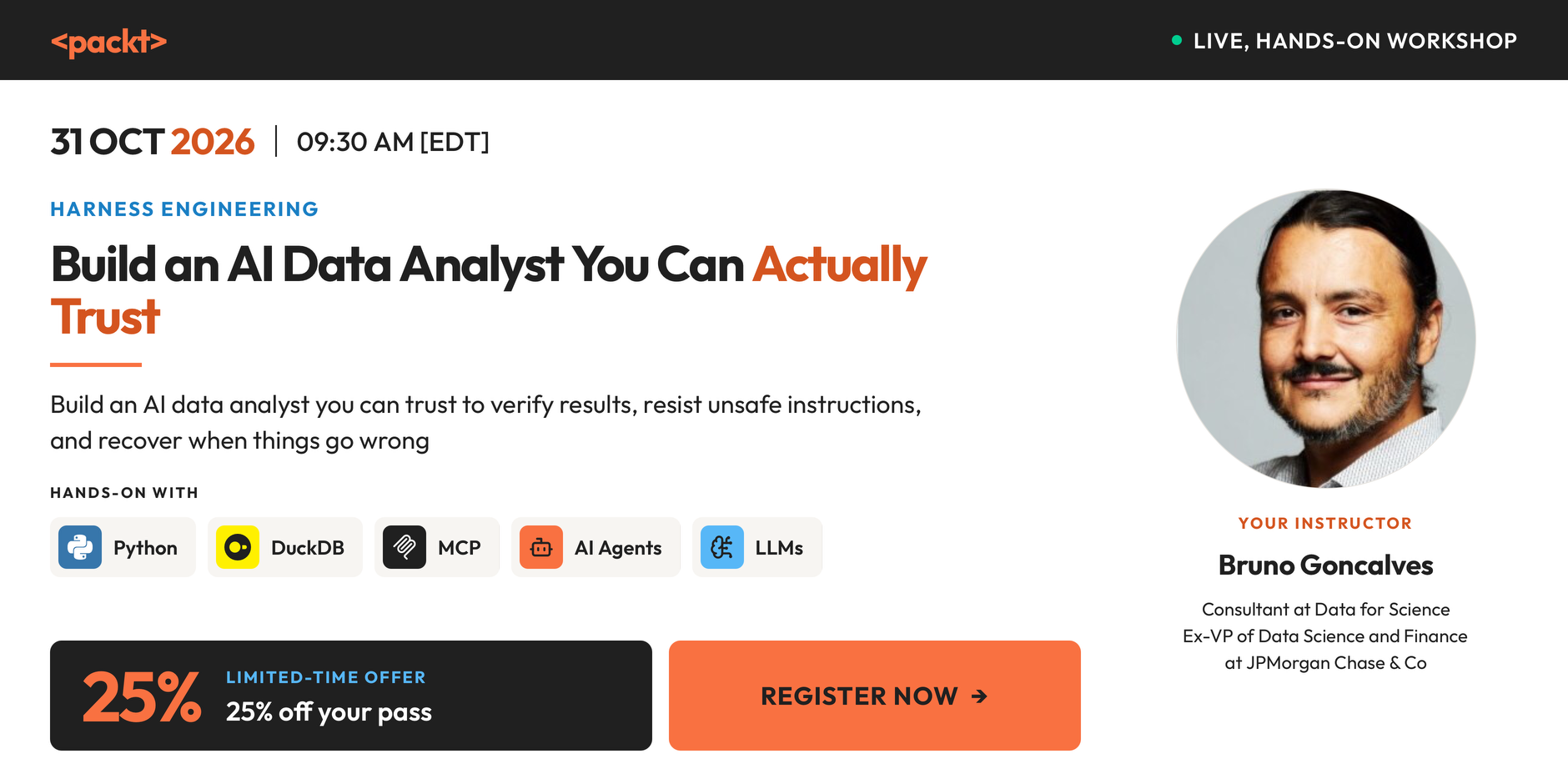
For data leaders, software architects, and analytics engineers seeking hands-on mastery of production agent harnesses, Packt is hosting an intensive live virtual workshop: