
 Español
 English
 Français
 Português
 Deutsch
 Italiano
Homelabber Uses Second-Generation Optane Memory to Run a 2.8-Billion-Parameter AI Model Exclusively on CPU
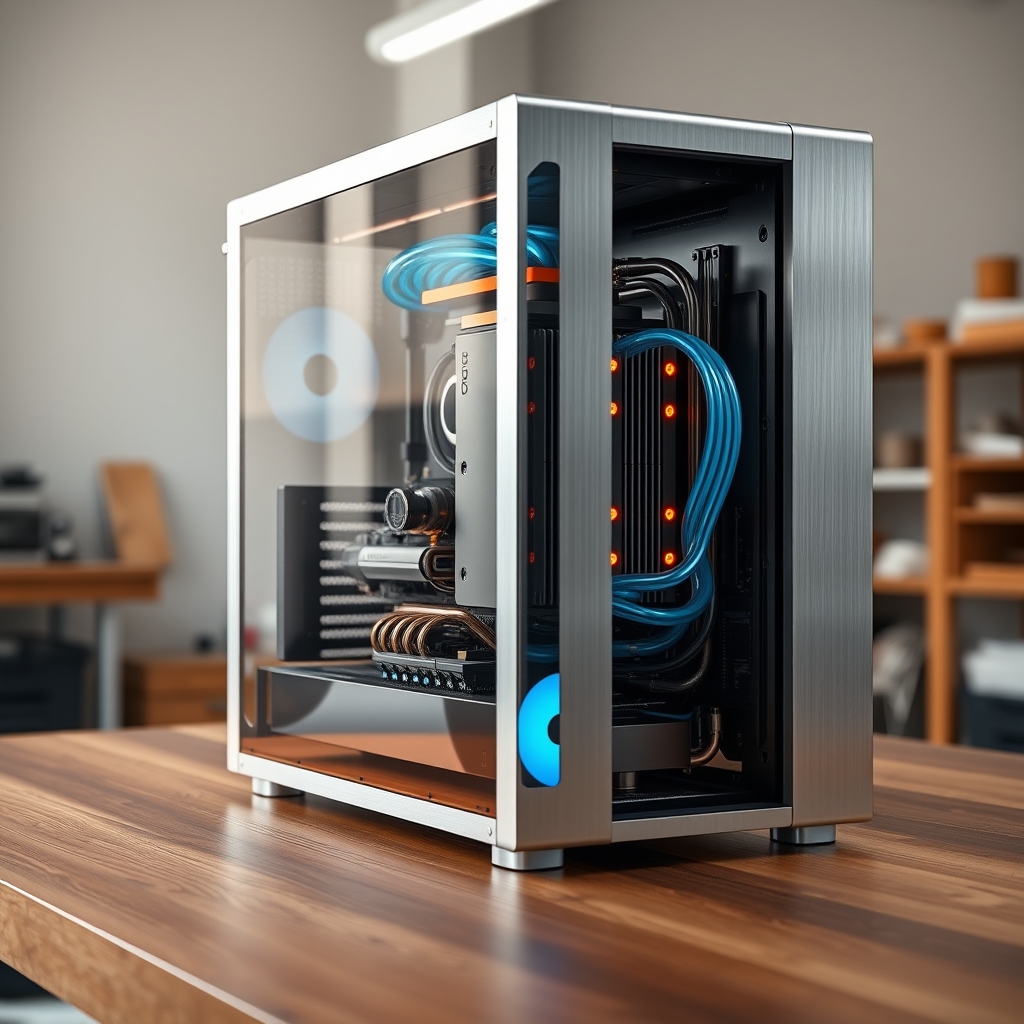 AI-generated
1. Context and Highlights
The artificial intelligence hardware landscape has been almost absolutely dominated by graphics accelerators, tensor processing units, and high-bandwidth memory configurations such as HBM stacks. However, a home computing enthusiast, popularly known in hardware communities as a homelabber, has managed to materialize an unexpected technical milestone by running a 2.8 billion-parameter artificial intelligence model using exclusively the computing power of conventional central processing units, supported by persistent memory infrastructure based on second-generation sticks from Intel's discontinued Optane line.
This achievement does not represent an immediate commercial replacement for hyperscale data centers equipped with massive clusters of cutting-edge accelerators, but it does redefine the limits of what is technically feasible outside traditional corporate environments. By exploiting byte-level persistence and the high-density addressing capabilities of Optane technology, the system manages to partially mitigate the traditional PCI Express bus bottleneck when main memory is insufficient to host colossal model weights in a quantized format.
The community of systems engineers, infrastructure architects, and open-source developers is watching this development with keen technical interest. The historical scarcity and high acquisition cost of AI-dedicated silicon have confined advanced experimentation with massive-scale models to a very small technological oligopoly. Demonstrating that a consumer and second-hand hardware configuration can process inferences on multi-billion-parameter architectures opens a window of analysis regarding memory efficiency, interconnect routing, and the future design of local computing environments.
2. Key Technical Aspects
To understand the magnitude of the feat, it is imperative to examine the physical limitations inherent in running large-scale language models. A 2.8 billion-parameter model, even when subjected to aggressive low-precision quantization techniques such as 2-bit or 4-bit per parameter formats, requires a volatile or persistent memory storage volume of several gigabytes just to load the static weights of the attention layers and feed-forward blocks of the model architecture. On a conventional motherboard, filling this space with traditional DDR RAM modules can be expensive both due to physical slot limitations and disproportionate financial costs.
The key to the success of this experiment lies in the strategic use of Intel Optane persistent memory, based on non-volatile memory express storage technology and 3D XPoint phase-change cells. Unlike conventional solid-state drives based on NAND flash memory, which suffer from severe latency and durability penalties under the intensive random access patterns typical of transformer inference, Optane sticks offer latency close to that of traditional DRAM and byte-level persistence that allows the operating system to map the address space directly using memory-mapping calls.
During execution, the critical bottleneck shifts from raw floating-point processing to the memory bus bandwidth and transfer latency. The homelabber configured the central processor's memory channels to interleave the Optane sticks alongside traditional RAM, creating a hierarchical and unified address space. Conventional RAM acts as an ultra-fast buffer for the activation tensors and the ongoing active context, while the bulk of the quantized model weights rests on the high-capacity Optane modules. The inference software used required substantial code-level modifications to optimize cache memory access and minimize read faults that paralyze the central processor's instruction cycles. Through the implementation of predictive loading algorithms and advanced calculation instruction vectorization, the system managed to maximize the utilization of the available processing cores without incurring catastrophic disk I/O waits. Despite these optimizations, the processing speed measured in tokens per second remains in an extremely low range when compared to commercial graphics accelerator standards. However, the technical value of the experiment does not lie in production speed, but in the mathematical and engineering viability of keeping a model of such magnitude active and operational without going bankrupt trying to buy dedicated server clusters.
3. Industry Repercussions
The economic and strategic implications of this experiment go beyond the boundaries of the home hobbyist, resonating within the technology departments of medium and large enterprises seeking alternatives for data sovereignty. The exclusive reliance on closed GPU ecosystems has generated significant financial pressure on corporate infrastructure budgets, forcing many organizations to outsource their artificial intelligence workloads to cloud service providers.
The demonstration that a high-core-count CPU paired with persistent memory can handle scaled models suggests an alternative path for inference scenarios where extreme latency is not the determining factor, but absolute data privacy is. Regulated sectors such as investment banking, public healthcare, and government administration handle strict restrictions that prevent sending sensitive information to third-party-managed public clouds.
| Hardware Architecture | Main Advantage | Critical Limitation | Relative Infrastructure Cost |
|---|---|---|---|
| GPU Cluster (HBM) | Massive speed and bandwidth per token | Prohibitive cost and high supply dependency | Very High |
| CPU with Conventional RAM | Ease of deployment and standard compatibility | Very limited capacity due to physical motherboard slots | Medium |
| CPU with Optane Persistent Memory | Extreme weight storage capacity at low cost | High transfer latency and low token rate | Low (Discontinued/Secondary hardware) |
For hardware manufacturers, this milestone highlights a missed opportunity with the discontinuation of the Optane line, but it also points the way toward the development of new classes of high-speed persistent storage memory tailored specifically for the era of distributed cognitive computing. The convergence between random-access memory and non-volatile storage remains the holy grail of modern computer architecture.
Likewise, developers of open-source software frameworks for local inference find in such initiatives an incentive to refactor their execution engines. The trend toward breaking down hardware barriers drives the creation of more efficient abstraction layers that make it possible to leverage any available silicon resource on a home or corporate network.
4. Market Perspectives
Advanced infrastructure analysts agree that while these types of configurations will not displace specialized data centers for training or massive real-time inference, they set a fascinating precedent for the flexibility of modern software. The ability to decouple model size from the immediate availability of high-bandwidth memory demonstrates that quantization and data flow management algorithms continue to mature at a dizzying pace.
From a systems engineering perspective, experts point out that the main challenge in replicating these configurations lies in the fine-tuning of the operating system and virtual memory management parameters. Modern Linux kernels offer advanced tools for huge page manipulation and memory-mapped files, but they require a deep understanding of bus topology and NUMA (Non-Uniform Memory Access) to avoid catastrophic bottlenecks in the communication links between different processor sockets.
Strategic recommendations for chief technology officers involve evaluating the use of heterogeneous architectures not only to reduce costs, but as an insurance policy against potential disruptions in the global supply chain for specialized artificial intelligence components. Having the capability to deploy advanced language models on general-purpose hardware ensures operational continuity in any industrial crisis scenario. However, strong warnings are issued regarding performance risks. Attempting to use a CPU and persistent memory-based configuration for interactive, low-latency applications will result in an unsatisfactory user experience. The ideal use case is strictly limited to background batch processing, analysis of large document volumes without time urgency, and internal research tasks.
5. Future Outlook
As language models and multimodal systems continue to expand their parameter counts, pressure on memory infrastructures will continue to intensify. In the coming years, the silicon industry is expected to evolve toward intermediate memory standards capable of offering a balanced compromise between the storage density of persistent memory and the extreme bandwidth of stacked technologies.
The adoption of standardized high-speed interconnection technologies will allow decentralized computing systems to pool distributed memory across local fiber-optic networks, virtually emulating the behavior of a unified cluster without the need to acquire highly specialized proprietary hardware.
On the software side, computational graph optimization compilers will natively integrate predictive management of complex memory hierarchies, allowing any developer to deploy multi-billion-parameter models on generic servers with minimal configuration effort and performance loss optimized through artificial intelligence directly within the compilation process.
6. Conclusion and assessment of the 2.8 billion parameter model on CPU with Optane
The homelabber's experiment in successfully running a 2.8 billion parameter model exclusively on CPU using Optane persistent memory marks a turning point in the democratization of hardware for advanced inference. Far from being a mere enthusiast anecdote, this technical feat challenges the industry dogma that large-scale models irreplaceably depend on massive clusters of graphics accelerators and high investments in VRAM.
By demonstrating that it is possible to overcome the limitations of conventional volatile memory through the strategic use of byte-mapped persistent storage, the technical community opens a solid path for data sovereignty and the local execution of artificial intelligence in highly regulated sectors with austere budgets. Although the tokens-per-second rate continues to relegate this architecture to batch processing tasks and background document analysis, the evolution of inference engines and future memory hierarchies promise to close the performance gap.
Ultimately, this milestone with the 2.8 billion parameter model reinforces the thesis that software engineering and systems optimization can redefine the limits of available hardware, offering a viable alternative to global supply chain bottlenecks and consolidating new perspectives for distributed cognitive computing.