 Español
 English
 Français
 Português
 Deutsch
 Italiano
How to Build Enterprise AI Applications That Actually Work: The Comprehensive Guide to Brij Kishore Pandey's Live Masterclass
 AI-generated
The explosive expansion of generative artificial intelligence has presented technology leaders with an unavoidable truth: building a quick demonstration prototype using a language model takes merely an afternoon, but deploying that system into production with high accuracy, predictable latency, and disciplined cost control remains one of the steepest engineering challenges of our time. The overwhelming majority of enterprise generative AI projects stall in early stages because standard semantic vector search returns mediocre answers, models suffer from unpredictable hallucinations, and engineering teams lack automated metrics to evaluate live performance.
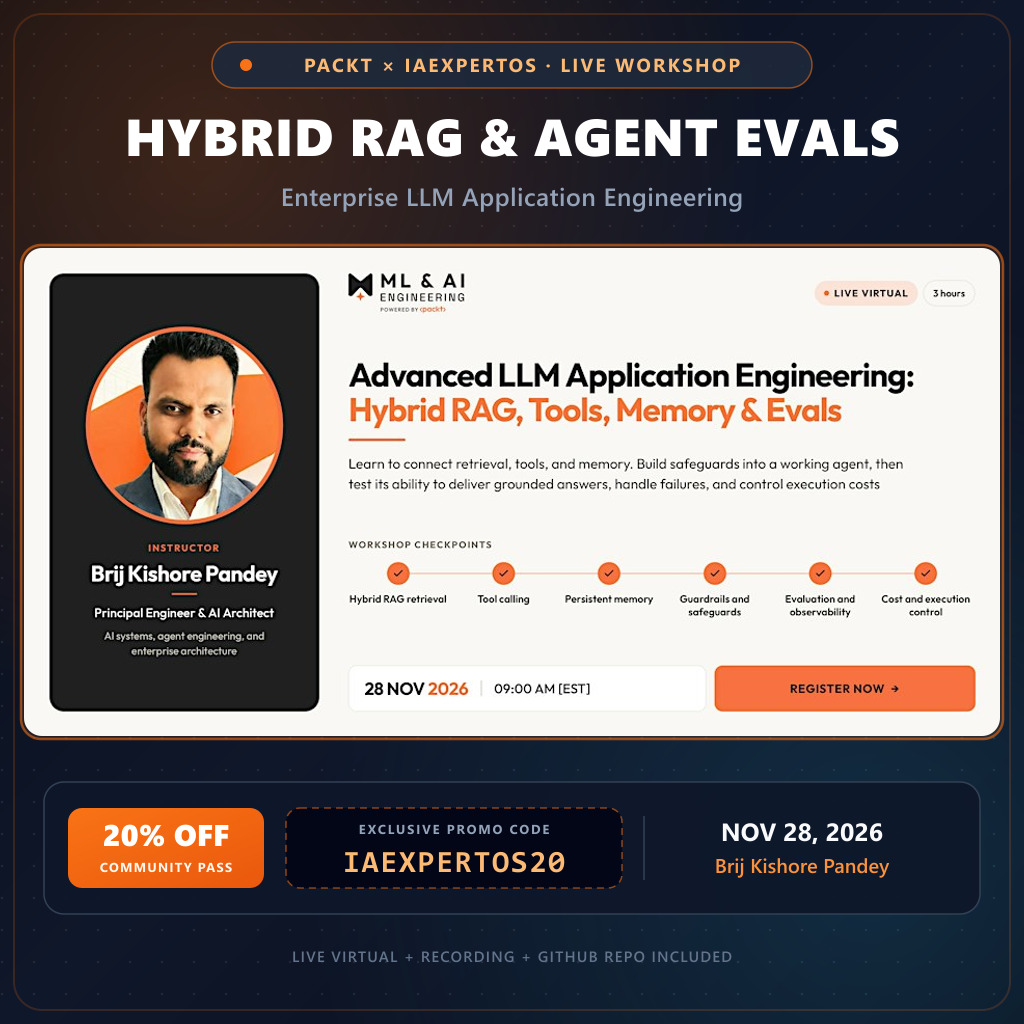
To overcome these structural bottlenecks and advance your technical career, renowned technology publisher Packt is hosting the premier live interactive technical masterclass on November 28, 2026: "Advanced LLM Application Engineering: Hybrid RAG, Tools, Memory & Evals", led by Brij Kishore Pandey, one of the industry's foremost experts in large language model deployment.
Moreover, as part of our exclusive partnership, the IAExpertos community benefits from a direct 20% discount using promotional code IAEXPERTOS20, reducing standard registration from $215.25 USD down to just $172.20 USD.
In this guide, we break down in clear, business-driven terms the core methodologies taught in this live workshop and explain why mastering these competencies places software engineers, technical leads, and architects at the forefront of the modern AI economy.
1. The Core Limitations of Naive RAG: Why Vector Search Alone Falls Short
Over the past two years, the standard recipe for grounding LLMs in corporate documentation has relied on basic vector search: breaking files into text chunks, calculating semantic embeddings, and retrieving matches using mathematical distance.
While this approach works reasonably well for simple conceptual questions, enterprise production workloads routinely expose severe failure modes:
- Failure on Precise Identifiers and Product Codes: When an end user queries an exact invoice identifier, a contract SKU, or an error code such as ERR-409-CONFLICT, standard vector search fails. Instead of matching exact character sequences, it attempts to guess abstract conceptual similarities, returning irrelevant paragraphs.
- Struggles with Logical Negations: When an analyst asks for "vendor agreements that do not include automatic annual price escalations", semantic spaces frequently retrieve contracts that prominently highlight price escalations, completely ignoring the negative modifier.
- Loss of Strict Temporal and Factual Ranking: Two distinct text chunks may yield nearly identical vector proximity scores, yet one may represent an outdated draft from three years ago while the other represents yesterday's verified corporate policy. Blind vector matching cannot differentiate between the two.
Production Golden Rule:
Vector search understands general conceptual meaning, but keyword search guarantees exact precision.
Successful enterprise applications combine both approaches into a unified hybrid architecture that filters, scores, and reorders results before passing them to the language model.
2. The Enterprise Solution: Hybrid RAG Architectures and Intelligent Reranking
Exclusive Tech Deals on Amazon
Brij Kishore Pandey's workshop provides a hands-on roadmap for designing high-performance hybrid retrieval engines:
- Advanced Lexical Search: Accurately retrieves product codes, specialized acronyms, proper names, and exact numbers using proven inverted index algorithms.
- Dense Vector Search: Identifies synonyms, conceptual relationships, and user intent, ensuring the system retrieves relevant answers even when users phrase questions differently from source documents.
- Intelligent Reciprocal Rank Fusion: A transparent mathematical method that merges results from both search systems into a single, balanced ranking, elevating documents that perform well across both methodologies.
- Second-Stage Rerankers: A lightweight, specialized cross-encoder model that jointly inspects the user query and candidate paragraphs, scoring their true contextual alignment before prompt assembly.
Intuitive Fusion Formula (Reciprocal Rank Fusion):
Document Relevance Score = Sum of [ 1 divided by (60 + Search Rank Position) ]
In plain English: the higher a document appears in both keyword search and conceptual search, the higher its final score, ensuring only top-tier context reaches the language model.
By applying this two-stage retrieval pipeline, the generative model receives only the few paragraphs that directly answer the inquiry. This reduces token consumption by up to 75% and virtually eliminates hallucinations caused by distracting context.
3. Reliable Tool Integration and Stateful Memory Management
A standalone language model can only regurgitate information contained within its pre-training weights. To function as an indispensable enterprise assistant, it must interact securely with real-world infrastructure: querying ERP inventory, executing database transactions, or updating customer records via internal APIs.
During this workshop, you will master:
- Error-Resilient Tool Calling: How to structure strict schemas and guardrails so models never invent fabricated arguments or execute unauthorized operations.
- Short-Term vs. Long-Term Memory Separation: Structuring memory pipelines that clearly separate current conversational context from persistent user preferences and enterprise access permissions stored in backend databases.
- Context Window Management and Cost Optimization: Practical summarization and selective pruning strategies that prevent long-running interactions from exhausting context budgets or driving up inference expenses.
4. Automated Evaluations (Evals): Moving from Experimental Prototypes to Defensible Products
The primary reason corporate engineering leaders hesitate to deploy generative AI applications to live customers is the fear of unpredictability. How can you be certain that a prompt modification or model version upgrade does not silently degrade answer accuracy across hundreds of edge cases?
Manually reviewing thousands of conversational outputs every week is unscalable and financially unsustainable. The professional solution is establishing an automated evaluation pipeline (Evals). In this masterclass, you will learn how to measure:
- Factual Faithfulness: Automatically calculating the percentage of claims in a generated answer that are directly supported by retrieved source text, sounding an immediate alert if unauthorized claims appear.
- Answer Relevance: Assessing whether the generated response directly addresses the user's specific request without irrelevant tangents.
- Context Precision: Evaluating whether the retrieval layer passes concise, pertinent information rather than bloated text that inflates operating costs.
Strategic Metric:
If your team cannot quantify application accuracy with an objective mathematical benchmark, you do not possess a production-ready product; you possess an uncontrolled experiment.
5. Concrete Business Use Cases Addressed in the Masterclass
During the live practical modules, Brij Kishore Pandey walks attendees through real-world implementation blueprints designed to solve recurring challenges across modern industries:
- Enterprise Customer Support and Ticket Resolution: Moving beyond static chatbots to dynamic assistants that query internal knowledge bases, verify warranty status, and draft compliant customer communications with zero hallucination.
- Automated Financial and Legal Document Auditing: Building pipelines capable of ingesting complex PDF filings, extracting exact tabular figures, and cross-referencing disclosures against regulatory frameworks with clear source citations.
- Internal Developer Knowledge Engines: Indexing millions of lines of proprietary code, architectural decision records, and API documentation to provide engineering teams with precise code snippets and context-aware debugging support.
Mastering these use cases equips technical practitioners with repeatable patterns that can be immediately adapted to their company's internal roadmap, translating theoretical knowledge into tangible operational efficiency.
6. A High-Yield Career Investment with Immediate Professional ROI
The global AI talent market is maturing rapidly. Simply prompting commercial chatbots has become an entry-level skill; the professionals commanding top compensation packages and leading strategic initiatives are engineers capable of building resilient, measurable, and integrated architectures.
Key benefits of attending this live session:
- Real-World Corporate Engineering Expertise: Brij Kishore Pandey shares architecture designs refined through years of production deployments across demanding enterprise environments.
- Interactive Live Masterclass: Engage directly with the instructor, discuss specific architectural hurdles in your own company's roadmap, and gain permanent access to comprehensive session repositories.
- Exclusive IAExpertos Partnership Benefit: Our community receives an exclusive 20% discount with promo code IAEXPERTOS20, bringing your total investment to just $172.20 USD (standard price $215.25 USD).
7. Conclusion and How to Reserve Your Seat
The generative AI applications that deliver lasting business value will not be those running the biggest or most expensive models, but those engineered with intelligent hybrid retrieval, reliable tool execution, and rigorous automated quality controls.
Packt's "Advanced LLM Application Engineering" live masterclass on November 28 is the most direct pathway to acquiring these mission-critical competencies. Live seats are strictly limited to ensure meaningful interaction with the instructor. Secure your registration today with your exclusive 20% discount and elevate your engineering capabilities.