Español
 English
 Français
 Português
 Deutsch
 Italiano
Infrastructure Analysis: The $30 Billion Investment to Build and Equip a 1 GW AI Data Center in Abilene, Texas
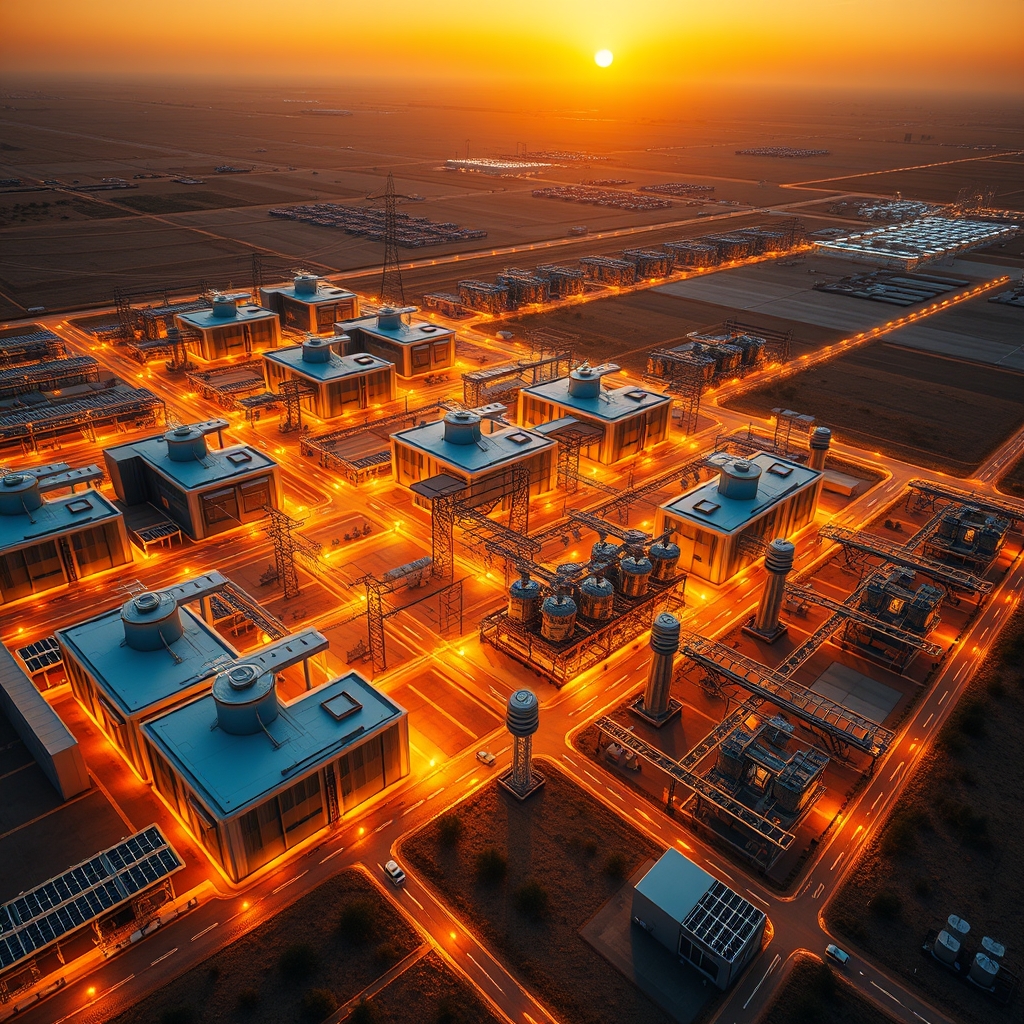 AI-generated
1. Context and Key Points
The race to deploy dedicated computing infrastructure for artificial intelligence has reached an unprecedented scale. Recent reports from financial analysts and the energy sector place the investment required to build and equip a single one-gigawatt (1 GW) AI data center in Abilene, Texas, at approximately $30 billion. This monumental deployment starkly illustrates the true cost of sustaining large-scale training and inference workloads for contemporary language model architectures and multimodal systems.
The economic breakdown of this project reveals that the vast majority of capital is concentrated in high-end silicon: about $17 billion dedicated exclusively to accelerator chips. Added to this are $3 billion aimed at securing and stabilizing power supply capacity, a critical bottleneck for the industry, and $2.4 billion allocated for civil works and the physical construction of the complex. This figure is part of a macroeconomic context where technology giants such as Meta Platforms, Amazon, Microsoft, and Alphabet collectively allocate hundreds of billions of dollars to secure their computational supremacy.
This analysis breaks down the technical, economic, and market implications of this 1 GW infrastructure, examining how the concentration of computing power in specific locations like Texas is transforming regional energy markets and setting a new standard for data center engineering globally.
2. Technical Highlights
The architecture of a 1-gigawatt data center represents a monumental engineering challenge that far exceeds the specifications of traditional cloud computing facilities. A complex of this magnitude requires not only millions of square feet of physical space, but a power density per rack that forces a complete rethinking of electrical distribution and liquid cooling systems. At the core of this infrastructure are specialized graphics processors and accelerators, the acquisition of which absorbs more than half of the total project budget with an estimated $17 billion. State-of-the-art chips, necessary to execute massive machine learning operations and support advanced model deployments, generate thermal densities that render conventional air cooling methods obsolete. Engineers must integrate Direct-to-Chip Liquid Cooling circuits and closed-loop thermal management systems capable of dissipating kilowatts of heat per rack unit. The logistical complexity of coordinating the supply chain for these silicon components requires millimeter precision, as any delay in the delivery of accelerators can paralyze entire phases of operational deployment.The second critical component is the power supply, valued at $3 billion. One gigawatt of power is equivalent to the energy consumption of a medium-sized city, raising immediate interconnection issues with the Texas electrical grid (ERCOT). Operators of these data centers must collaborate closely with utilities to build dedicated substations, high-voltage transmission lines, and, in many cases, integrate on-site power generation solutions such as solar farms, grid-scale battery storage, or direct supply contracts with firm energy sources to ensure 99.999% availability. The civil construction phase, estimated at $2.4 billion, encompasses much more than the erection of industrial buildings. It requires reinforced foundations to support the extreme weight of racks loaded with servers and uninterruptible power supply (UPS) systems, ultra-high-speed fiber optic networks with geographic redundancy, and physical security and perimeter cybersecurity systems. The integration of these elements turns the site into a mission-critical facility where structural integrity management and energy efficiency are non-negotiable variables.
| Infrastructure Component | Estimated Cost (Billion USD) | Approximate Percentage of Total Budget |
|---|---|---|
| Acquisition of AI Chips and Accelerators | $17.0 | 56.7% |
| Energy Infrastructure and Supply | $3.0 | 10.0% |
| Civil Construction and Physical Works | $2.4 | 8.0% |
| Other Components (Networks, Cooling, Auxiliary Servers) | $7.6 | 25.3% |
| Cumulative Total | $30.0 | 100% |
3. Sector Impact
The construction of 1 GW facilities like the one projected in Abilene redefines the competitive dynamics among major technology players in the global ecosystem. The magnitude of the financial outlay acts as an almost insurmountable barrier to entry for mid-sized companies and startups, consolidating the foundational AI market in the hands of a select group of corporations with access to massive capital markets and exceptional operational cash flows.
Regionally, the arrival of data centers of this scale radically transforms the economy of Texas and Taylor County. While these projects generate highly skilled jobs during construction and technical maintenance phases, they also impose significant pressure on local water resources and the grid's power generation capacity. Regulatory authorities face the challenge of balancing economic incentives to attract tech investment with the need to protect residential consumers from volatility in electricity prices.
At the macroeconomic level, global investment in AI infrastructure, projected toward the $750 billion mark driven by Meta, Amazon, Microsoft, and Alphabet, reflects a structural shift in the digital economy. Data centers are no longer considered mere passive data stores, but intelligent computing factories where the cognitive capabilities that will power the next generation of autonomous agents and enterprise systems are manufactured. Providers of networking equipment, uninterruptible power supply (UPS) systems, and thermal components are experiencing an extraordinary demand cycle. However, this accelerated growth also exposes vulnerabilities in the global supply chain, ranging from a shortage of high-power transformers to the limited availability of critical raw materials for manufacturing advanced semiconductors.
4. Market Outlook
Industry analysts point out that the transition toward gigawatt-scale data centers marks the end of the era when computing infrastructure was designed under traditional enterprise cloud parameters. The power density demanded by artificial intelligence workloads requires unprecedented alignment between model developers, silicon manufacturers, and electric utilities. From a strategic perspective, the geographic location of these data centers responds to strict criteria: availability of large plots of land at low cost, favorable regulatory frameworks, and access to diversified energy sources. Abilene has become an attraction hub due to its proximity to wind and solar resources, as well as the flexibility of the grid infrastructure in Texas. However, experts warn that relying exclusively on intermittent green energy sources without firm backup from storage or base generation can compromise the operational continuity of facilities that cannot afford even a second of downtime.Strategic recommendations for data center operators point toward the diversification of energy sources, including the exploration of long-term agreements with modular nuclear power generators and the development of advanced waste heat recovery systems. Likewise, software optimization and efficiency in algorithm execution are emerging as necessary counterweights to mitigate unsustainable pressure on physical infrastructure.
5. Next Steps
The trajectory of AI infrastructure over the coming years indicates that the 1 GW milestone will cease to be an exception and become the design standard for frontier training centers. As models evolve toward more complex Mixture of Experts (MoE) architectures and agentic multimodal systems, the demand for computing power will continue to scale exponentially. On the medium-term horizon, the widespread adoption of dedicated microgrids within the data center complexes themselves is expected, integrating on-site generation to isolate computing operations from public grid fluctuations. Concurrently, advances in accelerator efficiency and neural network compiler optimization will seek to decouple AI performance from linear power consumption.The consolidation of these facilities in energy-abundant regions will redefine the economic geography of technology, shifting major computational gravity centers toward rural and semi-urban areas with long-term expansion capacity.