Español
 English
 Français
 Português
 Deutsch
 Italiano
Kraken, the autonomous vessel startup, raises $175M and reaches $1B valuation: In-depth analysis of the new era of unmanned naval warfare
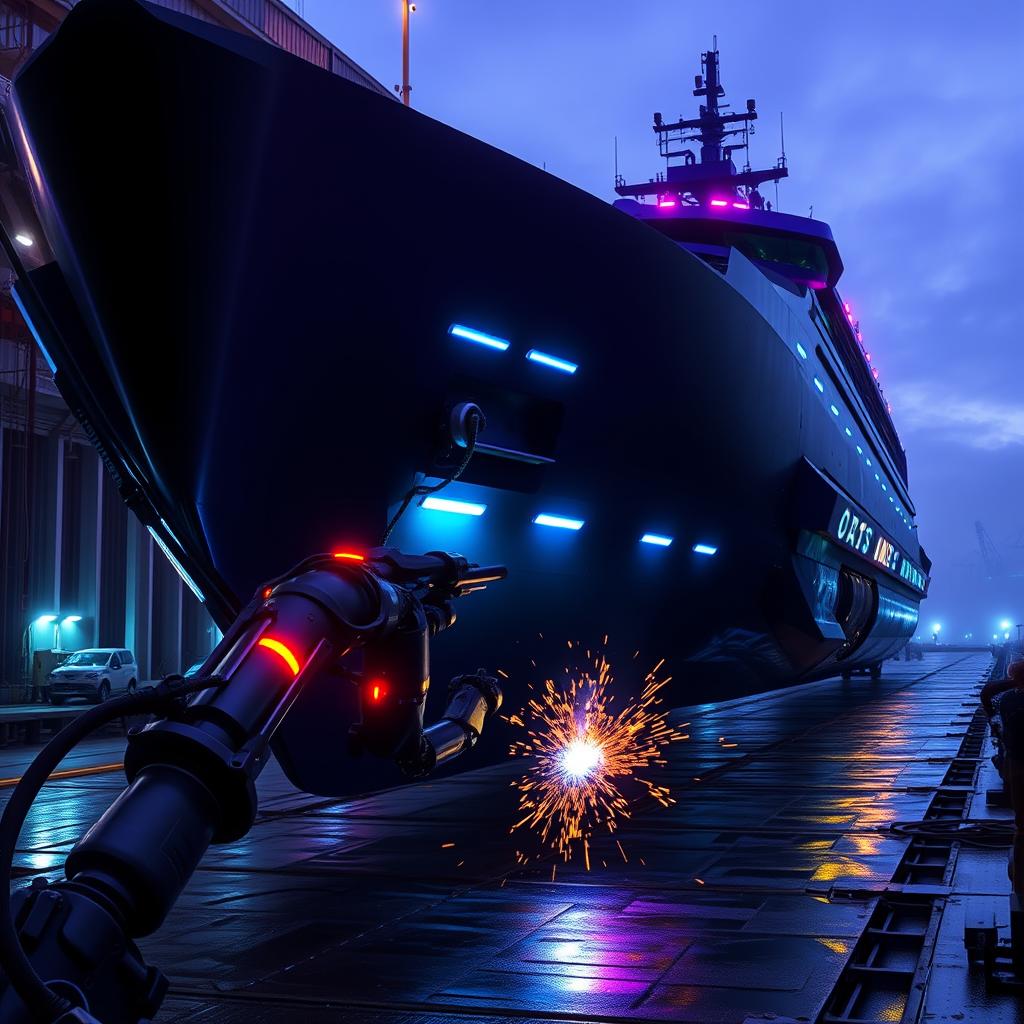 AI-generated
1. Executive Summary: The Unmanned Warfare Unicorn
On July 10, 2026, the defense and maritime technology landscape experienced a significant shift. Kraken Technology Group Ltd., a UK-based startup specializing in the development of Autonomous Surface Vessels (ASVs), announced the closing of a Series B funding round worth $175 million. The deal, led by venture capital fund DTCP, raises the company's valuation above $1 billion, cementing it as the first European unicorn in the unmanned naval warfare sector.
What makes this round particularly significant is not just the figure, but the composition of the investor syndicate. Alongside DTCP are the UK government's British Business Bank, the NATO Innovation Fund (NIF), NATO's venture capital fund, and more than half a dozen additional institutional and strategic investors. This alignment between private, sovereign, and military alliance capital underscores a reality: autonomous warfare has moved from a laboratory experiment to a strategic priority.
For industry analysts, this news is not a simple funding round. It is the signal that the market for unmanned defense systems is entering a phase of hypergrowth, driven by the need for asymmetric deterrence, reducing risks to human personnel, and the maturity of technologies such as autonomous navigation in GPS-denied environments and AI-based sensor fusion. This article is an analysis of what this milestone truly means for the industry, technology, and global geopolitics.
2. Technical Analysis: The Architecture of an Autonomous Hunter
To understand why Kraken has achieved this valuation, it is necessary to examine the technological core of its platforms. Unlike aerial drones, autonomous surface vessels operate in one of the most hostile and dynamic environments: the sea. Waves, salt corrosion, electromagnetic interference, and the lack of constant communication infrastructure pose considerable engineering challenges.
Kraken's main platform, codenamed "Kraken K-1", is a high-speed vessel, approximately 15-20 meters in length, designed for intelligence, surveillance, reconnaissance (ISR), and precision strike missions. Its central control system is a level 4-5 autonomous control system, meaning it can operate independently for days or weeks without direct human intervention, making tactical decisions in real-time.
The "brain" of the K-1 is based on a hybrid AI architecture that combines deep learning models for environmental perception (object detection, vessel classification, threat analysis) with rule-based and fuzzy logic systems for navigation according to the International Regulations for Preventing Collisions at Sea (COLREGS). This combination is crucial: large language models (LLMs) are not suitable for critical navigation decision-making where safety is paramount. Instead, Kraken uses specialized computer vision models to process data from radar, LIDAR, optical, and infrared cameras.
A key technical aspect is communications resilience. In a real conflict, adversaries are expected to attempt to jam or interfere with radio and satellite signals. Kraken vessels are designed with a "degraded operations" mode that allows them to execute pre-programmed missions using inertial navigation and map correlation, even if they lose the data link with the command center. This is achieved through a continuous edge retraining system, where onboard AI models are updated and refined with new data they collect, without needing to send everything to the cloud. It is an approach reminiscent of federated learning techniques seen in models like Gemma 4 (optimized for edge computing) or Llama 4 in its extended context variant, but applied to tactical decision-making.
The $175 million investment will be directed, according to sources close to the company, to three critical technical areas: 1) Scaling production of the K-1 hull and developing a larger variant (K-2) with the capability to launch aerial drones (UAVs). 2) Deepening the integration of directed energy weapon systems (lasers) and short-range missiles, automating the "observe, orient, decide, act" cycle (OODA loop). 3) Developing a "digital twin" of the ocean, a massive simulation environment where Kraken's AI models can train for millions of hours of navigation and combat, accelerating the learning cycle without the costs and risks of sea trials.
3. Industry Impact and Market Implications
The entry of the NATO Innovation Fund into a Series B round is a milestone that redefines the rules of the game. Traditionally, defense funds and governments entered at much later stages or through direct contracts. That NATO, as an entity, invests in a growth-stage startup indicates a paradigm shift: the Atlantic Alliance is betting on the agility of tech startups to counter the industrial capacity of adversaries like China and Russia.
This move has direct implications for the European defense ecosystem. Companies like France's Naval Group or Italy's Fincantieri, giants of traditional shipbuilding, now face an agile competitor, backed by capital and with technology that could render manned vessels obsolete for certain missions. It is not that aircraft carriers will disappear, but that "low-risk patrol" or "forward reconnaissance" tasks could be performed by swarms of autonomous vessels like Kraken's, which are much cheaper to produce and operate.
From a market perspective, the $1 billion valuation sets a new ceiling for the sector. A domino effect is likely: other startups in the autonomous defense space (aerial, ground, and underwater) will seek aggressive funding rounds. The cost of capital for these companies could decrease, and a wave of initial public offerings (IPOs) may be seen in the next 18-24 months. The British Business Bank, for its part, seeks to ensure that the UK is not just a consumer of defense technology, but a net exporter of autonomous systems, competing directly with Israeli (IAI, Elbit) and American (Anduril, Palantir) offerings.
However, not everything is optimistic. This autonomous arms race raises considerable regulatory and ethical dilemmas. Who is responsible when an autonomous vessel makes a mistake causing civilian casualties? How are these systems integrated into existing chains of command? The maritime insurance industry, already grappling with the costs of cyberattacks on ports, views the arrival of vessels that can make combat decisions without direct human oversight with apprehension. Insurance costs for this type of operation will be high until clear jurisprudence is established.
4. Outlook and Strategic Analysis
The technical consensus among defense analysts is that the key to Kraken's success lies not just in the ship's hardware, but in its swarm orchestration software. The ability to coordinate dozens or hundreds of K-1s into a cohesive swarm, where vessels share sensor data and dynamically distribute targets, is the true differentiating value. This requires a mesh communications infrastructure and multi-agent optimization algorithms that are closer to consumer robotics than traditional defense.
From a strategic perspective, the NIF investment is a direct response to the war in Ukraine and tensions in the Indo-Pacific. Ukraine has demonstrated the power of unmanned naval drones (the "Sea Baby" and "Magura V5") to deny access to the Russian Black Sea fleet. However, those drones were largely remote-controlled and single-use. Kraken offers a reusable platform with greater range and precision strike capability, changing the deterrence equation. A small country like Estonia or Norway, with a limited fleet, could deploy a swarm of K-1s to close access to its fjords or the Baltic Sea to a much larger invading fleet.
Recommendations for industry players are clear. For national security officials: it is imperative to begin designing war doctrines that integrate lethal autonomous systems. Naval officer training must include mandatory modules on AI, cybersecurity, and swarm warfare. For tech investors: the autonomous defense space is now a core investment sector, not a side bet. Seeking startups that solve the bottlenecks of this technology (long-duration batteries, jam-resistant quantum communications, open-sea collision avoidance systems) could be extremely profitable. For AI developers: the market for vision and control models for maritime environments is undervalued. Large-scale simulation techniques (sim-to-real) and reinforcement learning for autonomous navigation are the most in-demand skills in this new ecosystem.
5. Future Roadmap and Predictions
Based on the typical development timeline for these technologies and investor statements, a plausible roadmap for Kraken and the sector can be outlined:
- 2026-2027 (Integration and Testing Phase): Kraken will use the funds to complete sea trials of the K-1 with live weapon payloads. The first procurement contracts with the British Royal Navy and possibly the Ukrainian or Polish Navy are likely. The NATO Innovation Fund will push for the system to be interoperable across all Alliance members.
- 2028-2029 (Operational Deployment and Scaling): The first operational K-1 squadrons could enter service. The K-2, a mothership capable of launching and recovering UAVs and small USVs (unmanned surface vehicles), may be launched. Competition will intensify: expect a major acquisition of a rival startup by an aerospace giant (such as BAE Systems or Thales), or an IPO for Kraken if demand is high enough.
- 2030 and Beyond (Maturity and Disruption): Manned naval warfare could become a luxury for high-prestige missions. Most patrols, escorts, and attack missions could be carried out by autonomous fleets. The first international treaties on the use of lethal autonomous weapons systems (LAWS) are likely to emerge, probably led by the UN, but their effectiveness could be limited. The true battlefield could be cyberspace, where adversaries will attempt to take control of enemy swarms through data poisoning attacks or GPS signal spoofing.
6. Conclusion: Strategic Imperatives
Kraken's $175 million round is not just financial news; it is a signal of a new era in naval warfare. The combination of private, sovereign, and military alliance capital has created a vehicle for innovation in autonomous defense. Ignoring this trend is not an option for any nation-state or corporation with maritime interests.
The immediate strategic imperative is twofold. First, for governments: they must accelerate procurement processes and create controlled regulatory environments where companies like Kraken can test their technologies without the bureaucracy that often plagues traditional defense contractors. Second, for the tech industry: they must understand that the next frontier of AI is not just chatbots or self-driving cars, but systems operating in the planet's most extreme environments. Investment in robust hardware, safety-critical control software, and offensive and defensive cybersecurity for robotic systems will define the winners of the next decade.
The evolution of Kraken and its competitors will be closely watched. War has changed, and artificial intelligence is the new steel of the seas.