Español
 English
 Français
 Português
 Deutsch
 Italiano
Lenders Back SpaceX's $43 Billion Nvidia GPU Deal, but Fear Collateral May End Up in Orbit
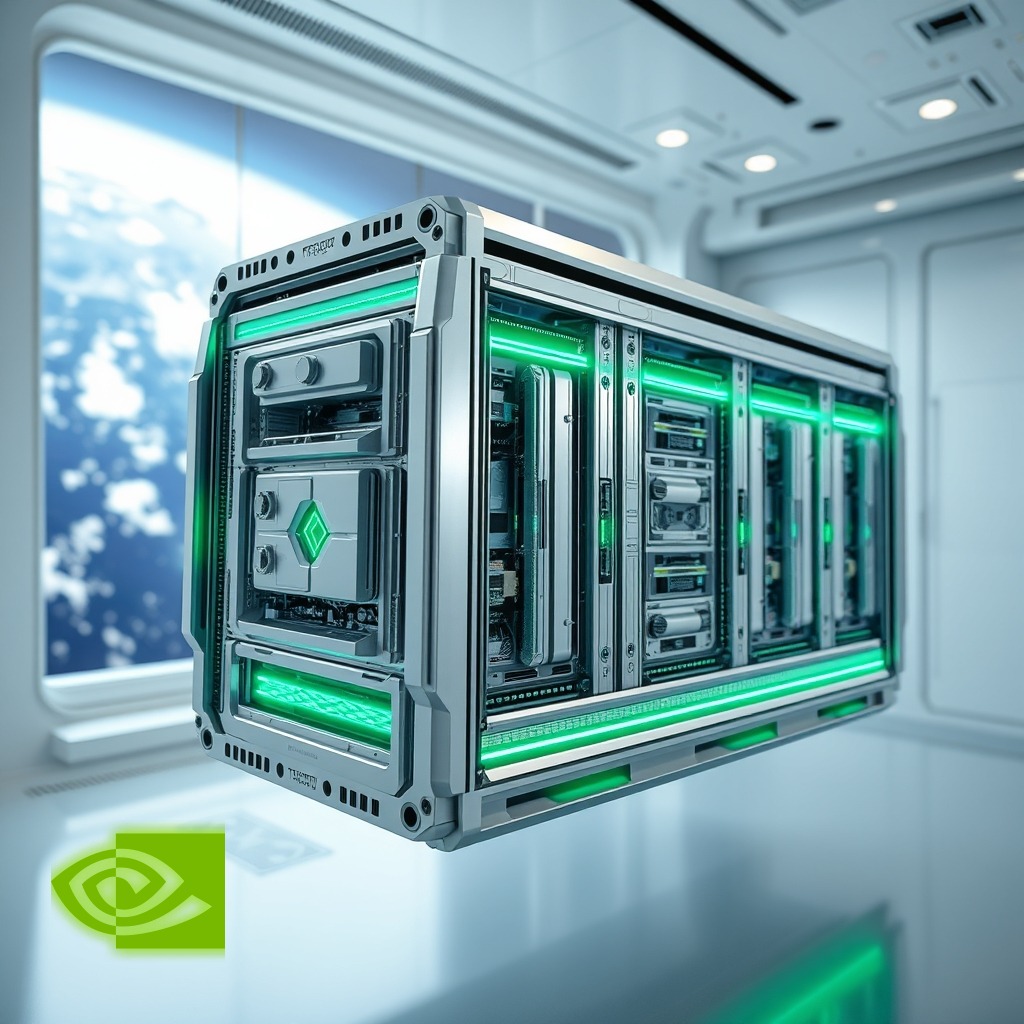 AI-generated
1. Context and Highlights
The convergence between artificial intelligence infrastructure and aerospace exploration has given rise to one of the most complex and high-risk financial transactions in recent technological history. A consortium of lenders has backed a $43 billion deal aimed at the massive acquisition of graphics processing units manufactured by Nvidia to fuel SpaceX's computational expansion ambitions. This monumental capital injection seeks to secure the critical supply of advanced silicon in a global market characterized by high demand and persistent bottlenecks in the semiconductor supply chain.
However, the initial euphoria of the financial markets has been overshadowed by an unprecedented legal and technical dilemma: the nature of the collateral. Given the possibility that part of this costly hardware infrastructure may be integrated into payloads destined for outer space, creditors have raised serious concerns about the feasibility of claiming or seizing those assets in the event of a credit default by Elon Musk. An orbital server or computing cluster is located outside traditional terrestrial jurisdictions, posing an alarming regulatory vacuum in the field of international financial guarantees.
This scenario forces both investment banks and private equity funds to rethink traditional risk metrics. It is no longer merely a matter of evaluating the book depreciation of a server in a terrestrial data center under local jurisdiction, but rather of calculating the obsolescence and physical inaccessibility of critical hardware operating in low Earth orbit or on long-range missions. The outcome of this controversy will set a decisive jurisprudential and financial precedent for the next decade of cross-investments between the space sector and supercomputing.
2. Key Technical Aspects
To understand the magnitude of the transaction, it is imperative to analyze the hardware architecture involved and the operational demands of modern payloads. Nvidia's graphics processors dominate with absolute hegemony the training and inference ecosystem of large language models and complex physical simulations. SpaceX, traditionally recognized for its prowess in rocket engineering and the Starlink constellation, requires unprecedented computing power to process the terabytes of telemetry collected in real time, optimize the aerodynamics of reusable boosters using computational fluid dynamics, and manage autonomous orbital navigation networks.
The integration of next-generation graphics processing units in space environments introduces major engineering challenges that partially justify the lenders' nervousness. Unlike a conventional data center equipped with advanced liquid cooling systems, networked electrical redundancy, and strict temperature and humidity control, the space environment subjects silicon to severe cosmic radiation, extreme thermal variations, and microgravity. These factors accelerate the physical degradation of transistors and multiply the rate of single-bit errors induced by energetic particles, requiring highly specialized error-correction architectures and considerable energy expenditure.
From a supply chain perspective, a volume of 43 billion dollars represents a substantial fraction of the annual production of high-end semiconductors. Lenders are not just financing silicon, but the most contested asset in the global tech ecosystem. The concern lies in the duality of the destination of these components. If a significant proportion of these cards are installed on the ground within server farms dedicated to xAI or associated projects, the collateral remains under the control of creditors through conventional chattel mortgage enforcement mechanisms. However, if the hardware is launched into space aboard Starship rockets, its physical recoverability becomes practically nil. The network infrastructure needed to interconnect distributed GPU clusters in orbit also differs substantially from terrestrial fiber optics. Latency and bandwidth between satellites via laser links require local processing to be highly autonomous. This means that the value of the hardware lies not only in pure silicon, but in the proprietary software, the weights of the models loaded into high-speed memory, and the optimization of the compilers executed on board, intangible elements that escape traditional banking valuations. Financial engineers face the challenge of auditing an asset that can literally leave Earth's atmosphere. The traceability of chip serial numbers, remote monitoring of the health status of the wafers, and the implementation of firmware locks by the manufacturer in the event of default are emerging as the only technical defenses to mitigate the risk of total loss of the collateral, transforming financial control into a matter of industrial cybersecurity and remote device management.
3. Industry Repercussions
The announcement of this monumental credit line drastically alters the competitive dynamics between tech giants and financial service providers. On one hand, it solidifies Nvidia's position as the undisputed economic arbiter of AI infrastructure and advanced computing. On the other hand, it exposes the growing dependence of Elon Musk's conglomerates on leveraged debt to finance technological ambitions on an interplanetary scale. The magnitude of the transaction demonstrates that capital markets are willing to take on colossal risks to avoid missing out on the foundational infrastructure of the next technological era.
| Risk Dimension | Traditional Terrestrial Environment | Space Deployment Scenario |
|---|---|---|
| Legal Jurisdiction | Subject to local and national bankruptcy laws | International regulatory vacuum regarding orbital assets |
| Physical Recoverability | Immediate via judicial seizure and eviction | Impossible without multimillion-dollar space rescue missions |
| Depreciation and Wear | Controlled by 3- to 5-year obsolescence cycles | Accelerated by cosmic radiation and severe thermal stress |
| Asset Auditing | Direct physical inspection and local ledger reading | Remote telemetry subject to satellite communication blackouts |
For investment banking, this agreement establishes a new risk-assessment paradigm. Historically, asset-backed loans have relied on tangible real estate or industrial machinery that is easily relocatable on the secondary market. The introduction of cutting-edge computer hardware that can be conceptually dematerialized or launched off the planet forces risk committees to rewrite collateral agreements. Restrictive covenants must include explicit prohibitions on using certain batches of chips in space missions without the prior written authorization of the syndicated creditors.
Likewise, the secondary semiconductor market is experiencing upward pressure and a silent restructuring. If banks decide to demand that 100% of the collateral remain in auditable terrestrial data centers, SpaceX and its subsidiaries will be forced to strictly segregate their hardware supply chains, isolating space computing from terrestrial commercial computing. This segregation will increase operating costs and slow down the synergy between SpaceX's launch capabilities and the real-time data processing needs of its vehicles and constellations.
The reaction from competitors in the aerospace and artificial intelligence sectors has been swift. Companies that compete directly in the development of advanced satellite constellations and supercomputing are watching cautiously as capital availability is disproportionately concentrated around Musk's projects. The ability to mobilize $43 billion for Nvidia hardware demonstrates a competitive advantage in capital access that threatens to widen the technological gap against emerging competitors that rely on traditional and much more restrictive funding rounds.
4. Market Perspectives
The consensus among technology-focused financial analysts and international commercial law experts indicates that this agreement marks a turning point. It is repeatedly noted that financial engineering has far outpaced established legal frameworks for the ownership of movable property in maritime and space law. When a physical asset crosses the Kármán line, foreclosure and asset seizure laws lose their practical effectiveness, turning the creditor into a powerless spectator if the borrower defaults.
Legal experts consulted in specialized forums warn that loan agreements will include early termination clauses based on the geographic location of IP addresses and the mapping of hardware serial numbers. If monitoring systems detect that the financed silicon is being integrated into launchers with orbital trajectories, creditors could declare an immediate technical default, demanding the interim repayment of principal before the servers leave the Earth's surface. This technical safeguard becomes the only real line of defense to protect invested capital.
From a strategic management perspective, analysts suggest that the transaction reflects extreme confidence in the future profitability of AI-based space services and high-speed global connectivity. However, warnings are also raised regarding the systemic dangers of debt concentration backed by volatile assets. If the AI market experiences a valuation correction or if the demand for advanced space services fails to generate the projected cash flow to service the debt, the resulting financial collapse could drag down multiple financial institutions exposed to the lending consortium. Recommendations for Chief Technology Officers and corporate risk committees are clear: establish strict taxonomies for the depreciation and tracking of high-tech assets. The boundary between software, terrestrial silicon, and space infrastructure is no longer diffuse, but rather a critical vector of financial risk that requires automated audits via smart contracts and cryptographically verifiable hardware telemetry to prevent asset diversion fraud.
5. Future Outlook
The evolution of this financial and technological landscape over the coming years will be marked by inescapable regulatory and operational milestones. In the short term, the banking syndicate is expected to finalize the implementation of real-time remote tracking systems for all graphics processors financed under the $43 billion agreement, establishing an immutable registry that clearly differentiates terrestrial hardware from that destined for space.
In the medium term, between 2027 and 2028, international regulatory pressure will drive the creation of new agreements on collateral rights in outer space. Given that satellite constellations and orbital computing will cease to be experimental projects and become the backbone of the global digital economy, international courts and multilateral bodies will need to draft regulatory frameworks that allow for the seizure of assets in orbit through the remote revocation of software licenses or the transfer of orbital exploitation rights.
In the long term, toward the end of the decade, the natural trend will be the manufacturing and deployment of silicon specifically hardened and optimized for space environments, moving away from Nvidia's terrestrial commercial architectures. This will reduce dependence on general-purpose hardware in orbit and transform the nature of financial collateral, definitively separating the infrastructure risks of terrestrial data centers from the risks associated with interplanetary exploration and computing.
6. Summary & Assessment
SpaceX's $43 billion deal to acquire Nvidia GPUs goes far beyond a simple commercial technology procurement transaction. It represents the frontal collision between the speed of innovation in artificial intelligence and space exploration, and the structural sluggishness of traditional legal and financial frameworks. The real possibility that physical collateral could end up orbiting out of creditors' reach forces a deep review of risk management policies in corporate banking.
For executives, investors, and systems architects, the lessons are clear. First, technology asset governance must be comprehensive, combining traditional financial auditing with cryptographic verification and remote firmware control. Second, expansion into space infrastructure requires designing new legal tools that protect capital in environments where terrestrial sovereignty has no effective jurisdiction. Ignoring these operational realities exposes organizations to catastrophic losses in a market where the most valuable hardware on the planet can, literally, take off and be lost in space.