Español
 English
 Français
 Português
 Deutsch
 Italiano
Meta AI: The Privacy Revolution with Zuckerberg's Incognito Chat
 AI-generated
1. Mark Zuckerberg Announces 'Completely Private' Encrypted Meta AI Chat
In a momentous turn that could redefine the landscape of artificial intelligence and digital privacy, Mark Zuckerberg, CEO of Meta, has unveiled the launch of 'Incognito Chat' for its Meta AI platform. This announcement, coming at a time of increasing scrutiny over data management by big tech companies, promises a truly private AI conversation experience, a bold claim that warrants detailed analysis.
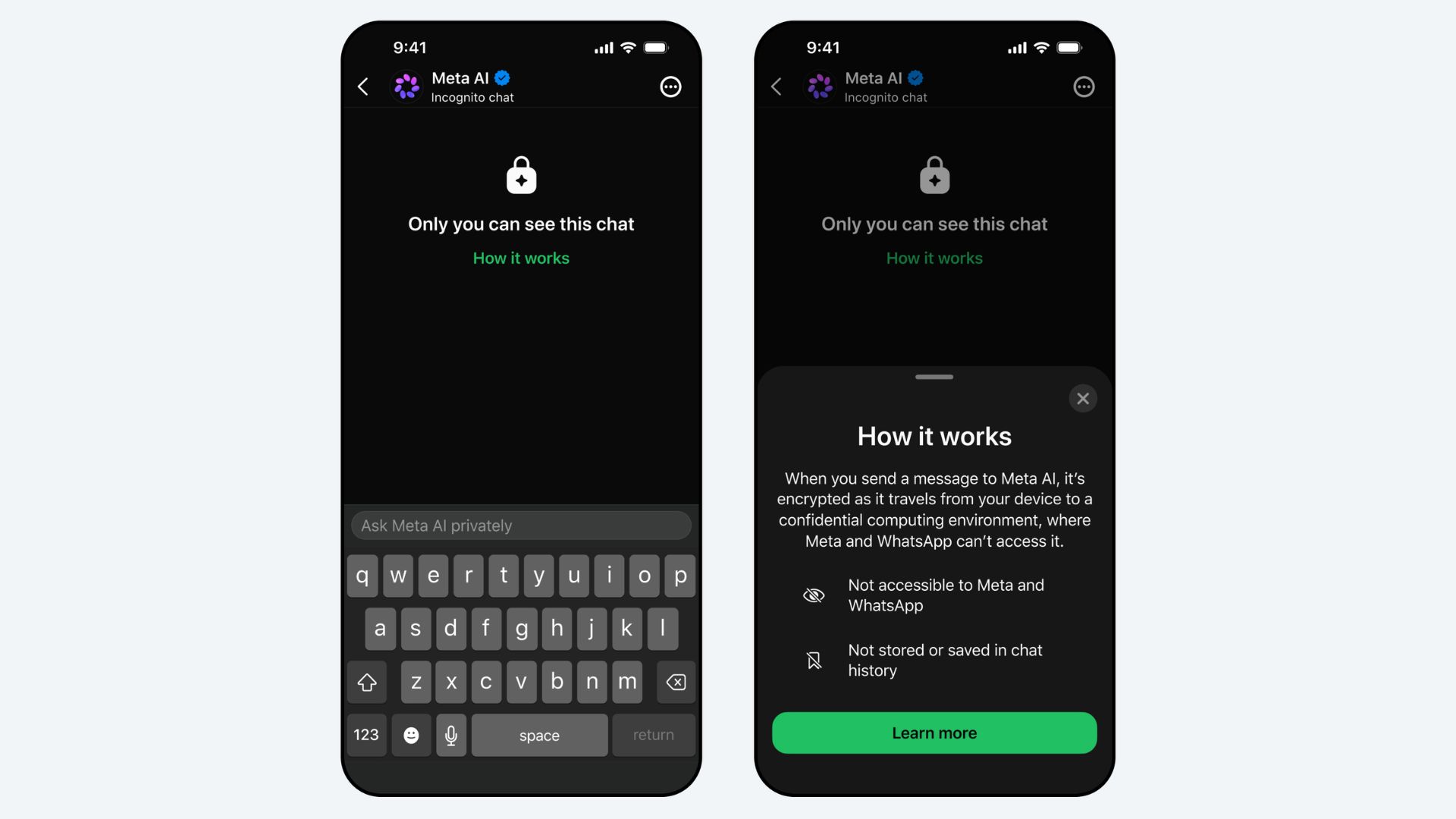
Zuckerberg has called Incognito Chat "the first major AI product where there is no record of your conversations stored on servers." This statement is a watershed moment, as it directly addresses one of the biggest user concerns in the AI era: the persistence and accessibility of their interactions with generative models. In essence, messages sent via Incognito Chat are not saved or stored in users' chat history, emulating the functionality of incognito modes we already know in browsers and other chatbot applications.
2. Meta's Fundamental Distinction: End-to-End Encryption
While the idea of an incognito mode for chatbots is not entirely new, Meta claims its implementation is radically different and superior. The key to this distinction lies in the incorporation of end-to-end encryption (E2EE), a security feature that Meta has inconsistently implemented across its other platforms, even removing it from Instagram direct messages recently. This contrast is notable and underscores the seriousness of Meta's commitment to privacy in its AI offering.
"Other apps have introduced incognito-style modes, but they can still see the questions coming in and the answers going out," Zuckerberg explained. "Incognito Chat with Meta AI is truly private, meaning no one, not even Meta, can read your conversations." This unprecedented promise of 'total privacy' sets a new benchmark for AI interaction and positions Meta as a pioneer in this critical aspect.
3. The Privacy Imperative in the AI Era
The demand for privacy in interactions with artificial intelligence has skyrocketed. As AI models, such as OpenAI's GPT-5.5, OpenAI's Claude 4.7 Opus, and Google's Gemini 3.1, become increasingly sophisticated and ubiquitous, users are becoming more aware of the amount of data they share and how this data could be used. Concerns about the security of personal information, the potential monetization of conversation data, and the prevention of sensitive information leaks have driven the need for robust solutions like Incognito Chat.
The implementation of end-to-end encryption in Meta AI means that conversations between the user and the AI model are protected from the moment they are sent until they are received, in such a way that only the sender and the intended recipient (in this case, the AI model on the user's device or a secure, ephemeral environment) can read them. Not even Meta, the service provider, has the technical capability to intercept or decrypt these messages. This architecture is fundamental to the promise of authentic privacy.
4. Competition and Comparison in the AI Landscape
In the competitive AI ecosystem, privacy has become a key differentiator. Industry leaders have addressed this challenge with diverse strategies:
-
OpenAI with GPT-5.5: OpenAI has continuously improved its privacy policies, offering options for users to disable the use of their data for model training and providing 'temporary chat' modes that do not retain history. However, Meta's distinction lies in E2EE, which goes a step further by preventing any access by the provider.
-
Anthropic with Claude 4.7 Opus: Anthropic, known for its focus on AI safety and ethics, has implemented rigorous data governance policies and offers enterprise environments with strict confidentiality agreements. Nevertheless, Meta's promise of such robust user-level encryption in a mass-market consumer product is a significant novelty.
-
Google with Gemini 3.1: Google has also introduced privacy controls for its Gemini 3.1 users, allowing activity deletion and offering modes that limit data retention. While Google emphasizes the security of its systems, Meta's claim that "not even Meta can read your conversations" sets a privacy standard that many other providers have not yet achieved or publicized in the same way.
Meta's move, therefore, is not just an incremental improvement, but an attempt to change the rules of the game, setting a new benchmark for what users can expect in terms of AI privacy. This move could pressure other tech giants to reconsider and strengthen their own privacy offerings to remain competitive.
5. Implications for Users and the Industry
For users, Meta AI's Incognito Chat represents a significant advance. Those concerned about sharing personal information, creative ideas, or sensitive queries with an AI now have an option that promises unparalleled confidentiality. This could encourage greater experimentation and adoption of Meta AI for tasks previously considered too delicate to entrust to a chatbot.
From an industry perspective, Meta's decision to prioritize end-to-end encryption in its AI product is bold. It could be a catalyst for a privacy arms race among AI developers, where data security and confidentiality become key differentiators in an increasingly saturated market. It could also force regulators to take a closer look at AI privacy practices and establish new standards.
6. A Strategic Move by Meta
This announcement is not just a technical feature; it's a strategic move by Meta. After years of criticism and fines related to data privacy on its social platforms, Zuckerberg and his team are looking to rebuild user trust, especially in the nascent but critical field of artificial intelligence. By positioning Meta AI as the most private option, the company seeks to differentiate itself and attract a privacy-conscious user base.
The initiative also comes at a time when Meta is investing heavily in AI, seeking to integrate it across all its products, from virtual reality to social networks. Offering a "completely private" AI foundation could be the pillar upon which to build future innovations, assuring users that their interactions with Meta's technologies are secure and confidential. It is a clear step towards a future where privacy is no longer an optional feature, but a fundamental expectation.
7. Conclusion
The launch of Incognito Chat for Meta AI with end-to-end encryption is a significant milestone in the evolution of artificial intelligence. Mark Zuckerberg's promise that "no one, not even Meta, can read your conversations" sets a new and ambitious standard for privacy in conversational AI. As AI becomes more deeply intertwined with our lives, the ability to interact with it in a truly confidential manner becomes indispensable. Meta has thrown down the gauntlet, and it will be fascinating to observe how the industry responds to this privacy challenge and how users embrace this new era of interaction with artificial intelligence.