Español
 English
 Français
 Português
 Deutsch
 Italiano
OpenAI Unveils Hardware for Codex: The Button-Based Interface Redefining AI Programming
 AI-generated
1. Executive Summary
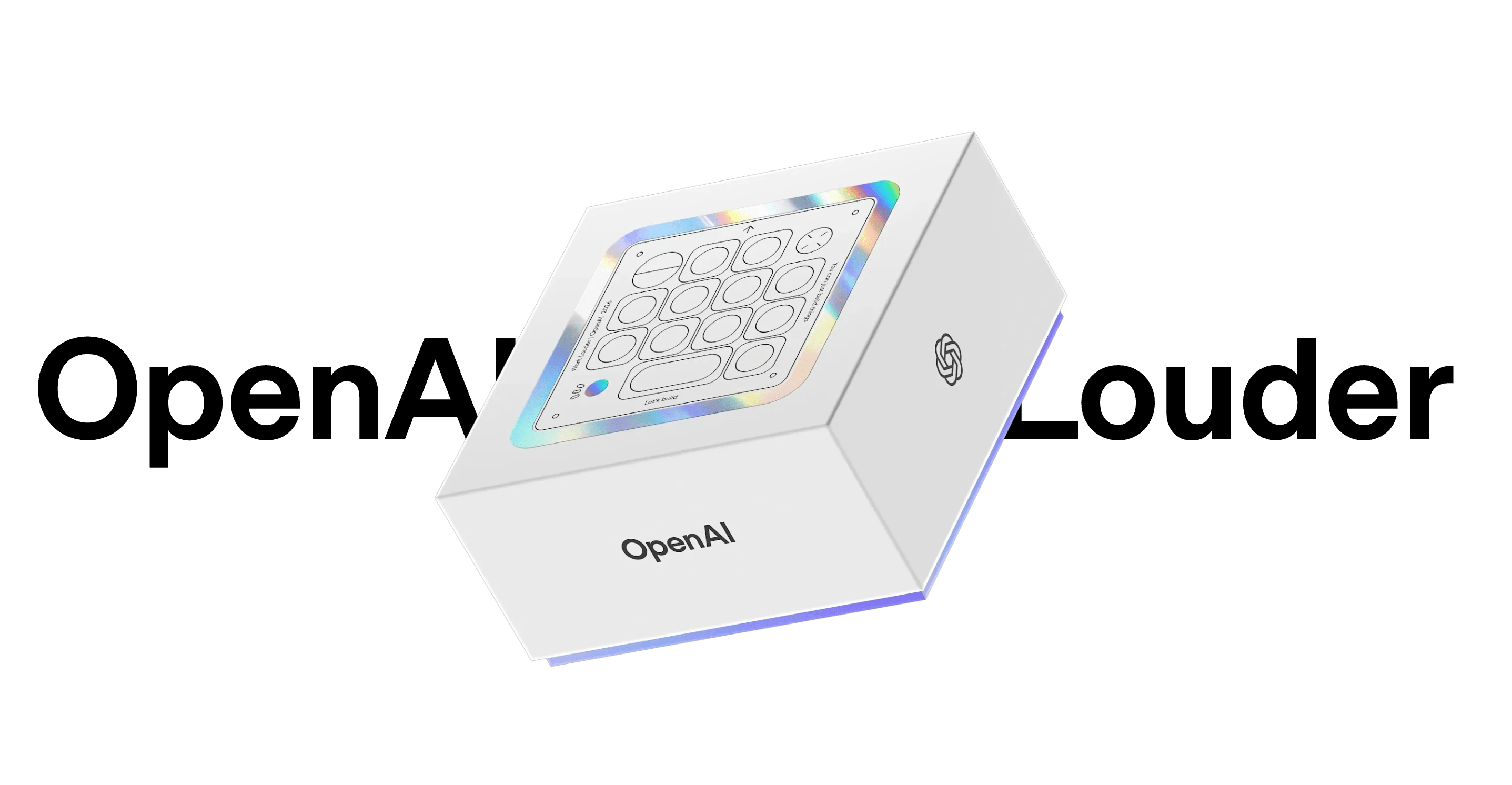
On July 16, 2026, OpenAI broke its silence on hardware, but not with the consumer device many expected. In a move that surprised analysts and developers alike, the company unveiled the Codex Micro: a square of physical buttons designed exclusively to interact with its coding platform, Codex. It is not the Jony Ive AI device, embroiled in litigation, but a tactile, minimalist tool that aims directly at the core of programmer productivity.
This launch is significant for several reasons. First, it marks OpenAI's first tangible foray into hardware, a territory dominated by giants like Apple and Google, but from an ultra-specialized angle. Second, it redefines the user interface for AI-assisted coding, moving away from the touchscreen and traditional keyboard towards a single-purpose haptic device. Third, it sends a clear signal to the market: AI is not only consumed through screens, but can be integrated into physical objects that optimize specific workflows.
For developers, CTOs, and software architects, the Codex Micro is not a gadget; it is a statement of intent about the future of interaction with large language models (LLMs). For the tech industry, it is a high-stakes experiment that could validate or refute the thesis that specialized AI hardware is a viable market. This article dissects every layer of the announcement, from the device's engineering to its geopolitical implications in the LLM war.
2. Deep Technical Analysis
The Codex Micro is, in essence, a square block approximately 10 cm on each side, with a matrix of backlit mechanical buttons. Its design evokes Elgato's Stream Decks, but with a fundamental difference: it is not a generic macro keyboard. It is a physical coprocessor for GPT-5.6, the model that powers Codex. Each button is wired to a specific function within the integrated development environment (IDE) that supports Codex, such as VS Code, JetBrains, or OpenAI's own web editor.
The key innovation lies in haptic and contextual feedback. The buttons are not static; their function changes dynamically according to the code context. For example, when debugging, a button might display "Suggest Fix," while when writing a function, the same button illuminates for "Complete Block." This real-time reconfiguration is possible thanks to a low-latency connection with the Codex API, which sends metadata about the current state of the code buffer. The device uses a proprietary protocol over USB-C or Bluetooth 6.0, with a declared latency of less than 5 milliseconds from button press to model response.
From the model's perspective, the Codex Micro does not execute inference locally. It is an intelligent terminal that sends signals to OpenAI's servers, where GPT-5.6 (in its Terra variant, optimized for reasoning speed) processes the request. However, the device includes a security chip (similar to a Secure Enclave) to handle authentication and end-to-end encryption of keystrokes, preventing a keylogger from intercepting code instructions. This is crucial for companies handling sensitive intellectual property.
The accompanying software, called Codex Micro Orchestrator, allows developers to customize the behavior of each button. "Profiles" can be created for different languages (Python, Rust, TypeScript) or frameworks (React, PyTorch, Spring). Customization does not require scripting; it is done through a drag-and-drop interface that assigns predefined actions from the Codex ecosystem, such as "Refactor," "Generate Tests," "Explain Code," or "Search Documentation."
A relevant technical detail is the integration with the long context of current models. Given that GPT-5.6 handles contexts of up to 2 million tokens, the Codex Micro can maintain a persistent work session. A button labeled "Context" allows the developer to "pin" files or code snippets in the model's memory, ensuring that future suggestions take into account the entire project, not just the current file. This eliminates one of the biggest bottlenecks of AI-assisted coding: loss of context when switching files.
Finally, the device includes a small monochrome OLED panel that displays the name of the current action or a model "thinking" indicator. It is not a touchscreen; it is purely informational. OpenAI has opted for a brutalist design philosophy: zero distractions, maximum tactile functionality. The absence of a touchscreen is a deliberate decision to encourage interaction without looking, allowing the programmer to keep their eyes on the code while their fingers execute complex commands.
3. Industry Impact and Market Implications
The launch of the Codex Micro shakes up the board on several fronts. To begin, it directly challenges GitHub Copilot and other code autocompletion tools. While Copilot (powered by GPT-5.6) has focused on passive integration within the IDE, OpenAI is betting on active and physical interaction. This could segment the market: developers who prefer automatic suggestions will stick with Copilot; those seeking granular control and rapid execution of complex commands will migrate to the Codex Micro.
The impact on the peripheral hardware ecosystem is immediate. Companies like Elgato, Logitech, and Razer, which dominate the market for macro keyboards and streaming devices, will be watching closely. If the Codex Micro succeeds, a new category of "AI peripherals" will open up. It won't just be for coding; similar devices could emerge for graphic design (with models like GPT-Image-2 or Midjourney), video editing, or data analysis. The question is whether OpenAI will patent this concept of "contextual AI buttons" or if it will become an open standard.
From a business perspective, the Codex Micro is an ecosystem lock-in play. By selling a physical device, OpenAI creates a tangible link with the developer. Switching to a competitor (such as Anthropic's Claude Opus 4.8 or Google's Gemini 3.5) would not only involve migrating code but also rendering obsolete hardware that will likely cost between $199 and $299. This increases the switching cost and fosters loyalty among Codex platform users.
However, the move is not without risks. The hardware market is notoriously low-margin and high-inventory risk. OpenAI now competes with Apple's manufacturing logistics and Amazon's distribution scale. An error in demand estimation could result in surpluses or shortages, damaging the company's reputation. Furthermore, the reliance on a constant internet connection (the device does not work offline) limits its appeal for developers working in isolated environments or with low connectivity.
For competitors, the reaction will be swift. Anthropic, with its Claude Opus 4.8, could announce an alliance with hardware manufacturers to create a "Claude Key." Google, with its hardware expertise (Pixel, Nest), could integrate Gemini 3.5 directly into its Chromebooks or a similar device. Meta, with its open-weight Llama 4, could opt for a different strategy: publish specifications for any manufacturer to create an open-source "Llama Pad," avoiding OpenAI's centralized control.
4. Expert Perspectives and Strategic Analysis
The technical consensus among industry analysts is that the Codex Micro solves a real but niche problem. Most developers do not need a physical device to interact with Codex; the keyboard and mouse are sufficient. However, for power users who perform hundreds of AI operations per hour (massive refactorings, test generation, code review), the reduction in cognitive friction is significant. Pressing a physical button is faster and less error-prone than navigating context menus or remembering complex keyboard shortcuts.
One strategic aspect that should not be underestimated is interaction data collection. Each press on the Codex Micro is valuable data for OpenAI. Knowing which buttons are pressed most, in what order, and in what context allows the company to refine not only the hardware but also the underlying models. For example, if the "Explain Code" button is used massively on files over 500 lines, OpenAI can optimize GPT-5.6 for long code summaries. This feedback loop is a competitive advantage that competitors without hardware do not have.
From a security perspective, the device introduces a new attack vector. If a malicious actor manages to compromise the Codex Micro firmware, they could inject malicious commands into the developer's workflow. OpenAI claims that the security chip and cryptographically signed updates mitigate this risk, but the history of IoT devices shows that vulnerabilities always exist. Companies adopting the Codex Micro will need to include this peripheral in their device security policies.
The decision not to include a touchscreen is, according to interaction designers consulted, a masterstroke. The touchscreen encourages visual interaction, which competes with code attention. Physical buttons, with their haptic feedback, allow for blind interaction. This aligns the device with the philosophy of mechanical keyboards for programmers: the tool disappears, leaving only intention and action.
Finally, price will be the determining factor. If OpenAI manages to keep the cost below $200, the device could find a market in tech startups and agile engineering teams. If it exceeds $300, it will become a luxury item for enthusiasts, similar to high-end custom keyboards. The recommendation for CTOs is clear: acquire one unit for the innovation team, evaluate its impact on productivity for a quarter, and only then consider a mass deployment.
5. Future Roadmap and Predictions
The launch of the Codex Micro is just the first step. Based on OpenAI's patents and executive statements, we can outline a likely roadmap for the next 18 months.
Q4 2026: Codex Micro Pro. A version with more buttons (possibly 24 or 36), a larger OLED screen to display code snippets, and wireless mesh connectivity so multiple developers on a team can sync their devices. This version will target enterprise teams and cost around $399.
Q1 2027: Integration with multimodal models. OpenAI will update the firmware so that the Codex Micro not only interacts with code but also with vision models like GPT-Image-2. A button could trigger the generation of architecture diagrams from text descriptions, or the conversion of user interface sketches into React code. This will expand the device's market beyond programmers.
Q2 2027: Protocol opening. Under pressure from the community and competition from open-source hardware, OpenAI could publish the Codex Micro communication protocol, allowing external developers to create their own buttons or integrate the device with other LLMs (such as Llama 4 or DeepSeek-V4-Pro). This would be a bold move to establish the industry standard.
Q3 2027: The Jony Ive device. By then, the litigation with Ive may have been resolved or cooled down. OpenAI will launch its general consumer device, likely a desktop assistant with a screen and camera, integrating lessons learned from the Codex Micro. This device will be the true competitor to Amazon's Echo Show and Google's Nest Hub, but with a much deeper AI layer.
On the competitive front, we expect Anthropic to launch a "Claude Knob" (a physical dial) to control response temperature and tone, and for Google to integrate Gemini directly into a wireless keyboard with shortcut buttons. The AI hardware war is just beginning.
6. Conclusion: Strategic Imperatives
The Codex Micro is more than a peripheral; it is a controlled experiment on the future of human-AI interaction. OpenAI has understood that the next frontier is not just improving models, but reducing friction between human intention and machine execution. By creating a dedicated physical object for a complex cognitive task, the company is testing a radical thesis: that hardware can be as important as software in the era of LLMs.
For technology leaders, the recommendation is twofold. First, experiment with the Codex Micro in controlled environments. It is not about replacing developers, but about empowering the best ones. A team of 5 engineers with Codex Micro could have the productivity of 8 or 10 without it. Second, closely monitor competitor movements. If AI hardware becomes a standard, companies that have not invested in this interaction layer will fall behind in efficiency.
Ultimately, the Codex Micro reminds us that AI is not just software running in the cloud; it is a tool that should be felt in the hands. OpenAI has taken the first step toward a world where everyday objects become intelligent. The success or failure of this small block of buttons will define whether that future is tactile, haptic, and deeply human, or whether we remain tethered to 20th-century screens and keyboards.