
 Español
 English
 Français
 Português
 Deutsch
 Italiano
Practicing with Precision: At CoRL, NVIDIA and Partners Reveal How Robots Rehearse Delicate Tasks in Simulation
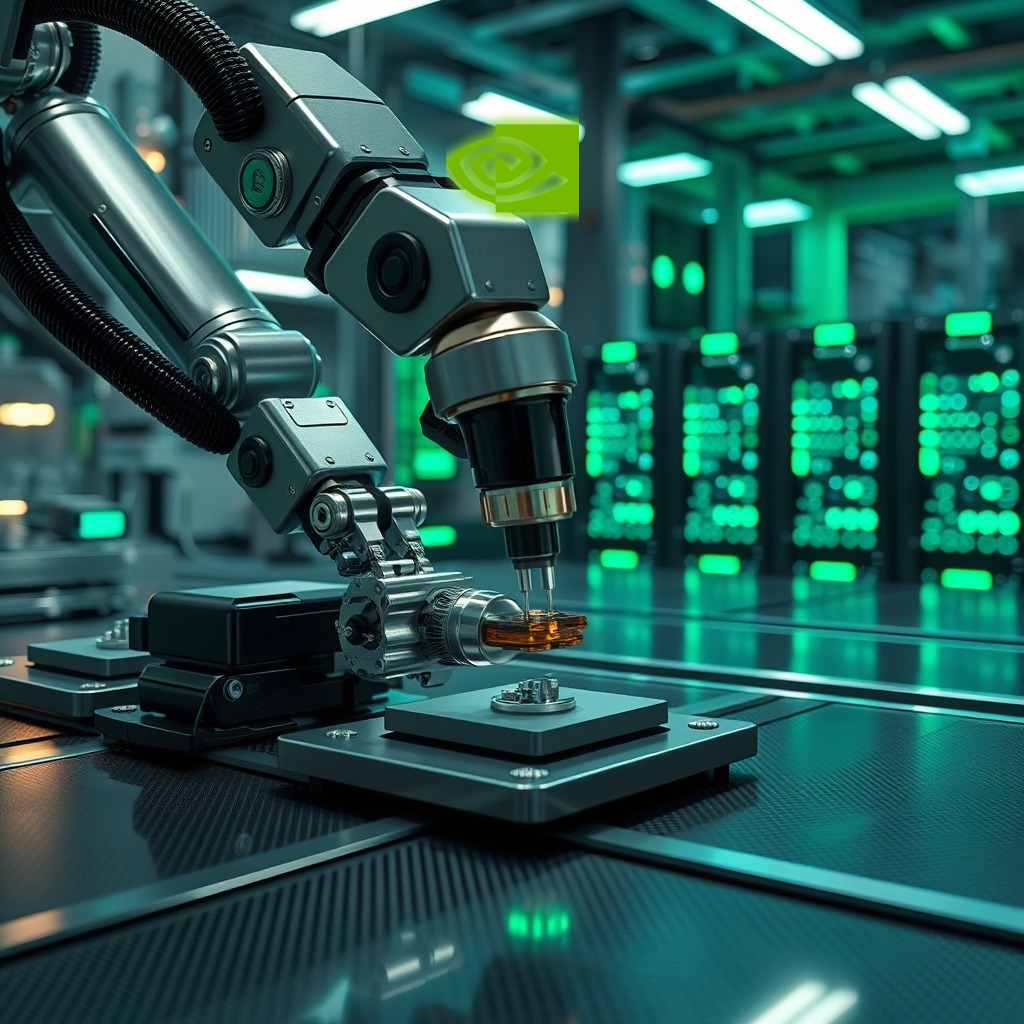 AI-generated
1. Context and Highlights
During the latest edition of the Conference on Robot Learning (CoRL), the tech ecosystem witnessed a significant turning point in applied robotics. While digital simulation has historically been the preferred testing ground for teaching robots to walk, roll, or maintain balance, the current frontier has shifted toward high-precision manipulation. This advancement encompasses the execution of complex mechanical tasks that require fine touch and dexterity, such as millimeter-level gear alignment, connector insertion, and the assembly of tiny electronic components.
The convergence of cloud computing power, advanced graphics engines with real-time ray tracing, and reinforcement learning algorithms has helped bridge the reality gap. NVIDIA, in collaboration with various academic and industrial partners, is spearheading this shift by providing the infrastructure necessary for robotic agents to rehearse millions of iterations in virtual environments before touching a single physical component. This evolution not only reduces development costs and prototype wear and tear, but also drastically accelerates the deployment of intelligent automation in advanced manufacturing.
For Chief Technology Officers, systems engineers, and operations managers across industrial sectors, this technological leap redefines the economic viability of flexible robotics. Global supply chains and highly complex assembly lines no longer depend exclusively on costly physical adaptations for each new product, but rather on the ability to program and validate complex behaviors in synthetic universes. The transition from macroscopic locomotion to micro-manipulation marks the beginning of a new era where artificial dexterity matches the standards of human dexterity.
2. Key Technical Aspects
The technological core behind these breakthroughs lies in overcoming the so-called reality gap, a classic obstacle in robotics that for decades has limited the usefulness of models trained in virtual environments. When a robot attempts to transfer a control policy learned in a simulator to the physical world, discrepancies in friction, material elasticity, mechanical tolerances, and sensor latency often lead to catastrophic failures. To solve this problem, the current architecture employed at CoRL combines massive data synthesis with domain randomization at an unprecedented scale.
Modern systems use GPU-based simulation engines that leverage massive parallel computing to run thousands of virtual environments simultaneously. In these digital universes, reinforcement learning models not only learn a geometric trajectory, but also internalize physical uncertainty. By stochastically varying parameters such as mass properties, surface friction coefficients, and the dynamic responses of end-effectors, the robotic agent develops intrinsic robustness that allows it to tolerate real-world imperfections from the very first physical deployment.
A critical aspect of this methodology is the integration of workflows based on the synthesis of visual and tactile data. Fine manipulation tasks, such as plugging in a flexible cable or meshing metal parts with tolerances of less than a millimeter, require dense sensory feedback. Researchers have demonstrated that it is possible to simulate the deformation of elastic materials and the response of force-torque sensors with sufficient fidelity so that policies trained remotely can execute the correct action without requiring prolonged physical retraining on the shop floor. From a hardware perspective, this level of simulation demands computing clusters capable of processing differentiable physics simulations. The ability to compute gradients through physical simulation allows optimization algorithms to adjust control parameters much more efficiently than through traditional brute-force reinforcement learning trial and error. State-of-the-art graphics processing units thus act as the virtual central nervous system where the robot experiences the equivalent of years of manual practice in a matter of hours. Furthermore, the software architecture relies on modular frameworks that separate visual perception from motor actuation. By using computer vision models to estimate the precise pose of manipulated objects, robots compensate for minor visual deviations in real time. The combination of robust latent representations and hyper-realistic simulation enables tasks that previously required rigid and costly manual programming to now be solved through emergent behaviors learned in the digital domain. The scalability of this approach also benefits from standardization in robot description formats and interoperability between different simulation platforms and execution environments. By unifying communication protocols between simulators and the control software embedded in robotic arms, developers can iterate on manipulation policies with an agility comparable to traditional software development, eliminating the physical constraints that held back hardware innovation.
3. Industry Repercussions
The impact of these innovations transcends the academic realm and directly alters the economics of entire industrial sectors, especially consumer electronics, automotive, and medical device manufacturing. Traditionally, automating delicate assembly tasks required highly specialized, rigid, and costly mechanical tooling, custom-designed for a single operation and a specific product. Any modification to the component design meant redesigning and reconfiguring the entire production line.
With the advent of advanced robotic manipulation tested in simulation, the paradigm shifts toward universal flexibility. The same robotic arm, guided by artificial intelligence models trained in virtual environments, can switch assembly tasks through a software update. This versatility drastically reduces factory downtime and amortizes the investment in robotic infrastructure across a much wider range of products and assembly lines.
In terms of operating costs, the ability to validate the feasibility of an assembly process before purchasing the first physical component transforms engineering project management. Companies can simulate complete production lines, identify kinematic bottlenecks, and optimize the spatial layout of manipulators without incurring the expenses associated with building physical prototypes. This democratizes access to advanced automation for medium-sized companies that previously could not assume the financial risk of integrating complex robotic systems.
| Dimension | Traditional Approach (Manual Programming) | Current Approach (Simulation and Learning) |
|---|---|---|
| Adaptability to design changes | Low (requires mechanical redesign and new tooling) | High (software policy updates) |
| Commissioning time | Months of physical calibration and on-line testing | Days or weeks of synthetic validation |
| Physical prototyping costs | High (wear and destruction of components) | Minimal (execution in virtual environments) |
| Uncertainty tolerance | Rigid (requires highly controlled environments) | Robust (handling variations through randomization) |
At the market level, the offering of simulation-based solutions is consolidating as a key competitive differentiator for technology infrastructure providers. Companies that dominate the value chain from silicon to the simulation engine and edge deployment capture a disproportionate share of the value generated in the digital transformation of heavy and light industry. The ability to offer integrated development environments accelerates the adoption of intelligent robotics and sets a new standard for operational efficiency.
4. Market Perspectives
The technical community agrees that the true breakthrough demonstrated at CoRL does not lie solely in the improvement of reinforcement learning algorithms, but in the maturity achieved by synthetic data engineering tools. The ability to generate millions of manipulation scenarios in parallel makes it possible to cover statistical edge cases that would rarely occur during conventional physical testing, endowing robots with exceptional resilience against unforeseen events.
From a strategic standpoint, market analysts point out that organizations seeking to lead industrial automation must rethink their data strategies. It is no longer enough to collect operational logs from existing machines; it is necessary to invest in the creation of high-fidelity digital twins that accurately reflect not only the geometry, but also the physics and dynamics of assembly processes. The quality of the simulation model thus becomes the company's most valuable intellectual asset.
Likewise, engineering directors are recommended to adopt an iterative approach where simulation and physical execution form a continuous improvement loop. Although simulation reduces the need for initial physical testing, validation in real-world environments remains essential to fine-tune the noise and friction parameters of the virtual model. Companies that manage to seamlessly synchronize their simulation environments with their production plants will gain a competitive advantage that traditional competitors will find impossible to sustain.
5. Future Outlook
For the coming years, the evolution of robotic simulation will be marked by the convergence between large language models, vision models, and motion control systems. The ability to interpret natural language instructions and autonomously translate them into complex manipulation trajectories within a simulator prior to physical execution represents the next major milestone in applied research.
On the medium-term horizon, the standardization of open libraries of simulation environments specialized in micro-assembly and soft material manipulation is expected. This will reduce barriers to entry for academic research and allow small and medium-sized enterprises to access pre-trained models of robotic dexterity in the same way advanced language models are used today.
Finally, the integration of edge inference with low-power hardware accelerators will enable robots to execute complex, adaptive manipulation policies directly at the end effector, minimizing dependence on low-latency network connections and opening the door to true operational autonomy in decentralized industrial environments.
6. Conclusion: The Triumph of Simulation in Advanced Robotic Assembly
The demonstration presented at CoRL by NVIDIA and its partners marks the definitive convergence between simulation and physical execution in manipulation robotics. Teaching robots to rehearse delicate tasks in virtual worlds eliminates the economic and technical barriers that historically hindered the automation of complex assembly processes, opening up unprecedented possibilities for advanced manufacturing.
Chief technology officers and engineering leaders must act decisively to integrate physics-based simulation into their product development cycles, leveraging the hardware and algorithmic advancements presented at this conference. Ignoring this transition means condemning production lines to unsustainable operational rigidity in the face of modern manufacturing challenges. Intensive simulation practice for fine manipulation stands today as the indispensable foundation upon which the new era of autonomous robotic assembly is built.