Español
 English
 Français
 Português
 Deutsch
 Italiano
Samsung Unveils Full-Body Controlled Humanoid Robot Prototype to Board of Directors, Targets CES
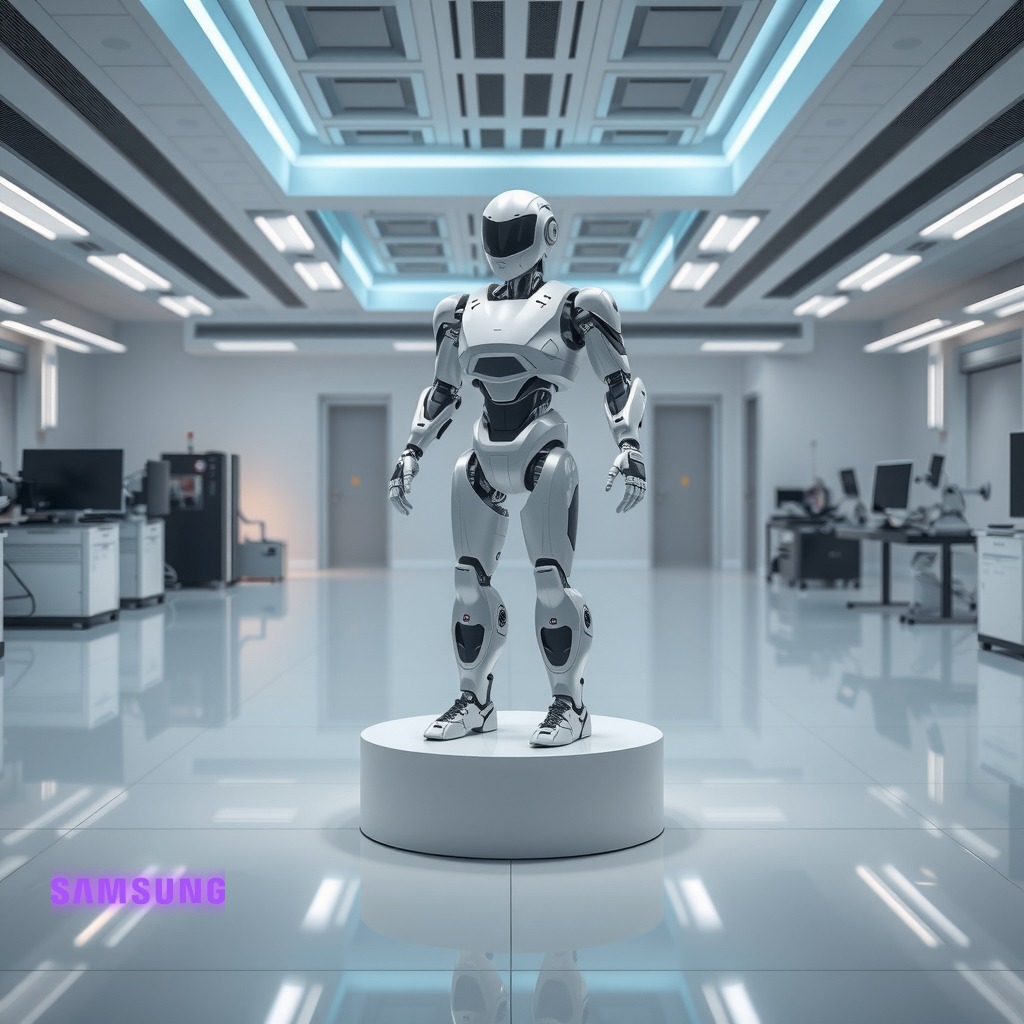 AI-generated
1. Context and Key Takeaways
Samsung Electronics has taken a decisive step in its advanced automation strategy by presenting a next-generation humanoid robot prototype to its board of directors. The internal demonstration stands out for a very specific technical focus: the implementation of full-body control algorithms designed to overcome the kinematic and dynamic limitations that have hindered the commercial deployment of similar systems in complex industrial environments.
This move places the South Korean technology giant squarely in the global race for humanoid robotics, a sector hitherto dominated by initiatives from specialized startups and experimental automotive divisions. The company's roadmap includes an official public presentation during the CES trade show in January, confirming that the project has moved past the internal conceptual phase and is heading toward validation in real manufacturing and logistics scenarios.
For industrial analysts and chief technology officers, Samsung's formal entry into this ecosystem redefines the competitive landscape. The company's vertical integration capability, ranging from advanced semiconductors and display panels to high-density battery systems and precision manufacturing, gives it a structural advantage in scaling the production of complex robotic hardware with optimized costs compared to smaller-scale competitors.
2. Key Technical Aspects
The core of the innovation presented by Samsung lies in its full-body control architecture, a classic challenge in advanced robotics that seeks to synchronously coordinate dozens of degrees of freedom without compromising the static and dynamic stability of the system. Unlike traditional robotic arms or androids with static locomotion limitations, the new prototype integrates force feedback sensors in every joint, allowing for real-time adaptation to unforeseen physical disturbances.
From a hardware design perspective, engineering these systems requires sophisticated solutions in thermal management and weight distribution. The rotary and linear actuators developed for this prototype leverage lightweight alloys and high-torque density brushless motors, optimized to reduce rotational inertia in the lower extremities. This enables more agile movements and more energy-efficient operation during prolonged walking phases, a critical parameter for ensuring viable operational autonomies during industrial shifts.
Local processing represents another fundamental technical pillar of the development. To handle inverse kinematics and trajectory planning in milliseconds, the robot integrates dedicated edge neural processing units. These units process massive data streams from depth sensors and tactile sensors distributed across the hands and the soles of the feet, executing reinforcement learning models previously trained in high-fidelity physical simulators.
The convergence between large language models and robotic control architectures also opens new avenues for programming complex tasks. While the hardware prioritizes precise motor execution, the underlying software infrastructure is designed to interpret natural language instructions, translating abstract commands into discrete motor action sequences through the mediation of advanced multimodal models.
Energy management and autonomy continue to be critical vectors for optimization. The use of high-capacity solid-state batteries helps minimize the volume of the energy compartment without sacrificing the energy density needed to sustain hours of continuous operation under heavy workloads. The consumption efficiency of the motor controllers and the reduction of thermal losses are the result of years of experience in designing miniaturized consumer electronics.
3. Industry Repercussions
Samsung's entry into the humanoid robotics market alters the competitive dynamics of industrial automation. Electronics assembly factories, which have traditionally relied on fixed-purpose automata and isolated work cells, are shaping up to be the first natural test beds for these systems. The flexibility of a humanoid form factor makes it possible to reuse existing infrastructure designed for human operators, eliminating the need to redesign production lines to accommodate specialized machinery.
On the financial front, Samsung's large-scale investment capacity puts pressure on emerging companies in the sector. While startups depend on successive rounds of venture capital financing to sustain their R&D and pilot manufacturing costs, the South Korean conglomerate can absorb initial development costs by relying on its own electronic component supply chain. This could accelerate mid-term per-unit price compression, democratizing access to advanced robotics for mid-sized companies.
The impact on the global supply chain is also significant. Mass demand for high-precision inertial sensors, harmonic actuators, and specialized semiconductors for motor control will experience exponential growth. Mechanical and optical component suppliers operating in South Korea and other Asian regions are already adjusting their production capacities to meet the volumes projected by Samsung's commercialization plans.
Furthermore, the convergence between robotics and artificial intelligence embedded in Samsung's home and commercial ecosystem suggests a long-term vision that transcends the industrial sphere. The experience accumulated in manufacturing smart home appliances and mobile devices provides a global commercial and technical service foundation that will facilitate the transition of these robots into advanced service and personal assistance environments.
4. Market Outlook
Various industrial analysts note that the commercial success of this prototype will not depend exclusively on the kinematic capabilities of the hardware, but on the robustness of the integration software and safety in human-robot interaction. In shared industrial environments, the system's ability to anticipate collisions and stop instantly in the presence of unexpected human operators is an inescapable regulatory requirement.
From a strategic standpoint, the decision to present the prototype to the board of directors prior to its public exhibition at CES reflects a shift in the corporation's internal governance toward high-risk projects and technological disruption. The company's engineering directors have emphasized that the current priority is to establish a proprietary standard for full-body control that can be licensed or deployed vertically according to market needs.
For companies evaluating the adoption of these technologies, the recommendation from technical analysis currents is to maintain an active yet prudent stance of observation. The transition from trade show prototypes to operational industrial fleets requires maturing predictive maintenance protocols, cybersecurity in robotic operating networks, and interoperability with existing enterprise management systems.
5. Next Steps
The immediate roadmap features its main milestone at the CES trade show in January, where a live demonstration of the robot's dynamic capabilities in a controlled environment is expected. This presentation will serve as a barometer to gauge international market reception and calibrate the expectations of business partners.
Over the eighteen months following that trade show, the company's focus will shift toward validation in pilot manufacturing plants within the business group itself. This internal deployment will make it possible to gather millions of hours of operational data under real conditions of load, friction, and material fatigue.
Toward the end of the decade, the strategic objective aims at commercializing the first units oriented toward precision logistics and complex material handling, paving the way for more widespread adoption in tertiary sectors.
6. Conclusion: The Deployment of Samsung's Humanoid Prototype
The presentation of the humanoid robot prototype to Samsung's board of directors marks a definitive turning point in the evolution of advanced robotics, transforming an internal research line into a first-rate industrial priority. By combining advanced full-body control algorithms with its unprecedented capacity for the vertical integration of semiconductors, batteries, and precision components, the South Korean corporation redefines the standards of robotic automation.
For technology leaders and chief operating officers, this milestone confirms that humanoid robotics has moved past mere conceptual speculation to establish itself as a tangible vector of operational transformation. As Samsung's humanoid prototype advances toward its imminent presentation at the CES trade show and its subsequent validation in factory environments, industrial organizations must audit their logistics architectures to anticipate the integration of anthropomorphic systems capable of operating with maximum efficiency in complex workflows.