Español
 English
 Français
 Português
 Deutsch
 Italiano
SoftBank Takes a $3.7 Billion Hit After Canceling Gas Turbines for AI Data Centers Days After Denying Elon Musk
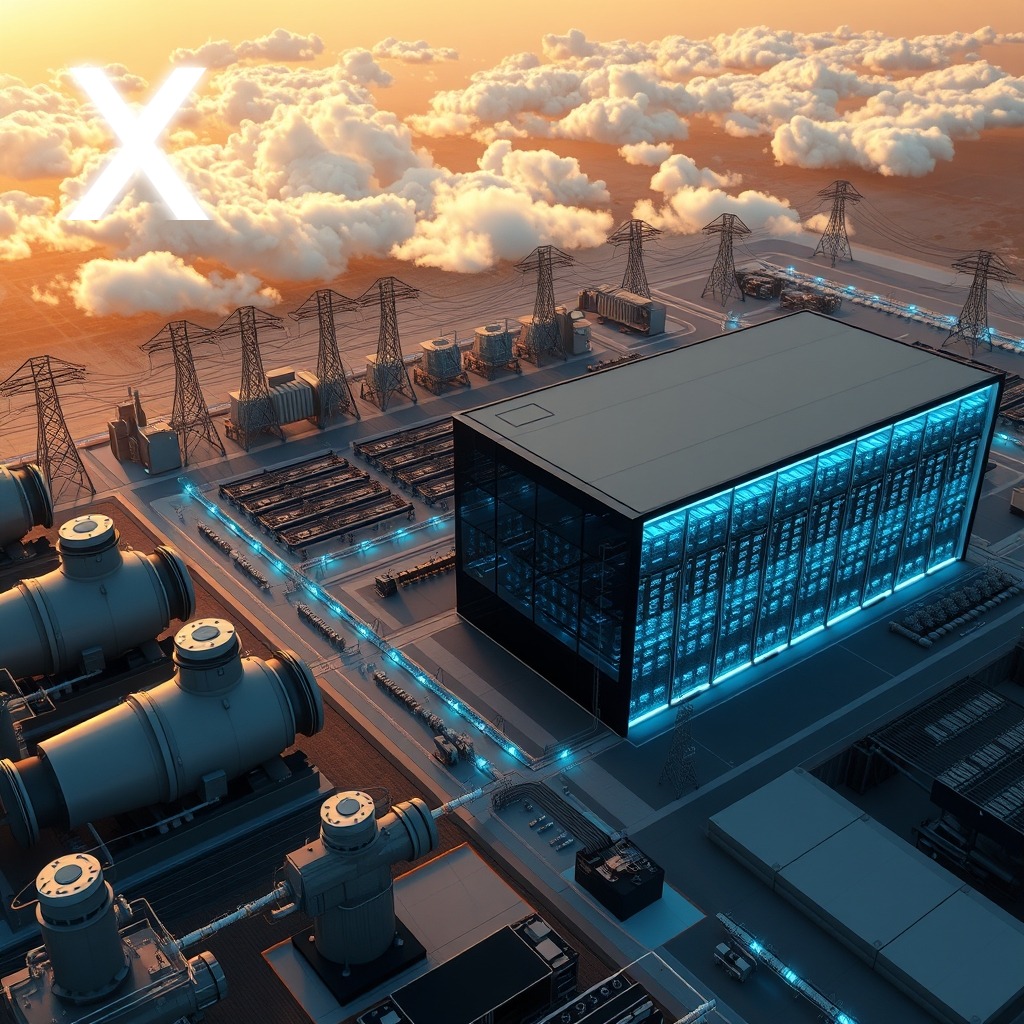 AI-generated
1. Context and Highlights
The global infrastructure strategy for artificial intelligence has just suffered a financial earthquake of unprecedented proportions. SoftBank Group has incurred net losses of $3.7 billion after abruptly canceling a series of orders for large-scale gas turbines. This equipment was intended to autonomously power its next-generation AI data centers. The drastic decision comes just days after the conglomerate led by Masayoshi Son publicly denied claims by Elon Musk, who suggested on social media that the Japanese firm was facing serious liquidity tensions and default risks on its financial commitments dedicated to the deployment of advanced computing.
The cancellation of these orders exposes the brutal collision between the financial exuberance of the AI race and the inflexible realities of physical infrastructure. In a context marked by a critical shortage of capacity in global power grids, major technology players have been forced to resort to isolated or behind-the-meter generation to supply power to supercomputing clusters capable of training and running frontier models such as Grok 4.7, GPT-6.1 Astra, or Claude Mythos 5.5. SoftBank's sudden retreat represents a 180-degree turn in its scaling architecture and underscores the severe financial penalties derived from canceling industrial equipment with long lead times. For executives, analysts, and technology infrastructure directors, this episode constitutes a crucial case study. It not only exposes the fragility of capital expenditure (CapEx) forecasts associated with the AI ecosystem, but also highlights the complex geopolitics and energy market tensions in November 2026. The discrepancy between SoftBank's public narrative of stability and the assumption of this multi-billion dollar loss raises fundamental questions about the sustainable pace of hypercomputing cluster deployment.
2. Deep technical and financial analysis
Exclusive Tech Deals on Amazon
To understand the magnitude of the $3.7 billion loss, it is essential to analyze the physics and economics of AI data centers in 2026. The training and massive inference of multimodal models with advanced Mixture of Experts (MoE) architectures demand power densities per rack that frequently exceed 100 kilowatts. When these infrastructures are grouped into clusters of hundreds of thousands of accelerators, the total power demand rapidly scales into the gigawatt range. Traditional energy distribution companies cannot offer interconnection timelines of less than five to seven years, which prompted SoftBank to directly contract combined-cycle gas turbines as a rapid-deployment interim energy solution.
The termination of these contracts has triggered draconian penalty clauses. In the heavy generation industry, the acquisition of frame-class gas turbines involves multi-year binding financial commitments, non-refundable manufacturing milestone payments, and severe cancellation indemnities to compensate manufacturers for reserving capacity on their assembly lines. The $3.7 billion lost reflects both the loss of initial deposits and direct penalties for breaking long-term supply contracts.
| Cost component | Description of financial impact | Operational consequence |
|---|---|---|
| Non-refundable manufacturing deposits | Payments for production capacity reservation for frame-class turbines. | Direct loss of capital with no physical asset in return. |
| Contractual termination penalties | Indemnity clauses for unilateral breach of supply agreements. | Immediate impact on the quarter's profit and loss statement. |
| Site engineering and land preparation | Costs incurred in civil adaptation and cancelled environmental permits. | Total halt of civil infrastructure development at key nodes. |
| PPA agreement restructuring | Cancellation of long-term natural gas purchase derivative contracts. | Exposure to litigation and arbitration with raw material suppliers. |
The chronology of the conflict between Elon Musk and SoftBank adds a component of profound market instability. Musk, whose firm xAI competes aggressively in the supercomputing space with massive infrastructures deployed in record time using temporary power modules, publicly stated that SoftBank lacked the operating cash flows to sustain the simultaneous construction of multiple gigawatt campuses. Although SoftBank's board described such assertions as unfounded and inaccurate, the confirmation of the abandonment of these turbine orders suggests that the group's leverage structure was under unsustainable pressure.
From a systems engineering perspective, the cancellation of the gas turbines invalidates the strategy of deploying "island" facilities off the grid. The planned data centers required a constant energy source with low thermal response time to support the sudden load variations associated with backpropagation cycles in neural network training. Without these dedicated turbines, SoftBank is forced to retreat to conventional grids or negotiate renewable energy Power Purchase Agreements (PPAs) with battery backup, a process that will significantly delay the commissioning of its new computing capacity. The technical impact also extends to water usage efficiency and carbon emissions. The cancelled high-efficiency gas turbines featured waste heat capture systems designed to power absorption cooling systems, reducing auxiliary power consumption (PUE). By abandoning this integrated architecture, any improvised alternative solution risks degrading the energy efficiency indices of the planned facilities.
3. Industry Repercussions
SoftBank's withdrawal from the private thermal generation market has sent a shockwave through the AI infrastructure supply chain. Over the last two years, power generation equipment manufacturers had become unexpected winners of the intelligent software boom. The cancellation of contracts worth billions of dollars creates immediate uncertainty regarding the order backlogs of these industrial giants, triggering downward adjustments in their stock market valuations.
In the hypercomputing market, SoftBank's retreat alters the balance of power. Competitors with stronger balance sheets or direct access to diversified energy grids, such as Microsoft, Google, and Elon Musk's own xAI, are gaining valuable ground. The ability to secure usable megawatts has consolidated as the industry's true limiting factor, surpassing even the availability of silicon wafers or advanced HBM memory packaging. Firms that fail to secure guaranteed power see their projects paralyzed despite having reserves of compute accelerators. The venture capital market and large infrastructure investment banking are also absorbing this blow with unease. This event highlights the residual risk of oversizing physical capacity based on hyperbolic AI demand projections. High capital costs and tightening credit terms will force funds to demand greater guarantees before financing energy projects dedicated exclusively to AI workloads, limiting the use of highly leveraged debt.
4. Market Perspectives
Financial and industrial sector analysts agree that this event marks the end of the phase of uncontrolled energy CapEx expansion in artificial intelligence. The vision of building dedicated fossil fuel generation plants on tight deadlines has encountered regulatory barriers, manufacturing bottlenecks, and unforeseen financial costs. Analysts emphasize that liquidity risk management must prevail over raw deployment speed.
Data center engineering specialists point out that relying on internal combustion gas turbines to power large-scale AI clusters always contained an inherent risk of environmental and financial misalignment. Global regulatory pressures to reduce the technology sector's carbon footprint have progressively increased the cost of capital for projects based on fossil fuels. SoftBank's change of course, while extremely costly in the short term, could avoid stranded assets if climate regulations tighten further before 2030. From the perspective of strategic competition, the dispute between Musk and SoftBank illustrates the fierce battle for market narrative. In the realm of corporate finance, perceptions of an actor's solvency directly influence their borrowing costs. The rapid confirmation of the contract cancellation following the official denial partially erodes the firm's credibility with credit rating agencies, forcing it to undertake a transparency campaign regarding its actual capital commitments in AI.
5. Future Outlook
In the short term, during the first half of 2027, SoftBank is expected to focus its efforts on restructuring its infrastructure asset portfolio. It is highly likely that the group will seek strategic alliances with established utility companies to share the costs of energy infrastructure development, moving away from the model of direct ownership of thermally isolated generation.
On the long-term technological horizon, 2028, the sector will experience an accelerated transition toward small modular reactor (SMR) solutions and long-term agreements with existing nuclear plants, complemented by large-scale battery energy storage systems (BESS). Although SMRs will not be fully operational at scale until the end of the decade, capital investments will be massively reoriented toward this technology to the detriment of conventional gas turbines. Likewise, a consolidation in data center design is expected. The industry will shift toward software optimization and algorithmic efficiency. Model compression, advanced quantization, and efficient learning architectures will take on even greater prominence to reduce consumption per token, compensating for the impossibility of indefinitely scaling physical power infrastructure at reasonable costs.
6. Summary & Assessment
The costly $3.7 billion setback suffered by SoftBank offers direct and urgent lessons for senior technology and financial management:
- Decoupling from pure energy risk: Technology organizations must avoid becoming power generation operators of last resort. Supply agreements should be structured through flexible PPA contracts that mitigate termination penalties in the event of sudden changes in computing strategy.
- Rigorous audit of infrastructure cash flow: The speed of acquiring computing capacity must not compromise corporate liquidity. Long-term CapEx commitments in energy hardware require financial stress tests against potential slowdowns in the monetization of AI services.
- Diversification of supply architectures: Reliance on a single source of rapidly deployable power (such as gas turbines) exposes firms to severe regulatory and supply chain risks. Resilience requires a hybrid mix that combines the traditional grid, renewables, and high-density storage.
Ultimately, the deployment of frontier artificial intelligence has ceased to be solely a challenge of model innovation and has become a discipline of heavy engineering and financial prudence. Those entities that manage to balance computing ambition with rigorous management of physical and energy capital will be the ones that prevail in the next stage of global technological development.