Español
 English
 Français
 Português
 Deutsch
 Italiano
Starship: Will the US Space Enterprise's Last Hope Finally Deliver on Its Promise?
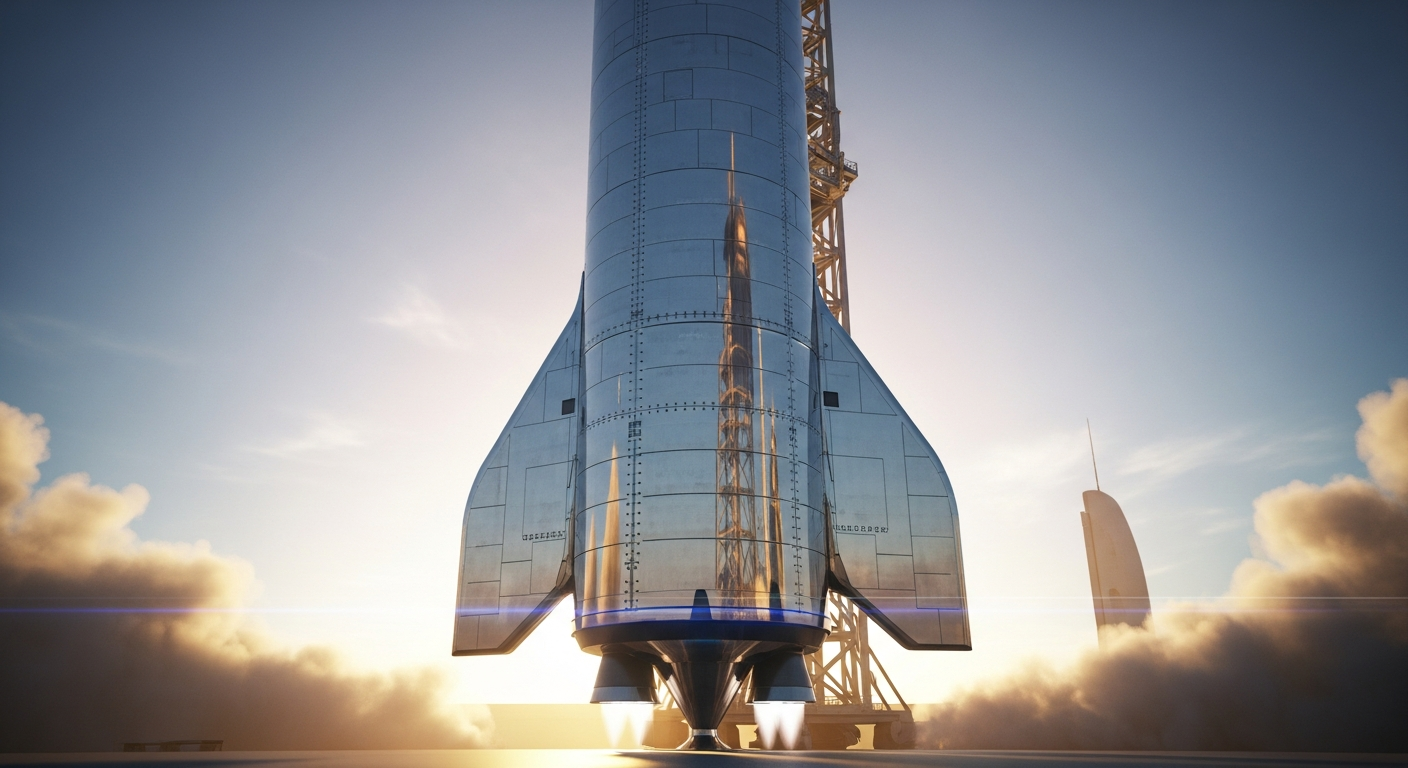 AI-generated
1. Executive Summary
As of May 18, 2026, the United States space enterprise is in a state of critical anticipation, with much of its ambitious future roadmap, especially NASA's Artemis program, intrinsically linked to the success and full operational capability of SpaceX's Starship launch system. Following a series of orbital test flights that have demonstrated significant progress but also exposed persistent challenges, Starship's promise of fully reusable, low-cost launch capability remains a tantalizing vision, not yet fully materialized.
This dependence is not merely technical; it is strategic, economic, and geopolitical. Starship's ability to transport massive payloads to orbit and beyond, and its central role as the Human Landing System (HLS) for Artemis, make it an indispensable asset. However, delays in its development and the complexity of achieving rapid and reliable reusability have generated palpable tension across the sector. This report delves into Starship's current status, the ramifications of its progress for the space industry, and the prospects of whether it will finally meet the expectations it has generated.
2. In-Depth Technical Analysis
The Starship system, comprising the Super Heavy booster and the Starship spacecraft, represents a generational leap in aerospace engineering. Its stainless steel design, an unconventional but economically advantageous choice, has proven robust under harsh launch and re-entry conditions. By May 2026, SpaceX has conducted a total of eight orbital test flights, with mixed results. While early flights focused on validating stage separation and atmospheric re-entry, more recent ones have achieved controlled landings of both Super Heavy and Starship, though not consistently and without the promised rapid reusability.
Starship's heart lies in its Raptor engines, fueled by methane and liquid oxygen. The Raptor 3 version, powering current flights, has significantly improved in thrust and reliability compared to its predecessors. However, the complexity of operating up to 33 Raptor engines simultaneously on Super Heavy and 6 on Starship has presented challenges. Engine failures during ascent or ignition for landing have been a recurring cause of anomalies, although system redundancy has on several occasions allowed for partial mission continuation.
Complete and rapid reusability is the cornerstone of Starship's philosophy. By May 2026, SpaceX has demonstrated the ability to land both Super Heavy and Starship, but the refurbishment and preparation process for the next flight remains a bottleneck. Damage to Starship's heat shield during re-entry, despite improvements in ceramic tiles, has required extensive inspections and repairs, hindering the goal of an "hours or days" turnaround. The automation of these processes, assisted by advanced AI models like GPT-5 from OpenAI or Claude 4 from Anthropic for predictive failure analysis and procedure optimization, is under development but not yet an operational reality.
Another critical component is orbital refueling (OFR) capability. For lunar or interplanetary missions, Starship needs to be refueled by multiple tanker spacecraft in low Earth orbit. SpaceX has conducted two demonstrations of in-orbit docking and propellant transfer, with partial success. Transferring large volumes of cryogenic propellant in space is an unprecedented technical feat, and the efficiency and reliability of this process are fundamental to unlocking Starship's potential beyond Earth orbit.
Regulatory challenges have also been a factor. The U.S. Federal Aviation Administration (FAA) has imposed increasingly strict safety and environmental requirements, resulting in delays in obtaining launch licenses. Each in-flight incident requires a thorough investigation, slowing the pace of testing. SpaceX's iterative development nature, which prioritizes learning through real test flights, often clashes with traditional regulatory frameworks, creating constant friction.
In summary, Starship is an engineering marvel that has achieved impressive milestones. However, the transition from the testing phase to commercial and mission-critical operation has proven more arduous than anticipated. Engine reliability, heat shield durability, orbital refueling efficiency, and regulatory agility are the main obstacles SpaceX must overcome for Starship to fulfill its promise.
3. Industry Impact and Market Implications
The wait for Starship has created a ripple effect across the entire space industry. NASA's Artemis program is, perhaps, the most affected. Starship was selected as the Human Landing System (HLS) to carry astronauts to the lunar surface, with the first crewed landing mission, Artemis III, initially planned for 2025. As of May 2026, this date has been postponed to late 2027 or even 2028, directly due to delays in Starship's certification and full operational capability, especially concerning orbital refueling and lunar landing reliability.
In the commercial launch market, Starship promised unprecedented disruption, with per-kilogram-to-orbit costs potentially orders of magnitude lower than any other vehicle. This promise has, to some extent, frozen investment decisions in next-generation satellites and massive constellations, as operators await the arrival of this low-cost capability. However, Starship's prolonged development phase has allowed traditional launchers, such as ULA's Vulcan Centaur and Arianespace's Ariane 6, to consolidate their order books and demonstrate their own capabilities, albeit with very different costs and payload capacities.
National security is another area of profound implication. The U.S. Department of Defense has expressed great interest in Starship for rapid satellite deployment, cargo delivery to remote bases, and even point-to-point transport of personnel and equipment. The ability to launch massive payloads in a matter of hours or days, rather than weeks or months, could revolutionize military logistics and space resilience. However, the lack of reliable operational capability for Starship means the DoD must continue investing in more conventional launch systems and diversify its options, mitigating the risk of over-reliance.
Global competition is also affected. While the U.S. waits for Starship, other space powers are not standing still. China, with its Long March 9 heavy-lift rocket under development and its lunar and Martian ambitions, is advancing rapidly. The capability of its AI models like Qwen 3 from Alibaba for complex mission planning and DeepSeek V4-Pro from DeepSeek for design optimization allows them to accelerate their own programs. Starship's delay could give China a window of opportunity to close the gap in certain space exploration and transportation capabilities.
Finally, the wait for Starship has led to a re-evaluation of investment strategies in the space sector. While venture capital continues to flow into space startups, there is growing caution about projects that rely exclusively on Starship's future capabilities. Diversification of launch options and investment in complementary technologies, such as in-orbit manufacturing or space tug services, are becoming more attractive as ways to mitigate the risk associated with a single disruptive launch system.
| Sector | Dependence Level (Scale 1-5) |
|---|---|
| Artemis Program (NASA HLS) | 5 |
| Commercial Satellite Launch (Large Constellations) | 4 |
| Defense and National Security | 3 |
| Scientific Exploration (Interplanetary Missions) | 4 |
| Space Tourism and Point-to-Point Transport | 2 |
4. Expert Perspectives and Strategic Analysis
The community of experts and strategic analysts is divided between cautious optimism and pragmatic realism. "Starship is an engineering project of unprecedented scale and ambition," states Dr. Elena Petrova, lead analyst at SpaceTech Insights. "It's naive to expect such a complex system to become fully operational without significant setbacks. The question isn't whether it will fail, but how SpaceX learns from those failures and how quickly it can iterate. NASA, by betting so heavily on Starship for Artemis, accepted a calculated risk, but that calculation is being stretched."
From a national security perspective, General Mark Thompson (ret.), former head of space operations at the Pentagon, notes: "Starship's promise of rapid response capability is transformative. However, reliance on a single provider and a system still under development for critical capabilities is a vulnerability. We need to see continued diversification of launch options and investment in smaller, more agile launch capabilities that can complement Starship, not just depend on it." The capability of AI models like Grok 4 from xAI to analyze space conflict scenarios and the resilience of space infrastructure is increasingly relevant in this planning.
SpaceX's "agile development" strategy, which involves building, testing, failing, and learning quickly, has been fundamental to its success with Falcon 9 and Dragon. However, Starship's scale and the implications of its failures are much greater. "The FAA and other regulatory agencies are under immense pressure to balance innovation with public and environmental safety," explains Sarah Chen, a space policy expert. "Every explosion or failed landing is not just a technical setback, but also a regulatory challenge that adds months to the timeline. Coordination between SpaceX and regulators must drastically improve to accelerate the pace without compromising safety."
Some analysts suggest that the U.S. space enterprise's "desperation" is, in part, self-inflicted. "A lack of sustained investment in heavy-lift alternatives for decades led to this situation," argues Dr. Javier Morales, a space economist. "Now, we are at a point where Starship is the only viable option for certain deep-space exploration missions in the short to medium term. This gives SpaceX considerable leverage but also places an immense burden on it. Diversifying the space industrial base is a long-term strategic imperative."
Ultimately, the consensus is that Starship will eventually deliver, but the timeline is the critical factor. The question is not whether the technology is possible, but when it will be mature and reliable enough for the most demanding missions. The patience of NASA and the commercial market has limits, and each additional delay erodes confidence and forces a re-evaluation of long-term strategies.
5. Future Roadmap and Predictions
The roadmap for Starship in the coming years is ambitious and subject to overcoming current technical challenges. By the end of 2026, SpaceX is expected to have achieved at least two fully successful orbital test flights, including controlled landing and recovery of both elements (Super Heavy and Starship) without significant damage that would prevent rapid reusability. This would imply substantial improvements in Raptor engine reliability and heat shield durability.
The year 2027 will be crucial for in-orbit refueling demonstrations. SpaceX is anticipated to conduct a series of Starship "tanker" missions, where multiple Starship spacecraft will transfer propellant to a mission Starship in low Earth orbit. The success of these missions is indispensable for NASA's HLS certification. If these demonstrations are successful, we could see the first uncrewed lunar landing test of Starship in late 2027 or early 2028, as a precursor to the Artemis III mission.
Looking towards 2028 and beyond, if Starship achieves full operational capability and rapid reusability, the impact will be transformative. We could see the launch of the first next-generation satellite constellations with unprecedented efficiency, the expansion of lunar infrastructure, and potentially the first crewed missions to Mars. However, any significant delay in the 2026-2027 milestones could push these ambitions further into the 2030s, with implications for U.S. space leadership and the economic viability of many space projects.
| Year | Key Milestone | Probability of Achievement (High/Medium/Low) |
|---|---|---|
| 2026 (Late) | 2 fully successful orbital flights (rapid recovery) | Medium |
| 2027 (Mid) | Successful in-orbit refueling (OFR) demonstration | Medium |
| 2027 (Late) | Uncrewed lunar landing (Artemis III precursor) | Low |
| 2028 (Mid) | Artemis III Mission (crewed landing with Starship HLS) | Medium |
| 2029 | First routine commercial heavy-lift launch | High |
| 2030 | Start of crewed Mars missions (preparation) | Medium |
6. Conclusion: Strategic Imperatives
The U.S. space enterprise stands at a defining moment. The reliance on Starship for its boldest aspirations is undeniable, and the question of whether it "will finally deliver" is not just a technical matter, but one of global leadership and strategic resilience. While SpaceX's progress has been remarkable, the transition from the testing phase to reliable, routine operation is the true challenge. Patience is wearing thin, and the pressure on SpaceX to fulfill its promises is immense.
The strategic imperatives are clear: first, SpaceX must accelerate Starship's maturation, prioritizing reliability and rapid reusability over mere launch capability. This will require continuous investment in R&D, optimization of manufacturing and maintenance processes, and more fluid collaboration with regulators. Second, NASA and the U.S. government must maintain a diversification strategy, investing in alternative launch capabilities and complementary technologies to mitigate the risk of over-reliance on a single system. Finally, global competition demands that the U.S. not only innovates but also executes efficiently. Starship's success is not just SpaceX's success; it is the success of American space ambition in the 21st century.