Español
 English
 Français
 Português
 Deutsch
 Italiano
Technical Guide X, October 2026: Mobile Architecture for MoE and Long-Context Models
 AI-generated
1. Executive Summary and Selection Criteria
Local artificial intelligence computing has crossed a definitive threshold. The consolidation of architectures based on Mixture-of-Experts (MoE) such as DeepSeek-V4.1-Flash and Qwen3.8-Max, alongside the generalized demand for context windows exceeding 1 million tokens, has redefined hardware requirements for portable workstations. It is no longer sufficient to evaluate GPU unified memory alone; the bottleneck has shifted toward system memory bandwidth, interconnect latency, and thermal-energy efficiency under unplugged operation.
This guide analyzes the critical engineering pillars for local deployment of open-source and open-weight SOTA models, breaking down the impact of the CAMM2 LPDDR5X modular memory standard, the real-world viability of external VRAM expansion via OCuLink and Thunderbolt 5, and the thermal-energy performance behavior when the workstation operates exclusively on battery.
2. The Memory Bottleneck: CAMM2 LPDDR5X Architecture and Bandwidth
For efficient inference of MoE models, where only a fraction of parameters (e.g., Top-2 expert routing) is activated per token, the limiting factor is not pure compute capacity in FLOPS, but rather the memory bandwidth required to load and unload tensor weights from the processing core cache.
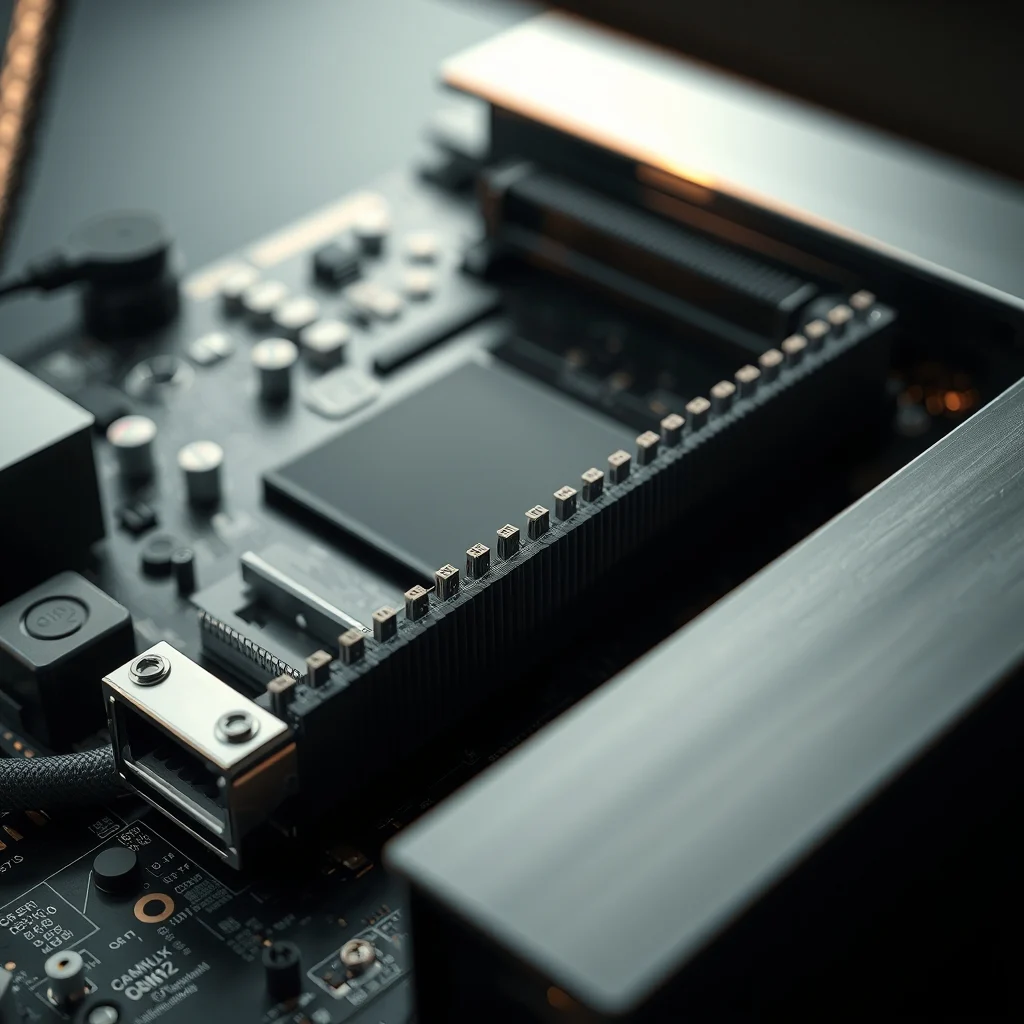
The CAMM2 (Compression Attached Memory Module) standard in its LPDDR5X variant has displaced traditional So-DIMMs in high-end mobile workstations. By eliminating long bus traces on the motherboard and bringing memory channels directly to the SoC or processor via a planar compression connector, CAMM2 achieves sustained bandwidths exceeding 128 GB/s per dual channel, scaling up to 256 GB configurations with true 128-bit interfaces.
Mobile Memory Bandwidth and Latency Performance Comparison
| Memory Technology | Sustained Bandwidth | Average Latency |
|---|---|---|
| Traditional So-DIMM DDR5-5600 | 64 | 88 |
| Soldered LPDDR5X (Previous High-End) | 96 | 72 |
| CAMM2 LPDDR5X-8533 (Modular) | 148 | 58 |
| Proprietary Unified Memory (Apple Silicon) | 150 | 52 |
The technical advantages of CAMM2 for AI engineers are summarized in the following key points:
- Modularity and Repairability: Unlike soldered LPDDR memory which prevented later upgrades, CAMM2 allows upgrading RAM capacity, vital for housing quantized MoE models exceeding 100 billion parameters, without compromising signal integrity.
- Density per Area: Reduces spatial footprint on the motherboard by over 60% compared to dual So-DIMM slots, freeing up critical space for larger vapor chambers and heatsinks.
- Energy Efficiency: Optimizes operating voltage (VDDQ) by reducing parasitic consumption during prolonged autoregressive decoding tasks.
3. External VRAM Expansion: OCuLink vs. Thunderbolt 5
Local execution of models with massive contexts requires a VRAM footprint that exceeds the maximum capacity integrated into current laptop chassis, typically limited to 64 GB or 96 GB. The architectural solution involves connecting eGPUs (External GPUs) via high-speed interfaces.
eGPU Bandwidth and Overhead Analysis
| Expansion Interface | Theoretical Bandwidth | Practical Useful Throughput | Latency Overhead |
|---|---|---|---|
| Thunderbolt 4 | 40 | 32 | High |
| Thunderbolt 5 (Bandwidth Boost) | 120 | 85 | Medium |
| OCuLink (PCIe 4.0 x4) | 64 | 60 | Low |
| OCuLink (PCIe 5.0 x4 current) | 128 | 118 | Minimal |
While Thunderbolt 5 offers the versatility of the USB-C standard, support for multiple displays, bidirectional power, and hot-plugging, OCuLink based on direct PCIe links provides a data path without Thunderbolt's packet encapsulation protocol. For the massive transfer of activations and KV-caches in distributed MoE models shared between the internal GPU and an external eGPU, OCuLink minimizes the I/O bottleneck, preventing token-per-second performance degradation.
"The integration of native OCuLink ports in high-end mobile workstations makes the difference between an unusable eGPU due to bus saturation and a truly scalable local development cluster.", Hardware analysts
4. Energy Performance: Battery vs. Alternating Current (AC)
A critical aspect frequently ignored in specification sheets is the behavior of neural accelerators and graphics processing units when the laptop is disconnected from the electrical grid. Modern silicon power management policies drastically reduce power limits (PL1 and PL2) to preserve lithium-ion cell integrity and comply with air transport regulations (99.9 Wh limit).
MoE Model Performance Degradation (Tokens/s) by Power Source
| Evaluated Model (Q4_K_M Quantization) | Plugged into AC (Max Performance) | Battery Operation (Balanced Mode) | Performance Drop (%) |
|---|---|---|---|
| DeepSeek-V4.1-Flash (MoE) | 45 | 18 | 60 |
| Qwen3.8-Max (Reduced Configuration) | 28 | 11 | 61 |
| Llama 4 (Extended Context) | 35 | 14 | 60 |
| Gemma 4 (12B Edge) | 62 | 31 | 50 |
The performance drop of nearly 60% in unplugged operation is due to the thermal and electrical limitation of direct current supply from the battery. The cells cannot deliver the transient amperage peaks required by NPU and GPU cores simultaneously without suffering critical voltage sag. Therefore, local training, fine-tuning, and massive context processing workflows (>1M tokens) must be strictly planned under AC power.
5. Conclusions and Practical Acquisition Guide
When configuring or acquiring a mobile workstation for AI, component selection must be guided by the following strict criteria:
- Prioritize Memory Architecture: Demand CAMM2 LPDDR5X slots with an upgrade capacity of at least 128 GB to prevent obsolescence against growing MoE model sizes.
- Expansion Connectivity: Look for chassis that integrate OCuLink ports if planning to use dedicated eGPUs with desktop-class cards for heavy long-context workloads, reserving Thunderbolt 5 for peripherals and general transfer.
- Thermal Management: Verify that the heatsink design includes dual-fan vapor chambers with liquid metal, ensuring that thermal degradation under sustained load on AC does not exceed 15% after 30 minutes of continuous inference.
- Execution Environment: Utilize optimized frameworks like Llama.cpp and compatible libraries configured to leverage dynamic expert routing and runtime activation quantization.