
 Español
 English
 Français
 Português
 Deutsch
 Italiano
Technical Guide XVI, November 2026: Memory Architecture for AI, CAMM2 vs. LPDDR5X
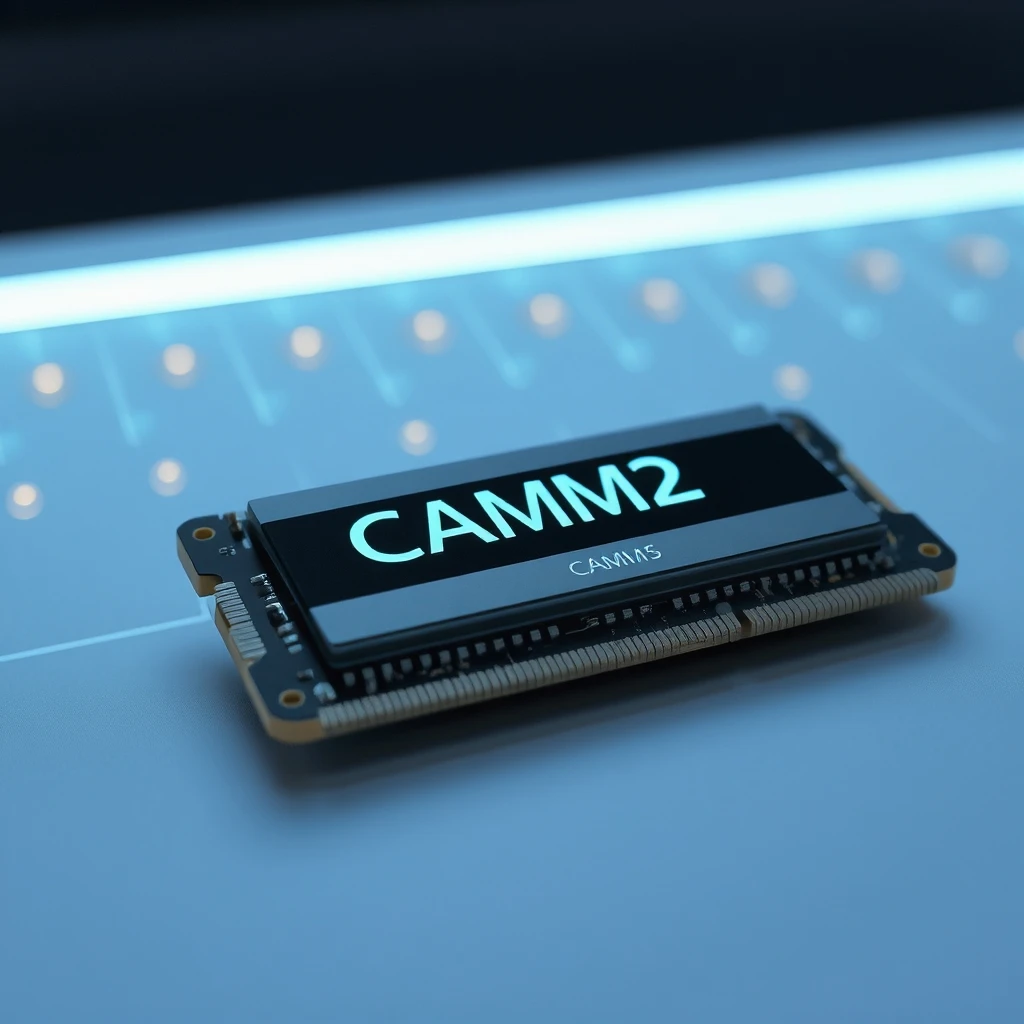 AI-generated
1. Executive Summary
By late 2026, the convergence of large language model (LLM) development and edge computing has reached a critical inflection point. With the deployment of models such as Llama 4 Scout and Qwen3.8-Max, memory architecture has emerged as the primary bottleneck for local inference. This guide evaluates the transition from soldered LPDDR5X memory, the industry standard for energy efficiency, to the CAMM2 (Compression Attached Memory Module) standard, which introduces essential modularity for high-performance mobile workstations.
2. The Memory Architecture Dilemma: CAMM2 vs. LPDDR5X
Memory selection is defined by bus topology and access latency rather than raw capacity alone. While LPDDR5X optimizes physical proximity to the SoC to minimize capacitance and maximize clock frequency, the CAMM2 format enables robust dual-channel configurations, which are necessary for AI workloads requiring high sustained bandwidth.
2.1. Comparative Performance Metrics
| Architecture | Bandwidth (GB/s) | Latency (ns) | Efficiency (W) |
|---|---|---|---|
| LPDDR5X-8533 | 68 | 14 | 5 |
| CAMM2-DDR5-6400 | 102 | 22 | 12 |
3. Optimizing TTFT (Time-To-First-Token)
TTFT remains the fundamental metric for user experience in autonomous agents. LPDDR5X architectures offer reduced latency, which is optimal for rapid interactions with models like Claude Mythos 5.5. However, when scaling to models with 70B+ parameters, the bandwidth limitations of LPDDR5X restrict throughput (tokens/s). Conversely, CAMM2 facilitates high-density configurations that, despite higher access latency, allow for loading larger model weights into the KV Cache without relying on virtual memory (swap), which would otherwise degrade TTFT in any inference environment.
4. KV Cache Management and Memory Footprint
Effective KV Cache management is decisive for supporting long contexts (1M+ tokens). In 2026, dynamic memory allocation is critical:
- LPDDR5X: Constrained by the capacity soldered onto the board. If the KV Cache exceeds 60% of total RAM, the system experiences severe performance degradation.
- CAMM2: Enables modular upgrades. For developers operating with Llama 4 Scout, the ability to scale to 128GB or 256GB provides a distinct operational advantage over soldered solutions.
5. Strategic Conclusions
On-device AI performance depends not only on NPU throughput but on the ability of the memory hierarchy to feed the inference engine without stalls. The CAMM2 architecture represents the technical maturity required for professional workstations in 2026. Technical Recommendation:
- For intensive development of MoE models (such as Qwen3.8-Max or MiMo-V2.6-Pro), prioritize workstations equipped with CAMM2.
- For standard corporate use and extreme portability with GPT-6.1 Astra, LPDDR5X maintains the optimal balance between energy efficiency and response latency.