Español
 English
 Français
 Português
 Deutsch
 Italiano
The Era of Physical Automation: Meta and the Integration of Robotics in Data Center Infrastructure
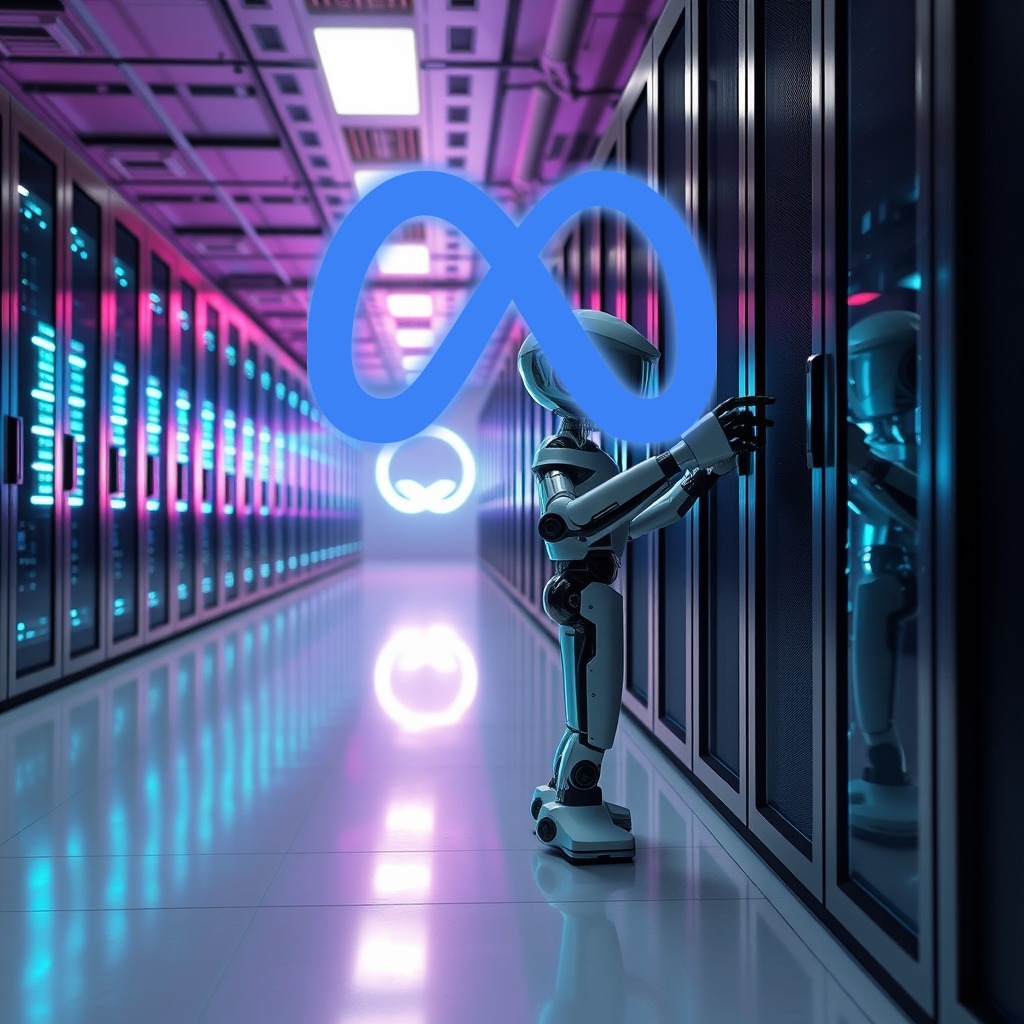 AI-generated
1. Context and Highlights
In August 2026, data center infrastructure reached a critical tipping point. The power density required to support the training and inference of frontier models, such as Llama 4 and its specialized variants, has surpassed the capacity of traditional human management. Meta has initiated a strategic deployment of autonomous robotic systems designed for the management, maintenance, and physical optimization of its hyperscale facilities. This move is an operational necessity. With the proliferation of next-generation GPU clusters and highly complex liquid cooling systems, human intervention has become a bottleneck. The integration of robotics into Meta's infrastructure marks the beginning of an era where AI hardware not only processes data but also oversees its own physical environment, reducing operational costs and minimizing downtime in critical infrastructure.
2. Key Technical Aspects
The robotic architecture that Meta is integrating into its data centers is based on a symbiosis between advanced computer vision and the reasoning capacity of models like Muse Glimmer, Meta's 30B parameter open-weights model designed for agentic workflows. Unlike the static industrial robots of the last decade, these units operate through an "embodied AI" architecture, allowing the robot to interpret the data center environment in real time.
The core of this technology lies in the robots' ability to perform preventive maintenance tasks, such as replacing memory modules, inspecting leaks in cooling systems, and managing high-density cabling. These systems use multimodal sensors that feed directly from the data streams of the center's thermal and electrical sensors, allowing for proactive response before a critical failure occurs.
3. Industry Repercussions
Meta's foray into data center robotics alters the competitive landscape for cloud service providers. The ability to scale infrastructure without proportionally increasing human headcount is a significant competitive advantage. Companies that rely on manual maintenance models will see their operational costs scale inefficiently compared to the automation achieved by Meta. The data center hardware market is also undergoing a shift. Server manufacturers are beginning to design racks with "robotic compatibility," facilitating access to internal components and standardizing grip and connection points. This creates a new industry standard where ease of robotic maintenance is as important as compute performance. From an economic perspective, the initial investment in robotics is high, but the return on investment is accelerated by the reduction of human errors, which have historically been the primary cause of data center outages. This shift also puts pressure on other tech giants. The race for physical automation is no longer exclusive to logistics or manufacturing; it has become a race for AI infrastructure sovereignty.
| Metric | Traditional Center | Center with Meta Robotics |
|---|---|---|
| Failure response time | Dependent on human shifts | Immediate (24/7) |
| Maintenance precision | Variable (Human error) | High (AI vision-based) |
| Thermal optimization | Static | Dynamic and proactive |
| Operational scalability | Linear (requires more staff) | Exponential (requires more robots) |
4. Market Perspectives
Industry consensus suggests that Meta is laying the groundwork for "dark" data centers, facilities that operate without lighting or climate control optimized for humans. This strategy allows for a reduction in energy consumption dedicated to staff comfort, redirecting those resources toward cooling high-performance compute clusters.
Companies operating critical infrastructure are advised to begin evaluating the modularity of their racks. The lesson from Meta is clear: infrastructure must be designed to be manipulated by machines. A point of caution is cybersecurity. The integration of robots into the data center's internal network opens a new attack surface. It is imperative that these systems operate in isolated network segments and that communication between the robot and the control model is encrypted and authenticated using Zero Trust protocols. Finally, the transition toward robotics in data centers should be viewed as an evolution of roles, where the demand for engineers capable of managing fleets of robots and overseeing the logic of control models is outpacing current supply.
5. Roadmap and Predictions
By the end of 2026, Meta is expected to complete the pilot deployment phase in its largest-scale data centers in the United States. The next phase, planned for 2027, will involve the interconnection of robotic fleets between different data centers to share learnings on maintenance and hardware optimization. By 2028, we anticipate that the industry will adopt an open standard for communication between robots from different manufacturers and data center management systems. This will allow smaller companies to access automation solutions without depending on a closed ecosystem. In the long term, the integration of robotics will allow data centers to be located in geographically remote places, taking advantage of renewable energy sources where human presence is unfeasible or costly.
6. Summary & Assessment
Modern data center architecture requires strict data governance and architectural resilience that integrates physical automation as a first-class component. CTOs must prioritize the interoperability of robotic systems through standardized protocols, avoiding vendor lock-in and ensuring that physical asset telemetry is processed by high-capacity reasoning models, thereby optimizing latency in critical maintenance and thermal management decision-making.
From an economic and operational perspective, efficiency is achieved through the transition toward modular infrastructures that allow for robotic intervention without interruptions. Investment must focus on security by design, implementing Zero Trust architectures for the robotic fleet and optimizing token consumption through specialized models for vision and control tasks, ensuring that the total cost of ownership (TCO) remains under control while scaling the compute capacity of AI clusters.