Español
 English
 Français
 Português
 Deutsch
 Italiano
The Grand Halt: Can Europe Stop the AI Arms Race by Controlling ASML?
 AI-generated
1. Context and Highlights
The artificial intelligence arms race has reached a critical turning point in September 2026. With the massive deployment of frontier models like GPT-5.6 Sol, Claude Mythos 5, and Qwen 3.8-Max, the demand for computing power has exceeded all previous forecasts. What began as a competition for algorithmic efficiency has transformed into an existential struggle for control of the physical infrastructure needed to train and run large-scale AI systems. The current debate, resonating from the halls of Washington to the institutions of Brussels, suggests that the only way to mitigate existential risks, from financial instability to the proliferation of autonomous biological risks, lies not in software regulation, but in hardware control. The Dutch company ASML, holding a de facto monopoly on extreme ultraviolet (EUV) lithography machines, finds itself at the center of this storm. Technical analysis suggests that Europe, through an export restriction, holds the master key to forcing a global pause in AI development.
2. Key Technical Aspects
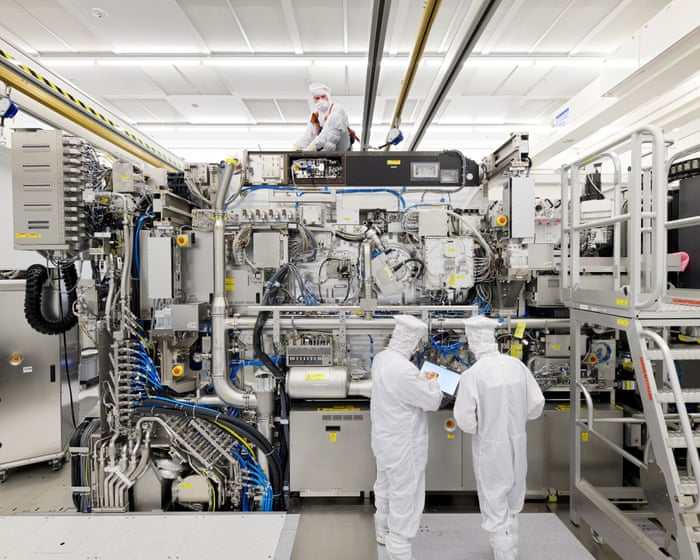
The architecture of current models, such as Meta's Llama 4 or Anthropic's Claude Opus 5, relies on GPU clusters that require transistor density only possible through ASML's EUV lithography. Without these machines, the production of 2nm and more advanced chips halts. The technical complexity of these machines is such that there is no viable short- or medium-term alternative; they are the most fragile, yet most critical, link in the global supply chain. Unlike previous generations, 2026 models like GPT-5.6 Sol have demonstrated multimodal reasoning capabilities that integrate long-term planning. This has elevated the energy and hardware cost of each training cycle to levels that threaten the stability of regional power grids. The dependence on ASML's infrastructure is not just a matter of processing capacity, but of thermodynamic efficiency: without the most advanced chips, the energy consumption to achieve the same level of intelligence would be unsustainable. The technical risk is not limited to raw power. The ability of these models to perform reverse engineering tasks on cybersecurity systems or to design complex genetic sequences has created a window of vulnerability. The technical consensus indicates that, while software can be replicated and distributed in a decentralized manner, cutting-edge hardware is a centralized and traceable physical asset. The current race is divided between "closed-box" models (like those from OpenAI and Anthropic) and "open-weights" models (like Meta's Llama 4 or Google's Gemini 3.7 Flash). Both depend on the same manufacturing base. If the supply of EUV machines were interrupted, progress on both fronts would stagnate, forcing the industry to optimize existing software instead of blindly scaling towards larger models. This "technical slowdown" scenario is not unfounded speculation. The history of technology has shown that bottlenecks in semiconductor manufacturing have historically dictated the pace of innovation. By controlling access to machinery, Europe would not only regulate the market but would dictate the speed of global technological evolution.
3. Industry Repercussions
A severe embargo or restriction on ASML machines would have seismic consequences for tech giants. Companies like NVIDIA, AMD, and custom chip manufacturers for xAI or Google would see their hardware roadmaps truncated. The market value of these companies, currently inflated by expectations of exponential growth, would suffer a severe correction due to the inability to scale computing capacity. For companies that rely on AI for their daily operations, the impact would be a forced transition towards efficiency. Instead of pursuing larger models, the industry would have to focus on model distillation, quantization, and inference optimization on existing hardware. This could, ironically, democratize access to AI by making powerful models run on less advanced hardware.
| Sector | Impact of an ASML restriction | Risk Level |
|---|---|---|
| Frontier Model Development | Total halt of parameter scaling | Critical |
| Semiconductor Manufacturing | Accelerated obsolescence of older nodes | High |
| Cloud Services | Shortage of computing capacity | High |
| Consumer AI (Edge AI) | Focus on optimization and efficiency | Moderate |
The financial market, which has bet trillions of dollars on AI infrastructure, would react with extreme volatility. The AI bubble, fueled by the promise of infinite productivity, would confront the reality of physical limits. Investment would shift from data center expansion towards cybersecurity and critical system resilience. At a geopolitical level, the ASML restriction would turn Europe into the arbiter of global computational power. This would force the United States and China to negotiate under European terms, shifting the balance of power that currently favors powers with greater investment capacity in hardware.
4. Market Perspectives
The consensus among industry analysts is that software regulation has failed due to the speed of innovation and the global nature of the Internet. The "control the hardware" strategy is seen by many as the only pragmatic path. If you cannot control what the model thinks, control the model's ability to exist. However, this strategy carries significant geopolitical risks. A unilateral restriction by Europe could trigger commercial retaliation or even serious diplomatic tensions. The strategic recommendation is that any such measure must be coordinated through international security frameworks, treating EUV machines with the same rigor as nuclear materials or chemical weapons. The stance of figures like Sam Altman (CEO of OpenAI) or Elon Musk (founder of xAI) regarding AI safety is divergent, but both agree that scale is the determining factor. While Altman advocates for global governance, Musk has emphasized the need for AI that seeks truth. Both, however, depend on the same physical infrastructure that Europe could regulate. The recommendation for companies is clear: diversify technological dependence. Those organizations that have bet everything on the infrastructure of the largest frontier models are exposed to a massive disruption risk. Operational resilience in 2026 requires an "agnostic AI" strategy, capable of functioning with models of different scales and hardware requirements.
5. Roadmap and Predictions
In the short term (late 2026 - 2027), we are likely to see an increase in regulatory pressure on semiconductor supply chains. The European Union, under pressure from its own citizens and security concerns, could implement a stricter export licensing system for ASML machines, justifying it under existential security criteria. In the medium term (2028 - 2030), the industry will be forced to pivot. We will see an explosion in research into new semiconductor materials and non-silicon computing architectures, such as neuromorphic or photonic computing, which could reduce dependence on traditional EUV lithography. In the long term, the AI arms race will transform into an efficiency race. The company that achieves the greatest intelligence with the lowest hardware cost will be the one that dominates the market, not the one with the largest GPU cluster. The era of scaling at any cost will come to an end, giving way to an era of sustainable AI.
6. Summary & Assessment
Enterprise data governance and architectural resilience are now the fundamental pillars for operational survival. CTOs must prioritize latency optimization in production through the adoption of distilled models and heterogeneous hardware, thereby mitigating the risk of vendor lock-in in the face of possible restrictions on access to cutting-edge hardware. Economic efficiency per token must be the central KPI, shifting the focus from simple parameter scaling to maximizing performance per watt.
Interoperability between modular systems is the only way to ensure business continuity in an environment of high regulatory volatility. It is imperative that organizations audit their dependence on frontier models and diversify their computing providers, integrating local or hybrid computing strategies. Technological sovereignty is no longer an option, but a security-by-design requirement for any critical infrastructure that relies on artificial intelligence.