Español
 English
 Français
 Português
 Deutsch
 Italiano
The New Era of Heavy Machinery: John Deere's Autonomous Skid-Steer and the Convergence of Robotics with Cutting-Edge AI
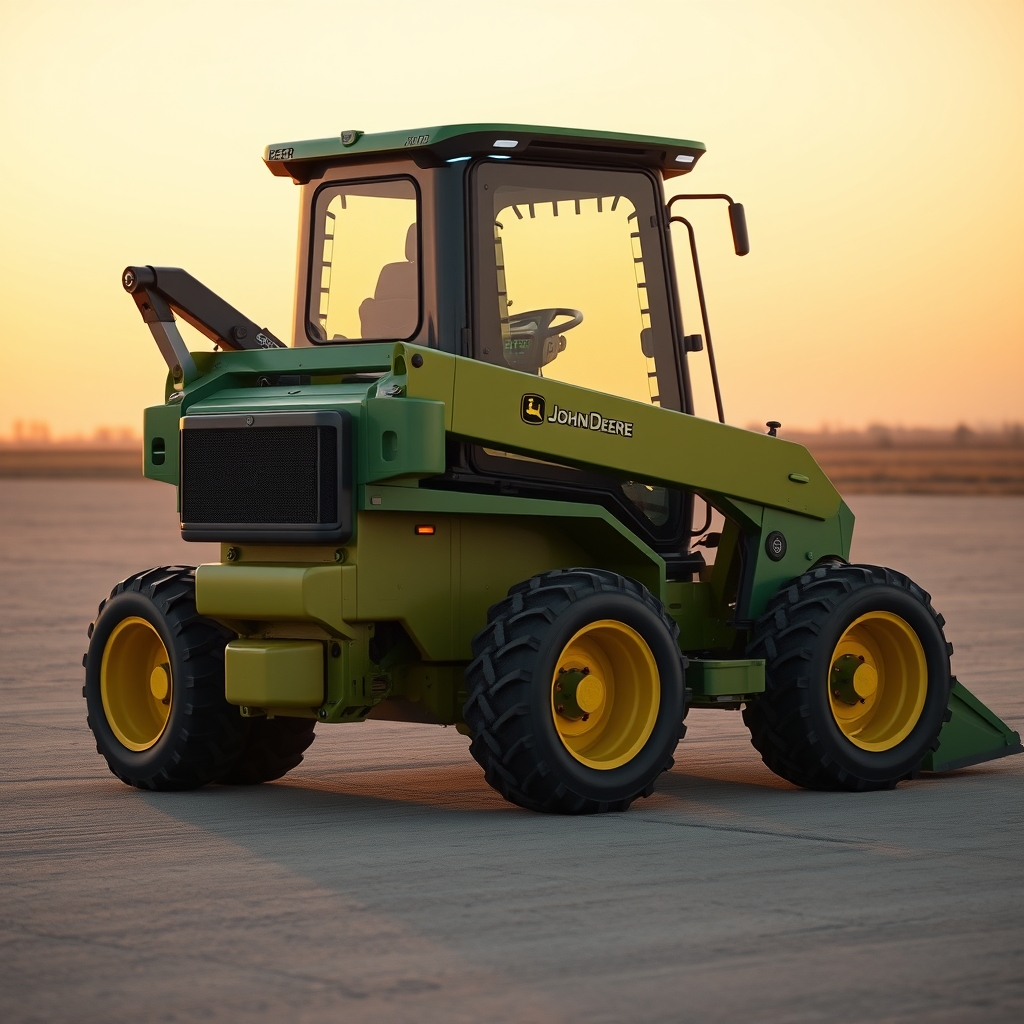 AI-generated
1. Context and Key Points
John Deere's recent technical demonstration, in which a 5-ton compact loader (skid-steer) executed high-complexity maneuvers with acrobatic precision, marks an inflection point in industrial robotics. Unlike automation systems based on rigid rules or preprogrammed trajectories, this vehicle has demonstrated a dynamic adaptability that suggests the integration of predictive control models based on state-of-the-art neural networks.
This advance is not merely an exhibition of mechanical dexterity; it represents the convergence between heavy machinery engineering and spatial reasoning models. For industrial sector leaders, this milestone underscores the imminent transition from the automation of repetitive tasks to cognitive autonomy in unstructured work environments, where terrain and load variability require decision-making in milliseconds.
2. Notable Technical Aspects
The core of this innovation lies in the control architecture of the skid-steer. Traditionally, autonomous heavy machinery relied on GNSS (Global Navigation Satellite System) navigation systems and LiDAR sensors to follow predefined routes. John Deere's new implementation transcends this paradigm by integrating a closed-loop control system that processes vehicle dynamics in real time, independently adjusting motor torque and hydraulic pressure at each wheel to maintain stability during maneuvers that challenge the center of gravity of a 5-ton machine.
From a software architecture perspective, the system appears to employ a Reinforcement Learning model trained in high-fidelity simulators that replicate the physics of deformable soils. This approach allows the machine to learn to compensate for traction loss or load displacement through a motor response that mimics the intuition of an expert human operator, but with significantly lower processing latency.
The integration of high-frequency inertial sensors (IMU), combined with edge-processed sensor data fusion, allows the skid-steer to maintain its structural and operational integrity even under asymmetric load conditions. Unlike language models that operate in the cloud, this system requires strict local execution to guarantee operational safety, avoiding the latency risks associated with wireless connections. The lineage of this technology dates back to adaptive control systems developed for mobile robotics over the last decade, but the 5-ton scale introduces inertia and momentum challenges that previous systems could not manage. The ability to perform acrobatic maneuvers implies that the model has internalized the laws of mechanical physics, enabling kinetic energy management that optimizes the wear of hydraulic components. It is fundamental to highlight that this level of autonomy does not depend on general "intelligence," but on extreme specialization in the domain of heavy machinery kinematics. The system architecture benefits from advances in inference model efficiency, allowing on-board hardware to manage sensor data flow without compromising safety control integrity.
3. Industry Impact
The adoption of this technology promises to transform the economics of operations in construction and mining sites. The ability of a machine to operate autonomously in conditions that previously required constant human intervention drastically reduces operational costs associated with operator fatigue and downtime due to human errors.
For construction companies, the value does not lie solely in labor substitution, but in optimizing work cycle efficiency. A skid-steer that can perform complex maneuvers autonomously can operate in confined or hazardous spaces where visibility is limited, increasing overall site safety and reducing insurance and civil liability costs.
| Efficiency Indicator | Traditional Method | AI-Based Autonomy |
|---|---|---|
| Maneuvering Precision | Low (Operator-dependent) | High (Predictive Control) |
| Terrain Adaptability | Limited | Real-time Dynamic |
| Operational Safety | Variable | Constant (360° Monitoring) |
| Load Management | Manual | Algorithmic Optimization |
The heavy machinery market is entering a consolidation phase where competitive advantage will shift from raw engine power to the sophistication of control software. Manufacturers that fail to integrate cognitive autonomy capabilities into their fleets will face accelerated obsolescence, as customer demand will orient toward intelligent fleets capable of integrating into digital project management ecosystems.
Furthermore, the ability to perform acrobatic maneuvers is an indicator of the control system's robustness. If a machine can manage its balance under extreme conditions, its reliability in routine loading and unloading tasks is substantially greater, which translates into a longer lifespan for mechanical components and a reduction in preventive maintenance costs.
4. Market Perspectives
Technical consensus suggests that we are at the beginning of an era where heavy machinery will cease to be a passive tool and become an active agent within the workflow. Sector analysts agree that the key to John Deere's success lies in vertical integration: total control over hydraulic hardware and AI software allows for an optimization that pure software manufacturers cannot replicate.
From a strategic perspective, the recommendation for CTOs and operations directors is to begin evaluating the data infrastructure necessary to support these autonomous fleets. Autonomy does not occur in a vacuum; it requires a sensor network and local processing capacity that must be planned in advance. The transition toward autonomy should be gradual, prioritizing low-risk tasks before scaling to critical operations.
It is imperative to consider cybersecurity as a fundamental pillar. By endowing 5-ton machinery with autonomous movement capabilities, the attack surface expands. The integrity of control models and protection against sensor data manipulation must be treated with the same rigor as the physical security of the machine. The final recommendation for companies is not to view this technology as a total replacement, but as an advanced assistance system that amplifies the capabilities of the human operator. Human supervision remains a critical requirement, but the operator's role is evolving into that of a systems supervisor, which requires a reconfiguration of training and technical education programs.
5. Next Steps
In the next 18 to 24 months, we expect to see the implementation of these control systems in larger-scale fleets, including excavators and large-tonnage wheel loaders. The maturation of Reinforcement Learning models will allow these machines to learn from their specific work environment, adapting autonomously to the particularities of each construction site.
By 2028, the standardization of communication protocols between autonomous machines from different manufacturers will be the next major challenge. Interoperability will allow a John Deere skid-steer to collaborate with an excavator from another manufacturer on the same site, sharing terrain data and coordinating material flow optimization.
In the long term, the integration of more advanced computer vision models will allow these machines to interpret visual signals and gestures from human workers, improving safety and the fluidity of human-machine collaboration in dynamic environments.
6. Conclusion and Assessment
John Deere's demonstration is not an isolated event, but the validation of a technological thesis: AI has reached the necessary maturity to manage complex physics in the real world. For industrial organizations, the message is clear: autonomy is no longer a futuristic vision, but an operational reality that demands an immediate strategic response.
Leaders must prioritize investment in data infrastructure and workforce training to operate in an environment where AI is a central component of the machinery. Inaction in the face of this technological change not only implies losing efficiency but also risks competitive viability in a market that is rapidly moving toward intelligent automation. The era of cognitive heavy machinery has begun.