Español
 English
 Français
 Português
 Deutsch
 Italiano
The Orbital Data Center Hype Machine: A Rigorous Analysis of its Viability
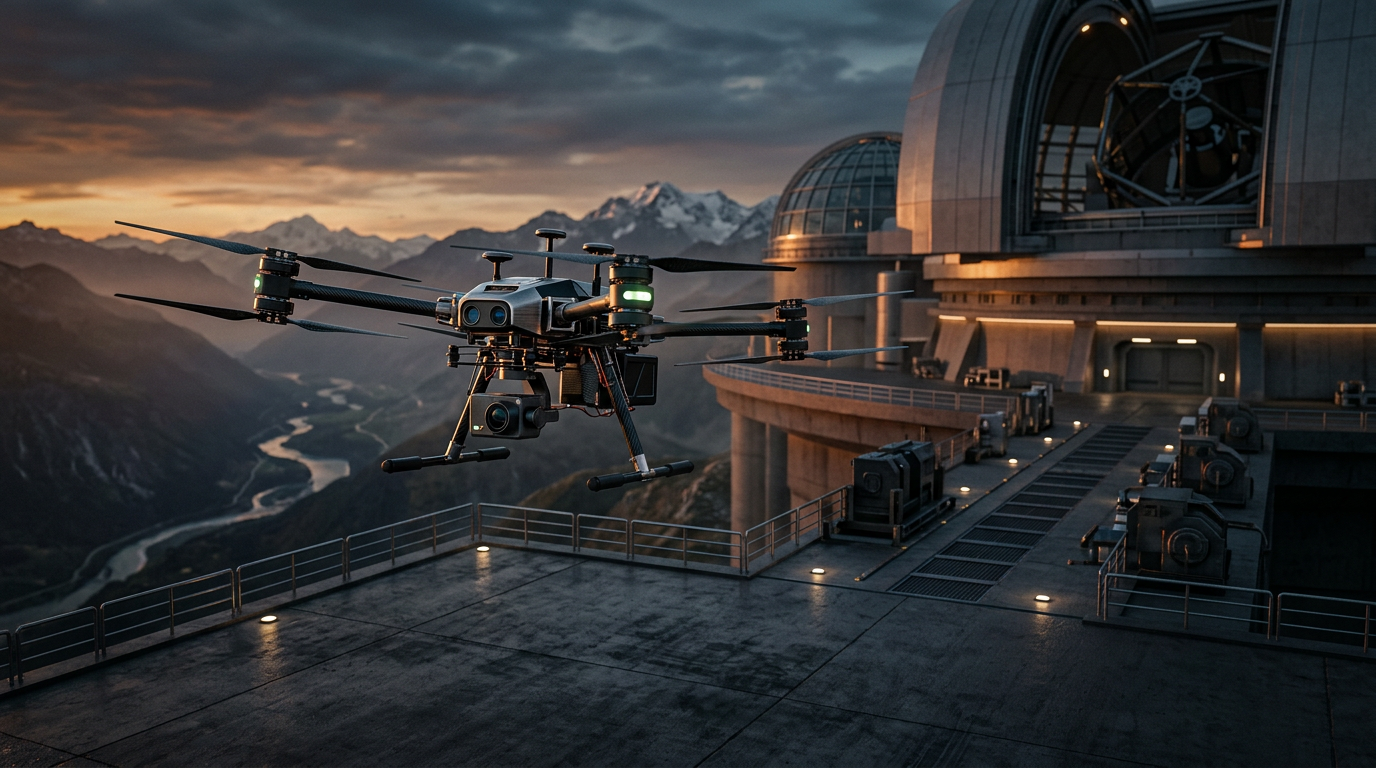 AI-generated
1. Executive Summary
In January 2026, SpaceX founder Elon Musk captured global attention at the World Economic Forum in Davos with a bold prediction: "The lowest-cost place to put AI will be in space, and that will be true within two years, maybe three at the latest." This statement, made as his company prepared for a potential IPO, was quickly followed by a SpaceX request to the Federal Communications Commission (FCC) for a constellation of orbital data centers comprising up to one million satellites, orbiting between 500 and 2,000 kilometers above Earth. Shortly before the rumored IPO date, Musk even shared initial specifications for a new data center satellite, the "AI-1," in a video interview.
However, rigorous analysis has subjected these claims to forensic scrutiny. Musk's history is dotted with optimistic timelines that rarely materialize: fully autonomous cars by 2017, the first human mission to Mars in 2026, or ten thousand Optimus robots by the end of 2025. The vision of massive orbital data centers, presented as a cost-effective alternative to terrestrial facilities within three years, faces a mathematical and logistical reality that defies credulity. Current satellite launch and manufacturing numbers reveal an abysmal gap between ambition and operational capacity.
This investigative report delves into the technical, economic, and strategic implications of Musk's proposal. With only about 14,500 active satellites in orbit today, of which Starlink already accounts for approximately two-thirds, the scale-up required to deploy one million orbital data centers is astronomical. It would necessitate an unprecedented increase in launch cadence and manufacturing capacity, which, according to projections based on current data, would take decades to materialize, if ever. The orbital data center "hype machine" may already be in orbit in the collective imagination, but physical and economic reality keeps it firmly anchored to Earth.
2. In-Depth Technical Analysis
Elon Musk's proposal for one million orbital data centers, with the AI-1 satellite as the spearhead, represents a bold conceptual leap, but its technical and logistical feasibility is, at best, extremely questionable. To understand the magnitude of the challenge, it is essential to break down the key components: launch capacity, satellite manufacturing, in-orbit support infrastructure, and the physical realities of operating data centers in space.
First, let's consider launch capacity. Musk's vision involves deploying one million satellites. If each SpaceX Starship, designed to carry up to 60 satellites, were exclusively dedicated to this task, 16,666 launches would be needed. To put this into perspective, in the entire history of humanity, approximately 7,000 orbital launches have been carried out. SpaceX, under Musk's leadership, has achieved impressive milestones, with a record of 165 orbital missions in 2025. However, even if SpaceX could multiply that cadence tenfold, performing 1,650 launches per year, the task of deploying one million satellites would require an entire decade of uninterrupted launches, dedicated exclusively to this project. This completely ignores the launch needs of Starlink, crewed missions, Earth observation satellites, military missions, and other commercial and scientific payloads. The global launch infrastructure is simply not prepared for such a volume, and the construction of thousands of additional launch pads and the production of rockets on that scale are engineering and manufacturing challenges that surpass any precedent.
Secondly, satellite manufacturing presents an even more severe bottleneck. Starlink, the world's largest satellite constellation, currently manufactures around 4,000 satellites per year. To produce one million data center satellites, even with a generous tenfold multiplication of Starlink's current manufacturing capacity (i.e., 40,000 satellites per year), the task would take 25 years. This assumes that AI-1 satellites are as simple to manufacture as Starlink satellites, which is unlikely given that they would house AI hardware and significant processing capabilities. A data center, even miniaturized, requires more complex components, advanced cooling systems, and greater redundancy than a standard communications satellite. Without a revolution in satellite manufacturing processes, going far beyond current automation, this timeline is unattainable.
Beyond manufacturing and launch, the technical challenges of operating data centers in orbit are formidable. AI servers generate a considerable amount of heat, and thermal dissipation in the vacuum of space is a complex problem. Active cooling systems would require additional power and mass, increasing the cost and complexity of each satellite. Space radiation is another critical factor; electronic components must be radiation-hardened, which increases costs and can limit performance. Communication latency, while potentially low for inter-satellite processing, becomes an issue when data needs to be sent to and from Earth, especially for AI applications requiring real-time interaction. Furthermore, maintaining and upgrading one million satellites in orbit, with rapidly evolving hardware, is logistically impossible with current technology. The lifespan of these satellites would be a critical factor, as the constant replacement of obsolete or failed units would add an unsustainable burden to launch and manufacturing cycles.
Finally, the question of cost. Musk claims that space will be the lowest-cost place for AI. However, the cost of launching and operating a single kilogram in orbit, while having decreased dramatically thanks to SpaceX, remains substantial. Multiplying this by one million satellites, each with its own processing, power, and cooling infrastructure, results in an initial and operational investment that dwarfs any terrestrial data center. The costs of development, manufacturing, launch, operation, maintenance, and deorbiting a constellation of this magnitude are immense. The promise of "lowest cost" seems to be based on an optimistic extrapolation of economies of scale that ignores the fundamental realities of space engineering and the lifecycle of AI components.
In summary, Musk's vision, while inspiring, clashes with the laws of physics, engineering, and economics at the proposed scale. Bottlenecks in manufacturing and launch, coupled with the inherent challenges of operating AI hardware in the space environment, make his 2-3 year timeline a pipe dream. The reality is that the infrastructure needed to support an orbital data center constellation of this magnitude is decades away, not years.
3. Industry Impact and Market Implications
The mere mention of orbital data centers on the scale proposed by Elon Musk, while currently unfeasible, has the power to generate significant ripples in the technology and space industry. The "hype" itself can influence market perceptions, investment decisions, and companies' long-term strategies, even if the technical reality lags far behind.
In the terrestrial data center and cloud computing sector, Musk's vision could, paradoxically, reinforce investment in existing infrastructure. Large cloud companies like AWS, Google Cloud, and Microsoft Azure, which already operate vast networks of global data centers, would see the orbital proposal as a distant threat and, therefore, would continue to consolidate and expand their terrestrial operations. The promise of "lower cost" in space, if taken seriously, could drive terrestrial providers to seek even greater efficiencies and to innovate in cooling, energy, and computing density to maintain their competitive advantage. However, the barrier to entry for orbital data centers is so high that it does not represent a credible short- or medium-term threat to the current business model.
For the space industry, Musk's proposal underscores the growing convergence between space and the digital economy. Although the scale is fantastic, the idea of processing data in orbit is not new. Satellites already perform on-board processing for specific applications such as Earth observation, where data reduction before transmission to Earth is crucial. Musk's vision, however, elevates this to a level of general-purpose computing, which could stimulate research and development in areas such as fault-tolerant computing in space, advanced thermal management, and high-speed satellite interconnectivity. Companies developing space-hardened components or power and cooling solutions for extreme environments could see an increase in interest, although the real demand for massive AI data centers in orbit does not yet exist.
The implications for the AI market are equally complex. If orbital data centers were to become a reality, they could offer unique advantages for certain applications. For example, real-time Earth observation data processing, artificial intelligence for autonomous space missions, or edge computing for globally distributed sensor networks. However, for most AI applications that require large volumes of training data and constant interaction with terrestrial users, the latency and bandwidth of Earth-to-space communication would remain a challenge. Furthermore, data security in an orbital environment, susceptible to cyberattacks and physical disruption, would raise new concerns for businesses and governments.
Finally, Musk's proposal impacts public perception and investment in the space sector. The "Musk effect" often attracts capital and talent to areas he highlights. This could lead to increased investment in startups promising solutions for space computing, even if their business models are speculative. However, there is also the risk that the failure of such ambitious projects could generate skepticism and disillusionment, affecting the funding of more realistic and pragmatic space initiatives. The key for investors and companies will be to discern between the long-term vision and short- to medium-term viability, avoiding being swept away by "hype" without a solid technical foundation.
4. Expert Perspectives and Strategic Analysis
From the perspective of aerospace engineering and data center architecture, Elon Musk's proposal for massive orbital data centers is met with a mix of admiration for its audacity and pragmatic skepticism. The consensus among space systems engineers and computing infrastructure architects is that while the idea of computing in space has merit for niche applications, the scale and timeline proposed by Musk are, at best, extreme hyperbole and, at worst, a distraction from the real challenges.
Industry experts point out that the main obstacle is not just launch or manufacturing capability, but fundamental physics. "Heat dissipation in a vacuum is a first-order engineering problem for any high-density computing system," comments a senior engineer from a major satellite company who prefers anonymity. "On Earth, we have the atmosphere and vast water resources for cooling. In space, we rely on radiation, which is much less efficient and requires large radiating surfaces, increasing the satellite's mass and volume. This, in turn, increases launch costs and complexity." Furthermore, protection against cosmic radiation and coronal mass ejections is vital for the reliability of AI chips, adding weight and cost to each unit.
From a strategic perspective, Musk's move can be interpreted in several ways. It could be a strategy to secure SpaceX's dominance in the launch market, creating massive internal demand for its own Starship rockets. If SpaceX were the sole provider capable of launching and maintaining a constellation of a million satellites, it would consolidate its position as the dominant player in the space economy. It could also be a way to attract talent and investment, painting a futuristic vision that resonates with engineers and venture capitalists. However, the credibility of these claims is undermined by Musk's history of missed deadlines, leading many to see this as another "call to action" for innovation, rather than a concrete business plan.
Musk's relationship with AI is complex and, in the current context (July 2026), is marked by his founding of xAI (creator of Grok 4.3) and his litigation with OpenAI. His interest in AI is undeniable, and his vision of orbital data centers could be an attempt to secure a strategic advantage in the AI race, freeing himself from the limitations of terrestrial infrastructure. However, current AI infrastructure, which relies on models like GPT-5.5, Claude 4.8 Opus, Gemini 3.5 Flash, Llama 4, and Qwen 3.7-Max, is trained and operated in massive terrestrial data centers, optimized for energy efficiency and low-latency connectivity. Replicating this in orbit, with power, cooling, and bandwidth limitations, is a challenge that goes beyond mere miniaturization.
A more sober strategic analysis suggests that space computing will develop incrementally, focusing on applications where on-board processing is indispensable. This includes data reduction for remote sensors, satellite and spacecraft autonomy, and perhaps, in the distant future, edge computing for interplanetary communication networks. The idea of a "general-purpose AI data center" in orbit, directly competing with terrestrial infrastructure, is a proposal that ignores Earth's inherent advantages in terms of gravity, atmosphere, access to resources, and ease of maintenance. Companies should focus on terrestrial solutions for most of their AI needs, while monitoring innovations in space computing for very specific, high-value applications.
5. Future Roadmap and Predictions
Given the magnitude of the technical and logistical challenges, the roadmap for orbital data centers, as envisioned by Elon Musk, extends far beyond the 2-3 years he predicts. A realistic assessment suggests that any significant implementation of AI computing in space, beyond current on-board processing capabilities, will develop in phases and over decades, not years.
In the short term (2026-2030), we will see a continuation of the current trend: an increase in on-board satellite processing capacity for specific tasks such as image preprocessing, anomaly detection, and autonomous constellation management. This will focus on optimizing the energy efficiency and radiation resistance of existing chips. Proof-of-concept tests with more advanced AI hardware on orbital platforms are likely to be conducted, but on a very limited scale, to evaluate performance and reliability in the space environment. The idea of an "AI-1" as a complete data center during this period is unfeasible.
In the medium term (2030-2040), we could see the emergence of orbital "mini-data centers" for niche applications. These could be specialized modules coupled with space stations or larger platforms, dedicated to high-performance computing tasks that benefit from proximity to space sensors or that require extremely low latency for inter-satellite communications. Advances in in-orbit manufacturing, robotic assembly, and advanced thermal management would be crucial for this phase. The ability to retrain AI models in orbit, while attractive, would require significant advances in downlink and uplink bandwidth, as well as in processor energy efficiency.
In the long term (2040 onwards), and only if fundamental obstacles in power, cooling, manufacturing, and maintenance in space are overcome, we could begin to see larger-scale orbital data center constellations. This would require an entirely new space infrastructure, including in-orbit service stations, refueling and repair capabilities, and perhaps even space resource mining for construction. The vision of a million data center satellites, competing with terrestrial infrastructure, remains a very distant horizon, conditioned on technological advances that today seem like science fiction. Musk's prediction of "lower cost" in 2-3 years is, therefore, a significant distortion of technological and economic reality.
6. Conclusion: Strategic Imperatives
Elon Musk's vision of massive orbital data centers, while stimulating, must be analyzed with a healthy dose of skepticism. As we have detailed, the challenges in launch cadence, satellite manufacturing capacity, thermal management, radiation protection, and operational costs are of a magnitude that places this proposal firmly in the realm of very long-term ambition, if not fantasy. The assertion that space will be the lowest cost location for AI in two or three years is, at best, a calculated hyperbole and, at worst, misinformation that could divert resources and attention from more pragmatic solutions.
For businesses and decision-makers, the strategic imperative is clear: do not get carried away by the "hype." Investment in AI infrastructure must continue to focus on terrestrial solutions, which offer reliability, scalability, cost efficiency, and ease of maintenance incomparable to any current orbital proposal. This includes optimizing existing data centers, exploring new edge computing architectures on Earth, and investing in renewable energy to power these facilities. While it is prudent to monitor advances in space computing for niche applications, such as Earth observation data processing or mission autonomy, the idea of moving general-purpose AI infrastructure into space is, for now, a costly distraction.
Ultimately, the orbital data center "hype machine" is already in orbit in public discourse, but technical and economic reality keeps it firmly anchored to Earth. True innovation in AI and computing will continue to occur on our planet, where costs are manageable, infrastructure is scalable, and engineering challenges, though complex, are fundamentally solvable with current technology. Musk's vision may inspire, but strategy must be based on reality.