Español
 English
 Français
 Português
 Deutsch
 Italiano
Tutor Intelligence Redefines Logistics Robotics: The Era of Foundation Models and Classroom Learning
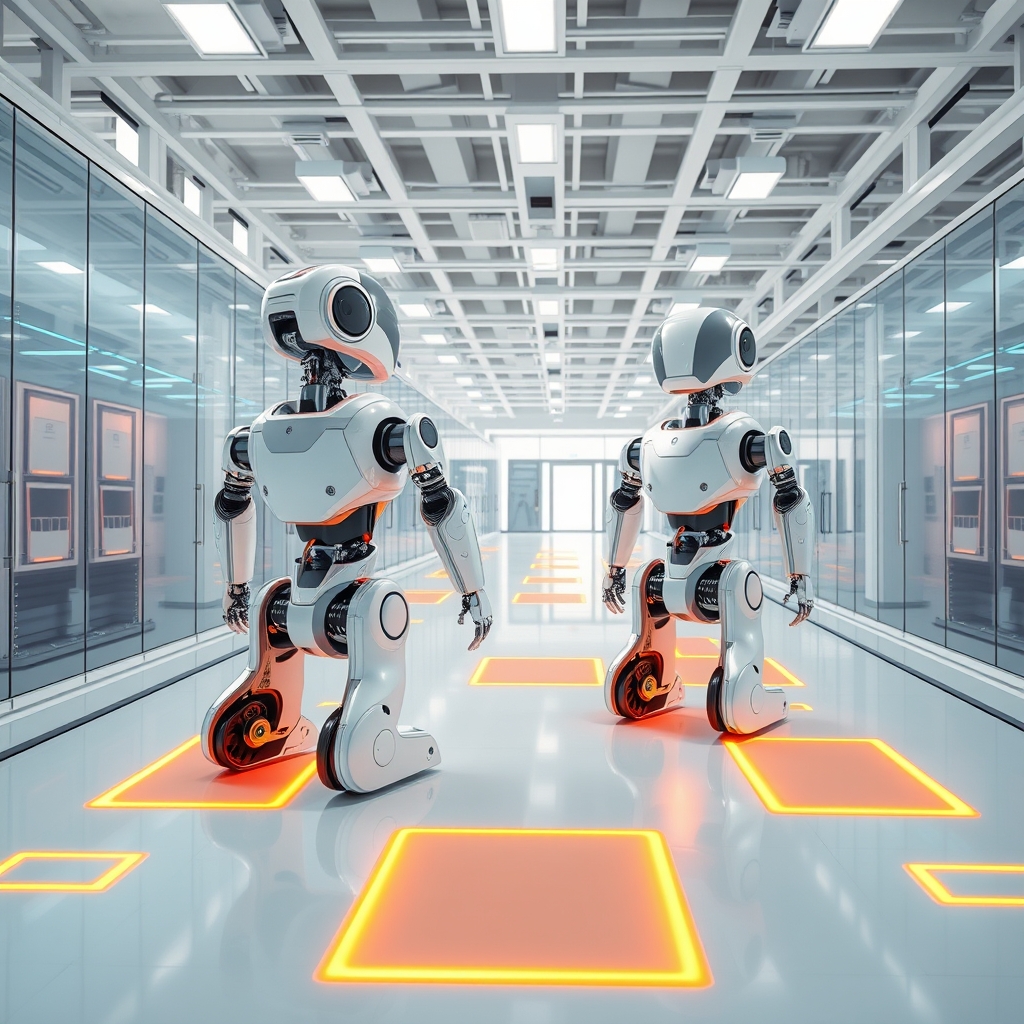 AI-generated
1. Context and Key Points
The logistics and warehousing industry is undergoing a fundamental shift. Tutor Intelligence has officially announced the deployment of its second generation of autonomous robots: Cassie and Sonny. This launch represents the culmination of a strategy focused on the integration of foundation models specifically designed for physical interaction in complex environments. The introduction of a training "classroom"—a controlled environment where robots acquire new skills before warehouse deployment—addresses the industry's primary challenge: adaptability. Industry analysts note that this advancement significantly reduces implementation costs and enhances flexibility in the face of volatile modern logistics demands.
2. Technical Highlights
The core of Tutor Intelligence's innovation lies in the evolution of its Ti0 model, a 4.5 billion parameter vision-language-action (VLA) system. Unlike traditional control systems based on rigid, hard-coded rules, the Ti0 model enables the Sonny and Cassie robots to interpret natural language instructions and translate them into precise physical actions. Sonny, the dual-arm semi-humanoid robot, has undergone significant refinement; its software architecture now allows for greater fluidity in object manipulation through deeper integration with the VLA model. This model processes visual data to identify products while simultaneously understanding task context, allowing the robot to adjust force and trajectory in real-time.
The "classroom" concept is the most disruptive element of the Tutor Intelligence ecosystem. In this environment, robots are subjected to training scenarios involving atypical or complex situations. By utilizing reinforcement learning and simulation techniques, robots retrain their movement policies without risking the integrity of goods or the safety of human workers. The architecture allows knowledge acquired by one robot to be propagated across the entire fleet, optimizing overall performance. Local processing capacity, combined with cloud synchronization, ensures minimal latency, while integration with large language models allows human supervisors to interact with robots using natural language commands.

3. Impact on the Sector
The second generation of Tutor Intelligence robots alters the cost structure of logistics automation. Historically, industrial robotics required massive investment in systems integration and custom programming. The capacity for autonomous learning in the classroom shifts the deployment cost toward a service subscription model, democratizing access for medium-sized companies. From a market perspective, this places pressure on traditional hardware manufacturers; competitive advantage now resides in the intelligence of the governing software rather than mechanical robustness alone. Workplace safety is also improved by delegating ergonomically hazardous tasks to robots with superior environmental perception. However, this transition necessitates workforce retraining, as companies must shift personnel toward technical supervision roles to manage these robotic classrooms.
4. Market Perspectives
Industry consensus indicates that Tutor Intelligence has successfully bridged the gap between generative AI and physical robotics. Sonny's fine manipulation capabilities, combined with the scalability of the Ti0 model, position the company as a leader in "last mile" automation. Organizations considering adoption should conduct a process audit to determine a hybrid strategy—deploying Cassie for transport and Sonny for complex manipulation. Data governance remains a critical priority; as robots learn continuously, companies must ensure that facility data is protected and that training processes comply with industrial privacy regulations. Furthermore, interoperability with existing warehouse management systems (WMS) remains the next significant hurdle for long-term integration.
5. Roadmap and Predictions
By late 2026 and early 2027, Tutor Intelligence is expected to expand its training classroom capabilities to include reverse logistics scenarios, addressing the variability inherent in product returns. In the medium term, we anticipate greater miniaturization of processing components, facilitating more complex inferences directly on the device (edge computing) and reducing reliance on constant connectivity. Long-term, the convergence of vision-language-action models and autonomous mobile robotics (AMR) will likely enable the creation of fully "dark" warehouses, where human intervention is restricted to high-level strategic oversight.
6. Conclusion and Assessment
The launch of the second generation of Tutor Intelligence robots represents a definitive shift in industrial automation. By enabling machines to learn in controlled environments via advanced foundation models, Tutor Intelligence has effectively removed the high entry barriers that previously restricted sophisticated robotics to large-scale e-commerce operators. For business leaders, the transition from hardware-centric projects to data-driven, continuous learning strategies is now an operational imperative. Organizations that integrate these intelligent platforms will be better positioned to scale operations and navigate the complexities of global supply chain volatility.