Español
 English
 Français
 Português
 Deutsch
 Italiano
Video Friday: The New Era of Lunar Robotics and Space Autonomy
 AI-generated
1. Context and Key Points
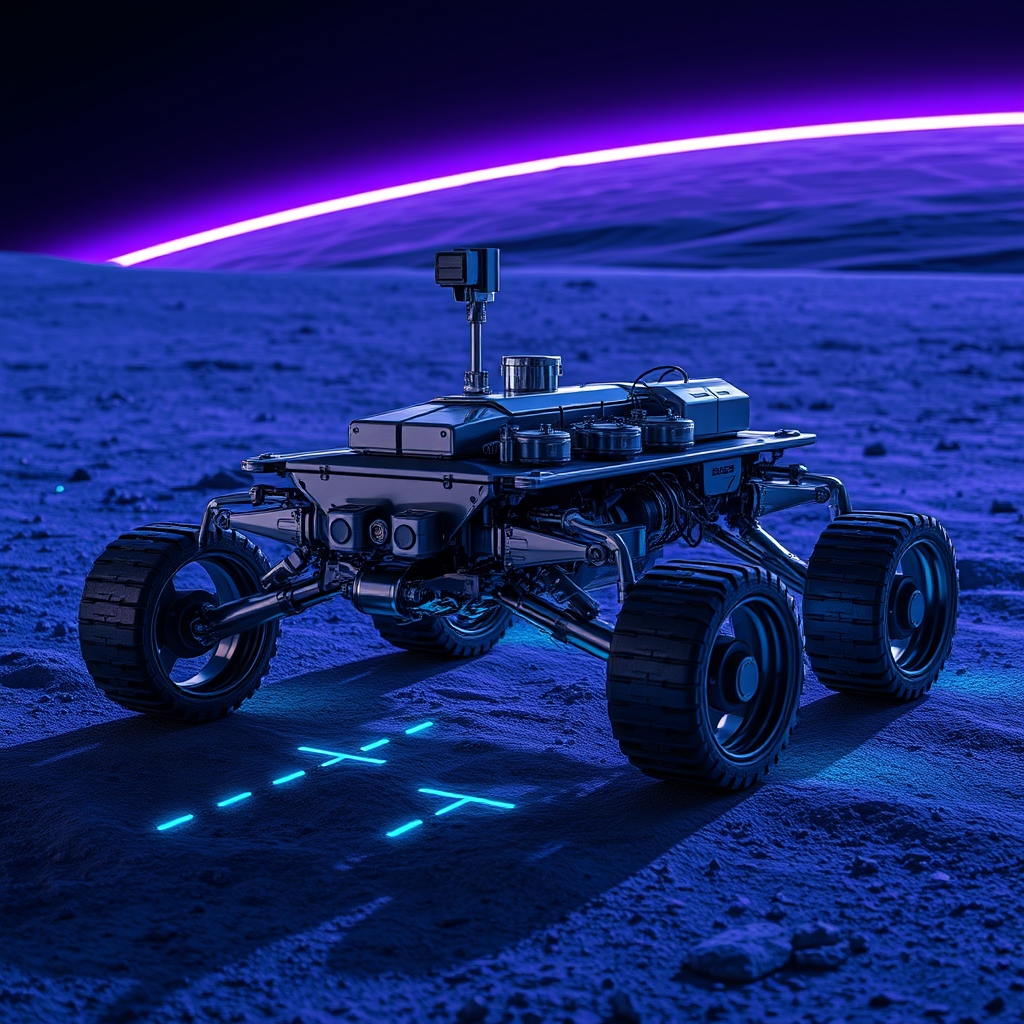
NASA's recent revelation of the PROMISE (Polar Rover for Observation, Mapping, and In-Situ Exploration) mission marks a turning point in lunar exploration strategy. By prioritizing the reuse of flight components and testbeds inherited from the Curiosity and Perseverance missions, the agency not only optimizes operating costs, but also establishes a new space engineering paradigm: modularity based on proven hardware. This approach is fundamental to the viability of the Moon Base Program, where hardware reliability is as critical as its rapid deployment capability.
Simultaneously, the terrestrial robotics ecosystem is experiencing an unprecedented technological convergence. From the integration of learned controllers in humanoid platforms like Atlas, to DARPA's advances in autonomous orbital manufacturing, the industry is demonstrating that the boundary between research robotics and industrial applications is blurring. For technology leaders and engineering directors, these developments signal a transition toward more resilient systems capable of operating in unstructured environments with minimal human intervention.
2. Technical Highlights
The PROMISE rover represents a systems engineering feat. The decision to use spare hardware from Mars missions allows NASA to mitigate the risks associated with developing new mobility subsystems. The architecture of Curiosity-class rovers has demonstrated exceptional robustness on the Martian terrain, and its adaptation for the lunar south pole, an environment characterized by cryogenic temperatures and extremely low illumination, requires specific adjustments in thermal management and autonomous navigation algorithms.
In the field of humanoid robotics, Boston Dynamics' experiment with Atlas illustrates a fundamental shift in control architecture. By replacing the end effectors and subjecting the robot to a learned controller, the team has managed to push the limits of the actuators. This approach, which combines traditional dynamic models with reinforcement learning policies, allows for greater tolerance to uncertainty in ground contact, a historic challenge in bipedal locomotion.
On the other hand, DARPA's program has achieved a milestone in-space manufacturing. The demonstration of a lattice structure built using a three-axis gantry robot underscores the feasibility of in-situ construction. The ability to connect composite lattice members while deploying a reflective mesh is a critical proof of concept for future large-aperture antennas, which would be impossible to launch in a deployed configuration due to volume constraints of current rockets. Integrating these systems requires a software infrastructure capable of managing latency and local autonomy. While lunar rovers rely on navigation autonomy based on stereo vision and local processing, terrestrial industrial robots are integrating advanced computer vision capabilities for real-time data reading, optimizing the supply chain with a precision that exceeds traditional manual methods. The convergence of these technologies suggests that the future of robotics lies not solely in computing power, but in the efficiency of the integration between physical hardware and control models. The reuse of components, as in the case of PROMISE, and the application of learned controllers, as in Atlas, demonstrate that optimizing development costs is just as important as innovating in the design of new actuators or sensors.
3. Industry Impact
The impact of these innovations on the market is profound. NASA's strategy of using existing hardware drastically reduces R&D costs, enabling a higher frequency of missions. For aerospace companies, this means the supply chain must adapt to a more predictable demand for high-reliability components, fostering a market for standardized deep-space parts.
In the logistics and security sectors, the resurgence of mobile robots and advanced robotics solutions indicates that the market is beginning to value real utility over novelty. The transition from experimental prototypes to security and inventory-counting tools suggests that deployment costs are reaching a break-even point where return on investment is justifiable for large-scale operations.
The automation of orbital manufacturing, driven by DARPA's program, opens up a new market category: space construction. As in-orbit infrastructure becomes more complex, the ability to assemble large structures in space will reduce reliance on heavy-lift launches, altering the economics of space logistics and enabling the creation of larger-scale space stations and observatories. Finally, the adoption of learned controllers in humanoid and quadruped robots is accelerating the adoption of robotics in hazardous or monotonous work environments. The ability of these systems to adapt to environmental changes without the need for exhaustive reprogramming reduces long-term operational costs, making automation accessible to a broader range of industries.
4. Market Outlook
Technical consensus suggests that the key to success in the coming decade will be interoperability. The ability to integrate components from different suppliers into a unified architecture, as seen in the PROMISE rover, is a lesson that terrestrial industry must adopt. Reliance on proprietary systems has historically been a bottleneck for the scalability of robotics.
Analysts emphasize that humanoid robotics, while impressive, must prove its value in specific tasks before achieving mass adoption. The approach of using learned controllers to maximize actuator performance is a necessary step to demonstrate that these robots can perform tasks that conventional systems cannot, thereby justifying their acquisition cost.
Regarding space manufacturing, the strategic recommendation is clear: companies must start considering in-orbit manufacturing as an extension of their terrestrial production capabilities. The ability to build structures in-situ is not just a technical advantage, but a competitive one that will allow organizations to lead in the emerging space economy. Robotic security, a market that many considered saturated or unviable, is proving to be a resilient niche. The key here is the integration of edge AI, allowing robots to make critical decisions without relying on a constant cloud connection, which is vital for security and privacy in corporate environments.
5. Roadmap and Future Predictions
For the 2027, 2028 period, the PROMISE mission is expected to begin its final integration testing, marking the start of a new phase in lunar exploration. The reuse of hardware from Mars missions will serve as a blueprint for future missions to other celestial bodies, reducing development times by approximately 30%.
This will open the doors to automation in sectors such as construction and emergency healthcare.
Orbital manufacturing, following the success of DARPA's program, will enter a scalability phase. By 2029, the first large-aperture antennas assembled in orbit are expected to be operational, providing unprecedented communication and Earth observation capabilities, which will transform global telecommunications infrastructure.
6. Conclusion and Assessment
The fundamental lesson from current developments is that innovation does not always require inventing new components, but rather the intelligent application of existing technologies. For CTOs and engineering directors, the imperative is clear: prioritize modularity and the reuse of proven hardware to reduce costs and accelerate time to market.
The integration of learned controllers and the automation of space manufacturing are not merely technical advances; they are strategic tools for gaining a competitive edge. Organizations that successfully integrate these capabilities into their current workflows will be better positioned to lead in a market that values resilience, adaptability, and operational efficiency over mere technological novelty.