Español
 English
 Français
 Português
 Deutsch
 Italiano
3D-Printed Molar Clip Converts Silent Mouth Movements into AI Commands
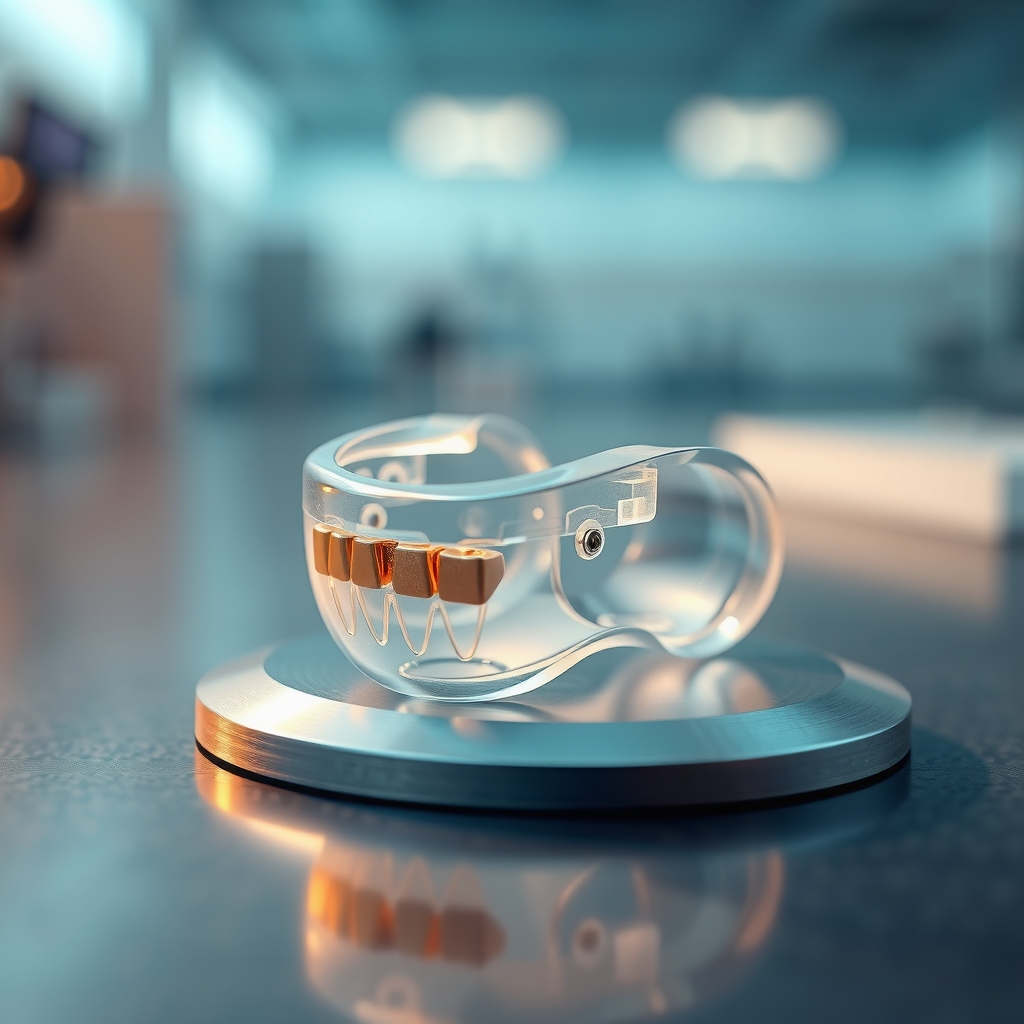 AI-generated
1. Context and Highlights
The convergence between 3D biomedical printing and ambient computing has taken an unexpected leap with the development of a molar clip capable of capturing subvocal micromovements and translating them into structured prompts for state-of-the-art language models. At a moment when frontier architectures compete to shave milliseconds off voice and text interfaces, this device proposes an alternative route that dispenses with audible phonation and body cameras altogether. The system operates via high-density piezoelectric sensors integrated into a biocompatible resin structure, recording mandibular kinematics with millimetric precision.
This advancement transcends ergonomic curiosity to establish itself at the core of discussions regarding human-machine interfaces. By transforming subvocalization and discrete molar gestures into direct instructions for inference engines, the technology redefines the concepts of accessibility and ubiquitous computing. However, it also shifts the security vector toward the user's anatomical environment, raising severe questions about the persistence of local biometric data, energy consumption in ultra-compact devices, and latency management in asynchronous workflows.
For technology directors and system architects, the device represents a disruption in traditional input channels. Far from being a mere aesthetic peripheral, the molar clip forces a reevaluation of abstraction layers in natural language processing and multimodal context management. Analyzing its underlying architecture allows for an understanding of how the boundaries between human physiology and silicon continue to dissolve at an accelerating pace.
2. In-Depth Technical Analysis
The core of this development lies in the integration of miniaturized piezoelectric transducers within a dental splint manufactured using high-resolution stereolithography. Each molar experiences unique pressure patterns during the silent articulation of phonemes, simulated mastication, or intentional tongue clicks. These physical changes deform the polymer matrix, generating electrical tensions that are converted by an ultra-low-power microcontroller into kinematic feature vectors.
Unlike surface electromyography systems located on the neck or external jaw, the intraoral environment offers an exceptionally high signal-to-noise ratio. The captured signals are not transmitted as raw audio, which drastically reduces the required bandwidth. Instead, an edge-integrated language model translates pressure patterns directly into semantic embeddings before sending them to the main model in the cloud or on local servers.
The communication architecture uses ultra-low-power short-range protocols to route data to a smartphone or an edge node. This flow avoids the bottlenecks typical of traditional voice recognition systems. Preliminary local inference classifies the molar gesture into a typified intention, optimizing computational cost and allowing models such as open-weight architectures (like open-weight architectures) in local environments or optimized clouds to receive clean and structured instructions.
From a hardware and silicon perspective, the greatest challenge has been thermal and energy management. The device operates on a miniature solid-state battery that recharges via electromagnetic induction or through the masticatory friction itself using experimental triboelectric systems. Firmware optimization requires that the memory footprint of the resident classification model on the chip occupies less than a few megabytes, operating under strict heat dissipation constraints to avoid any discomfort in the oral cavity.
Processing kinematic data requires advanced noise filtering techniques to isolate involuntary mastication, swallowing, or audible natural speech from intentional AI commands. Machine learning algorithms trained with high-frequency temporal sequences detect specific pressure signatures that act as activation keywords, ensuring that the system does not interpret every natural jaw movement as a query to the model.
Integration with current language models is achieved through APIs optimized to receive streams of discrete tokens derived from gestures. While native multimodal models process audio, video, and text simultaneously, this clip introduces a new modality: structured oral kinematics. This requires infrastructure providers to adapt their input layers to accept these kinematic tensors as a valid prompt channel, expanding the versatility of architectures.
Material durability is another critical pillar of the technical analysis. The oral cavity is a chemically hostile environment, subjected to pH fluctuations, salivary enzymes, and intense cyclic mechanical loads. Engineers have resorted to advanced ceramic coatings and medical-grade polymers reinforced with carbon nanotubes to ensure that the sensor encapsulation remains airtight and structurally intact during months of continuous use.
Finally, the initial calibration of the device represents a fascinating computational process. Given that dental anatomy and occlusion habits vary drastically between individuals, the system requires a personalized training phase where the user performs a series of standardized movements. This process adjusts the weights of the local classifier to adapt them to the unique kinematic signature of the wearer's dentition, ensuring high accuracy rates from the first day of use.
3. Impact on the Industry and Market Implications
| Input Modality | External Privacy | Perceived Latency | Required Bandwidth | Energy Consumption |
|---|---|---|---|---|
| Traditional Voice (Audio) | Low (audible in public) | Medium-High | High (Audio streaming) | Low (Standard hardware) |
| Tactile Text (Keyboard) | Medium (requires visual display) | Low | Low | Low |
| Computer Vision / Gestures | Low (exposed to cameras) | High | Very High (Continuous video) | High |
| 3D-Printed Molar Clip | Maximum (silent and invisible) | Very Low | Minimal (Local tensors) | Ultra low (Optimized) |
The introduction of this form factor immediately alters the value chain in wearable technology. Mobile device manufacturers and smart accessory makers are seeing the center of gravity of interaction shift from touch screens and wireless earbuds to the oral cavity. This transformation opens an entirely new market for digitized dental labs and orthodontic clinics, which can now act as distribution centers for advanced computational hardware.
For software companies and language model providers, the emergence of this input modality requires rethinking user-interface strategies. Prompts generated through molar movements tend to be more concise and structured than conversational voice queries, which changes average prompt length metrics and lowers inference costs per query. Organizations that achieve native compatibility certification with this type of device will gain a competitive advantage in professional settings where discretion and hands-free operation are operational imperatives.
The cybersecurity and corporate privacy market also experiences a ripple effect. Financial analysts and executives operating in public spaces or high-confidentiality meetings find the molar clip an ideal tool for interacting with AI systems without revealing information via voice or exposing screens to potential third-party observation. However, this also introduces new physical security and spoofing risks, as unauthorized capture of intra-oral signals could become a novel attack vector.
Economically, the adoption of this technology will depend on the scalability of its manufacturing. High-precision, patient-specific 3D printing raises the initial unit cost compared with mass-produced earbuds. Nevertheless, the automation of computer-aided design workflows and the maturation of biocompatible resins point toward a sustained reduction in production costs in the medium term.
4. Market Perspectives
Industry analysts agree that the greatest merit of this innovation lies not exclusively in the miniaturization of the sensor, but in redefining the bodily boundary in ubiquitous computing. The integration of interfaces directly into the stomatognathic system demonstrates that the evolution of form factors aims to eliminate the social friction associated with speaking into the air or gesturing in front of screens in public spaces.
From a software engineering perspective, AI platform developers are advised to prepare their systems to handle highly compressed multimodal data streams. The exclusive reliance on voice and text as standard inputs is yielding ground to direct kinematic and neural streams. Companies that design their APIs in an open manner to receive these structured tensors will lead the next wave of adoption in industrial and office environments.
Experts in ergonomics and dental health, however, point out the need for rigorous monitoring of the long-term impact of foreign bodies on dental occlusion. Although the materials used are inert and the design strictly conforms to the geometry of the user's molars, any millimetric alteration in the bite can generate muscle fatigue or temporomandibular joint problems if the device is not designed with absolute biomechanical rigor.
Corporate technology departments are recommended to evaluate the potential of these interfaces for field workers, medical personnel, and critical infrastructure operators, where the use of hands and voice is compromised. The ability to issue complex commands completely silently and without diverting visual attention represents a substantial operational leap over traditional mobile terminals.
5. Future Outlook
The evolution of smart molar clips will follow a predictable trajectory, marked by convergence with additional biological sensors and improvements in energy efficiency.
- Phase 1 (Short term): Expanded clinical validation and deployment in closed professional environments for high-security personnel and reduced mobility. Optimization of local classifiers for edge language models.
- Phase 2 (Medium term): Integration of salivary biometrics and vital-sign monitoring into the same dental form factor, allowing the device to serve not only as an AI command interface but also as a continuous preventive health node.
- Phase 3 (Long term): Standardization of ultra-low-power intra-oral communication protocols and massive adoption in everyday workflows, directly competing with smart rings and augmented glasses as the preferred silent input method.
As ambient computing matures, the distinction between external devices and intelligent functional prostheses will become increasingly blurred. The ability to interact with advanced artificial intelligences through an imperceptible molar movement marks the beginning of an era where technology is firmly anchored in human biology.
6. Summary & Assessment
The development of the 3D-printed molar clip that translates micro-movements into AI prompts transcends the category of a technological anecdote to become a clear symptom of where interaction architecture is headed. Eliminating friction between thought, anatomical gesture, and the language model's response redefines expectations of speed and privacy in modern computing.
For technology leaders, the immediate imperative is to audit the flexibility of their input architectures. AI-based applications and services must prepare to receive non-traditional data streams, optimizing their processing layers to handle structured intents at the edge. Ignoring these kinetic signals would be akin to overlooking the revolution that the shift from command line to graphical user interface once represented.
Ultimately, technology shows that true computational invisibility is achieved when the human body becomes the input peripheral itself. Managing this transition toward anatomical integration will require a rigorous balance between design ambition, data security, and absolute respect for the user's physiological health.