Español
 English
 Français
 Português
 Deutsch
 Italiano
Agile Robots Secures $500 Million Led by SoftBank, Reaching $8.5 Billion Valuation
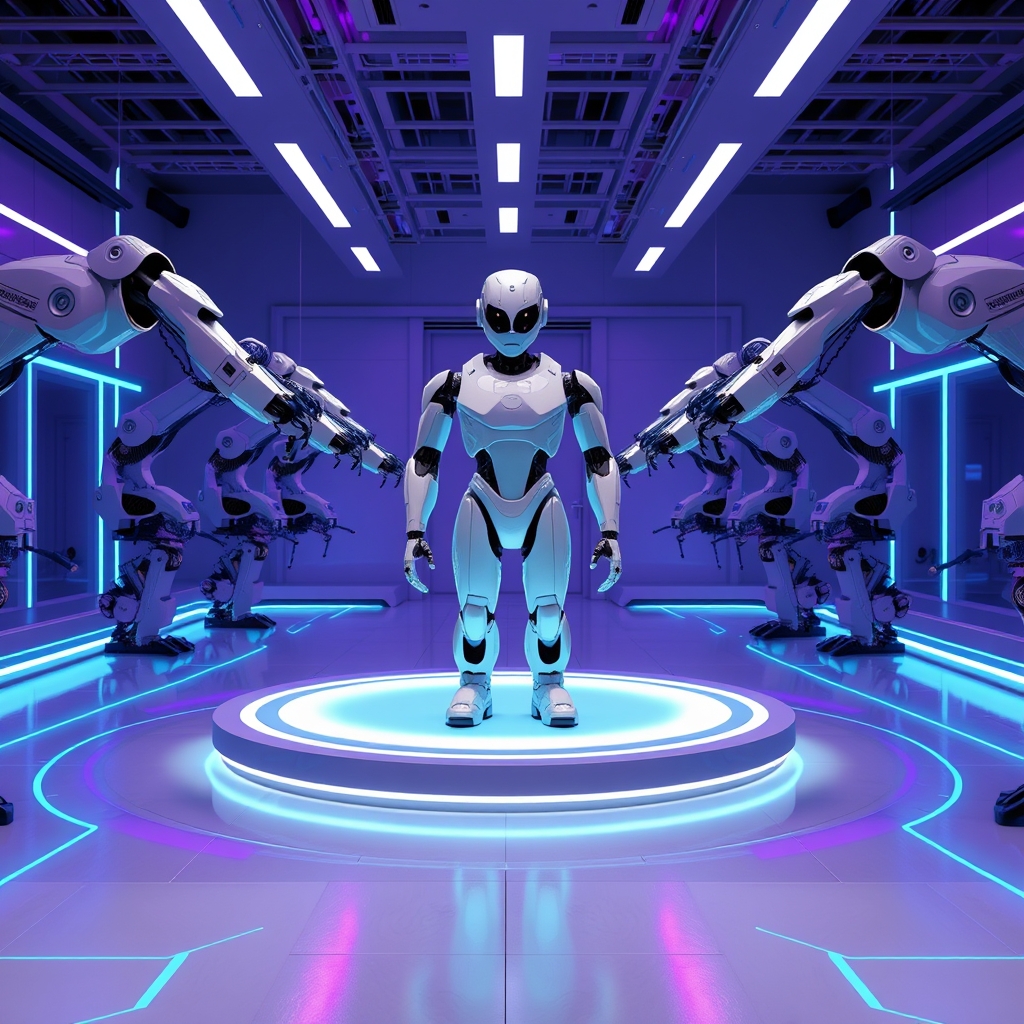 AI-generated
1. Context and Key Points
The global intelligent automation industry has just witnessed one of the most significant capital movements in recent years. Agile Robots SE, the Munich-based company specializing in the integrated development of robotic systems, articulated arms, mobile platforms, and humanoids equipped with proprietary control software, has completed a $500 million funding round. The operation was led by SoftBank Group Corp., an investor that thereby reaffirms its bet on the convergence between artificial intelligence and general-purpose robotics.
This capital injection raises the valuation of the German company to $8.5 billion, placing it in the select group of high-tech industrial unicorns with global reach. Far from being a mere speculative venture capital exercise, the round responds to the accelerated demand for advanced automation in complex industrial environments and to the commercial maturation of control architectures based on machine learning and high-precision force sensors. For technology directors, manufacturing engineers, and market analysts, this move marks a turning point. The transition from traditional closed-loop industrial robots to autonomous systems capable of manipulating objects with near-human dexterity ceases to be a laboratory promise and becomes an industrial competitiveness imperative. How these financial resources are deployed will determine the pace at which next-generation robotics penetrates global supply chains strained by rising labor costs and the need for extreme operational flexibility.
2. Highlighted Technical Aspects
The core of Agile Robots' technological proposal lies in the symbiotic convergence between high-precision hardware and adaptive control software. Unlike traditional robotic arm manufacturers that sharply separate hardware kinematics from the logical programming layer, Agile's architecture is built on native integration. Its systems combine highly sensitive tactile and force sensors in the joints with real-time impedance control algorithms, allowing manipulators to react to unforeseen physical disturbances within fractions of a millisecond.
The company's offering ranges from collaborative robotic arms and autonomous mobile platforms to the development of humanoid systems aimed at complex manipulation and assembly tasks. This modular approach relies on a unified software platform that serves as the robot's central operating system. That platform translates high-level commands, processed through computer-vision models, into safe, physically optimized kinematic trajectories. At the local processing level, Agile Robots' systems address one of modern robotics' most critical challenges: reducing latency in the control loop. While high-level cognitive tasks can be offloaded to cloud computing infrastructures or high-capacity on-premise servers with advanced accelerators, fine motor execution requires rigorous, deterministic edge inference processing. The company has optimized its software stacks to minimize energy consumption and maximize sensor sampling rates, ensuring the robot's physical behavior maintains mathematical stability even under heavy dynamic load. The scalability of these systems critically depends on the software's generalization capability. Using advanced simulation techniques in virtual environments and learning transfer from the simulated domain to the real world, Agile Robots dramatically reduces the time required to program new industrial tasks. Workstations no longer need exhaustive manual parameterization of every trajectory point; integrated models interpret the spatial goal and autonomously adjust the end-effector's degrees of freedom. The underlying infrastructure supporting this massive deployment requires rigorous management of compute resources and connectivity. Integrating heterogeneous fleets of mobile robots and fixed arms demands low-latency synchronization protocols on the factory floor. The robustness demonstrated by Agile's control software in handling these distributed communications has been a decisive factor in attracting institutional investors of SoftBank's scale.
3. Industry Repercussions
The $8.5 billion valuation achieved by Agile Robots redefines evaluation metrics for the advanced robotics sector in Europe and globally. For years, the European ecosystem has been distinguished by its excellence in precision engineering and mechanical manufacturing, but it has faced chronic challenges in scaling technology companies to the megacapitalization range without resorting to premature acquisition by US or Asian tech giants. This round led by SoftBank demonstrates that European high-tech champions can retain their independence and capture massive value while remaining at the center of the industrial board.
For the global business fabric, especially in high-assembly-intensity sectors such as automotive, consumer electronics, and precision logistics, the availability of truly versatile robotic systems alleviates structural pressures arising from the shortage of skilled labor. The operational costs associated with the integration and maintenance of rigid production lines have historically penalized the agility of supply chains. With platforms capable of reconfiguring themselves through software updates and real-time visual adaptation, the total cost of ownership decreases substantially over the equipment's useful life cycle. The market for humanoid robotics and advanced collaborative arms thus enters a phase of consolidation where accumulated capital will determine who establishes the de facto standards. Agile Robots' ability to deploy its solutions at a global commercial scale will create direct competitive pressure on traditional industrial machinery manufacturers, forcing them to accelerate their own digital transformation roadmaps and to acquire competencies in artificial intelligence applied to physical control.
| Strategic Indicator | Current Value / Detail | Market Implication |
|---|---|---|
| Funds Raised | $500 million | Accelerated expansion of production capacity and global R&D. |
| Post-Money Valuation | $8.5 billion | Consolidation as a leading unicorn in advanced robotics. |
| Lead Investor | SoftBank Group Corp. | Strategic bet on the convergence of AI and physical automation. |
| Technological Core | Integrated hardware + Proprietary control software | Drastic reduction of latency in the kinematic control loop. |
4. Strategic Analysis
The consensus among industry analysts is that Agile Robots' success does not reside solely in the excellence of its mechanical manipulators, but in its full-stack approach. By simultaneously designing the physical components and the algorithmic control layer, the company avoids the integration inefficiencies that often burden automation projects in complex industrial environments. This vertical integration enables parametric optimization that external integrators rarely achieve.
From a corporate strategy perspective, SoftBank's entry brings not only financial muscle but also access to a global ecosystem of first-tier technology partners and industrial clients. SoftBank's experience in scaling high-tech intensity companies facilitates Agile Robots' transition from a project-based engineering growth model to a scheme of standardized products and massive deployments in a platform-as-a-service format (Robotics-as-a-Service). Chief Technology Officers and operations leaders are advised to evaluate the maturity of their own data architectures before initiating pilots with next-generation advanced robotic systems. Machine learning-based automation requires clean, structured, and accessible data flows from the factory floor. Organizations that maintain disconnected information silos will experience significant operational frictions when attempting to integrate adaptive platforms such as those developed by Agile Robots.
5. Next Steps
With the funds secured in this round, Agile Robots' roadmap for the next twenty-four months will focus on three priority pillars: expanding its manufacturing capacity to industrial scale, deepening the cognitive capabilities of its humanoids through the integration of advanced multimodal models, and deploying technical and commercial support networks in the North American and Asian markets.
In the medium-term horizon, the company is expected to introduce iterations of its control software capable of operating with a higher degree of autonomy in unstructured scenarios, reducing the need for human supervision in maintenance tasks and the resolution of unforeseen anomalies. The convergence between advances in large-scale language models and precision kinematics will enable human operators to interact with robotic fleets using natural language, radically simplifying the parameterization of new assembly lines. By the end of the decade, the standard in the manufacturing industry will have definitively shifted toward heterogeneous fleets where collaborative arms, mobile robots, and humanoids operate under a unified software orchestration, consolidating intelligent automation in the global industrial fabric.
6. Conclusion
The $500 million funding round led by SoftBank in Agile Robots underscores the commercial maturity of advanced robotics and its consolidation as a fundamental pillar of the future industrial economy. With a valuation of $8.5 billion, the Munich-based company demonstrates that the combination of precision engineering and adaptive control software represents one of the most attractive investment opportunities in the current technological landscape.
For engineering leaders and chief executives, this deal with Agile Robots confirms that flexible automation has ceased to be a tactical option and has become an existential variable of competitiveness. Organizations must audit their current technological integration capabilities, ensure the interoperability of their data infrastructures, and prepare the ground for the incorporation of high-capacity autonomous robotic systems. The competitive advantage will belong to those who know how to effectively integrate artificial intelligence into the physical world with the help of proven platforms such as those from Agile Robots, before market pressure makes traditional operating models unviable.