Español
 English
 Français
 Português
 Deutsch
 Italiano
Agile Robots Secures $500 Million to Scale Global Production Capacity in Advanced Robotics
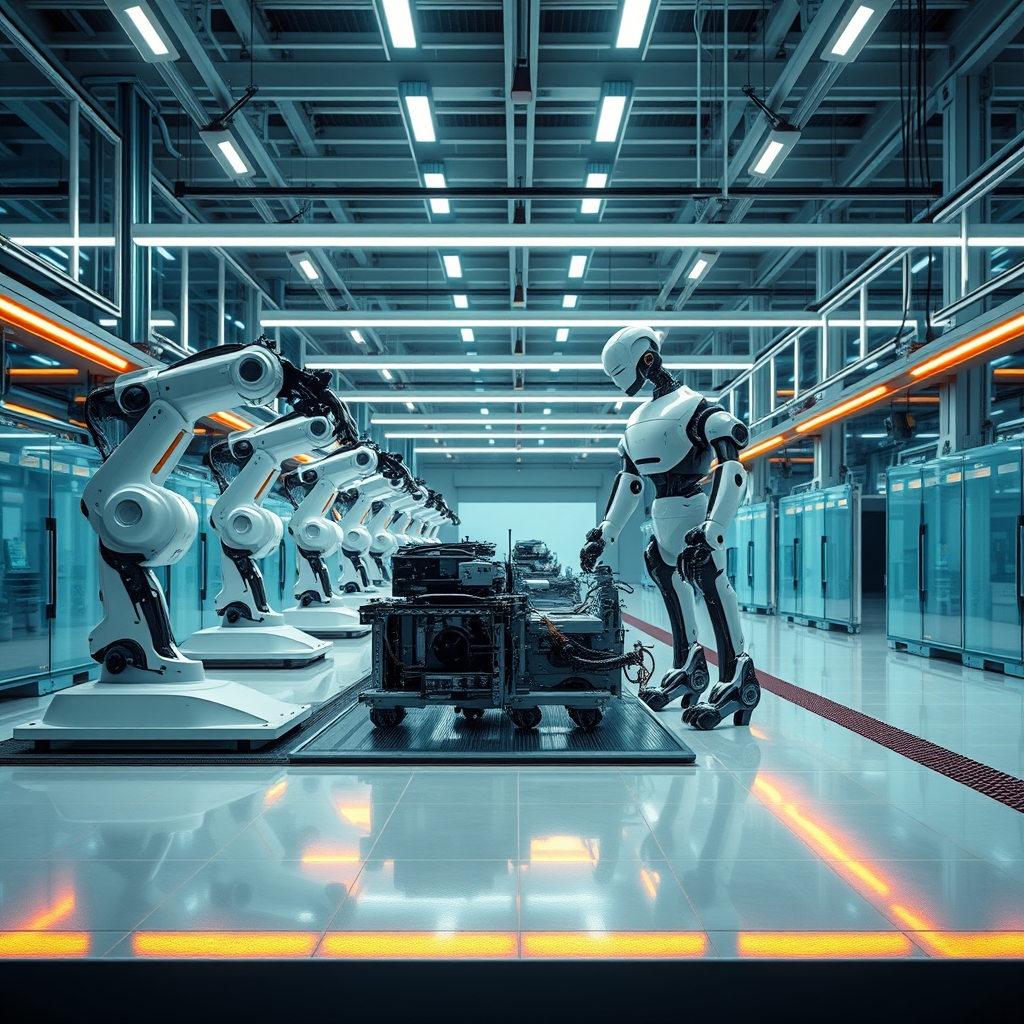 AI-generated
1. Context and Key Points
The industrial automation and humanoid robotics sector has reached a critical strategic inflection point. Agile Robots has announced the closure of a $500 million financing round, with the primary objective of scaling physical production capacity. In an industry where the transition from research-grade prototypes to commercial-scale assembly lines remains the primary bottleneck, this capital injection represents a decisive operational shift. The company's strategy is distinguished by its heterogeneous product portfolio. Unlike competitors focused exclusively on bipedal androids or traditional articulated arms, Agile Robots designs and deploys a comprehensive ecosystem that includes bipedal humanoids, autonomous mobile platforms, high-precision robotic arms, and haptic-enabled robotic hands. This multi-format approach necessitates a robust, highly automated supply chain and advanced assembly facilities. For operations engineers and industry analysts, this development signals the market's urgency to move beyond the prototype phase, addressing the unmet demand for flexible automation in complex sectors such as automotive manufacturing, consumer electronics, and heavy logistics.
2. Technical Highlights
The technological architecture of Agile Robots relies on the tight integration of high-precision kinesthetic manipulation and real-time multimodal perception. Their systems utilize torque sensors in every joint, coupled with force and position control loops operating at ultra-high frequencies. This enables both robotic arms and mobile platforms to interact with unstructured environments without requiring rigid or pre-programmed tooling. Within this ecosystem, the robotic hands serve as a critical component. By utilizing dense tactile matrices on the fingertips, these grippers address the historical challenge of manipulating deformable, fragile, or irregularly shaped objects. Integrating these hands with articulated arms requires extremely low latency in internal communication buses and precise kinematic synchronization to maintain control during fine assembly tasks. The company's humanoid systems inherit this force-control engineering, allowing them to navigate infrastructure originally designed for humans, a feat that requires sophisticated gait dynamics, balance control, and optimized energy management. The $500 million investment will directly facilitate the redesign of manufacturing processes. Historically, the production of elastic actuators and high-torque-density transmission systems has been costly due to tight-tolerance machining and manual assembly. Scaling production requires the implementation of robotic assembly lines capable of self-replicating components, thereby reducing unit costs. Furthermore, the software layer leverages virtual simulation environments based on realistic physics; as unit production increases, the volume of operational data collected from customer facilities will grow, providing the necessary feedback for retraining navigation and manipulation policies.
3. Industry Impact and Market Consequences
The global automation market is currently navigating chronic labor shortages and rising operating costs. Agile Robots' ability to provide a diversified portfolio positions the company advantageously against traditional original equipment manufacturers that rely on static, closed catalogs. Hardware diversification provides a clear competitive edge: a single facility may require autonomous mobile robots for logistics, robotic arms for welding, and humanoids for general handling. Centralizing procurement with a vendor that integrates these elements under a unified software platform significantly reduces systems integration friction.
| Robotic Form Factor | Main Application | Plant Operational Advantage |
|---|---|---|
| Robotic Arms | Assembly, welding, and dispensing | High repeatability and dynamic force control. |
| Mobile Platforms (AMR) | Internal logistics and material transport | Autonomous navigation without guided infrastructure. |
| Haptic Robotic Hands | Handling delicate parts and fine assembly | Distributed tactile sensitivity and grip adaptability. |
| Humanoids | Multi-purpose tasks in human-designed spaces | Spatial versatility without facility redesign. |
The implications for the global supply chain are profound. By concentrating production in highly technologized facilities, Agile Robots mitigates geopolitical and logistical risks that have historically plagued the electromechanical component industry. This proximity between design, software development, and physical manufacturing accelerates product iteration cycles and exerts pressure on established industrial giants to prioritize algorithmic flexibility and native AI integration over legacy hardware.
4. Market Outlook
Industry analysts emphasize that the primary challenge for advanced robotics is no longer technical viability, but industrial scalability and long-term reliability in three-shift environments. Agile Robots' decision to allocate the $500 million primarily to production capacity reflects a mature understanding of market requirements. Chief operations officers demand clear metrics regarding mean time between failures (MTBF) and total cost of ownership (TCO) before committing to large-scale deployments. Mass-production capability ensures not only a steady supply of units but also the availability of spare parts and standardized technical support. The success of this expansion will depend on the company's ability to simplify integration into existing factory software infrastructures. The adoption of open communication standards and the provision of robust programming interfaces will determine the speed at which customers can incorporate these systems into their manufacturing execution systems. This funding secures Agile Robots' position in the competitive race for dominance in embodied robotics, with real-world validation in production lines serving as a trust multiplier for future corporate adopters.
5. Next Steps
The execution of this capital injection follows a clear chronological progression over the next twenty-four months:
- Assembly plant optimization: Deployment of automated manufacturing machinery to reduce cycle times for actuators and control boards.
- Humanoid volume increase: Transition from limited-batch production to stable commercial series for pilot deployments in logistics and light manufacturing.
- Software evolution: Integration of next-generation perception and control models to enhance autonomy in mobile robots and articulated arms.
- Consolidation of the partner ecosystem: Strategic alliances with global system integrators to ensure service coverage in international markets.
Looking toward the technological horizon, the convergence of advanced language models, vision systems, and low-latency physical control will transform these robots from tools programmed via rigid trajectories into autonomous agents capable of interpreting natural language instructions and adapting dynamically to assembly line variations.
6. Conclusions and Assessment of Agile Robots
The $500 million financing round secured by Agile Robots marks a definitive milestone in the maturation of the advanced robotics and humanoid manufacturing sector. The era of conceptual prototypes has transitioned into a phase of installed industrial capacity, where hardware scalability and operational reliability serve as the primary vectors of competitive differentiation. For technology leaders evaluating the integration of Agile Robots, the implications are clear: the company's multi-format portfolio, spanning high-precision arms to bipedal humanoids, represents a critical lever for achieving manufacturing resilience and cost optimization in modern industrial environments.