Español
 English
 Français
 Português
 Deutsch
 Italiano
Anthropic's Claude Science Redefines Scientific Research and the Carbon Challenge in California
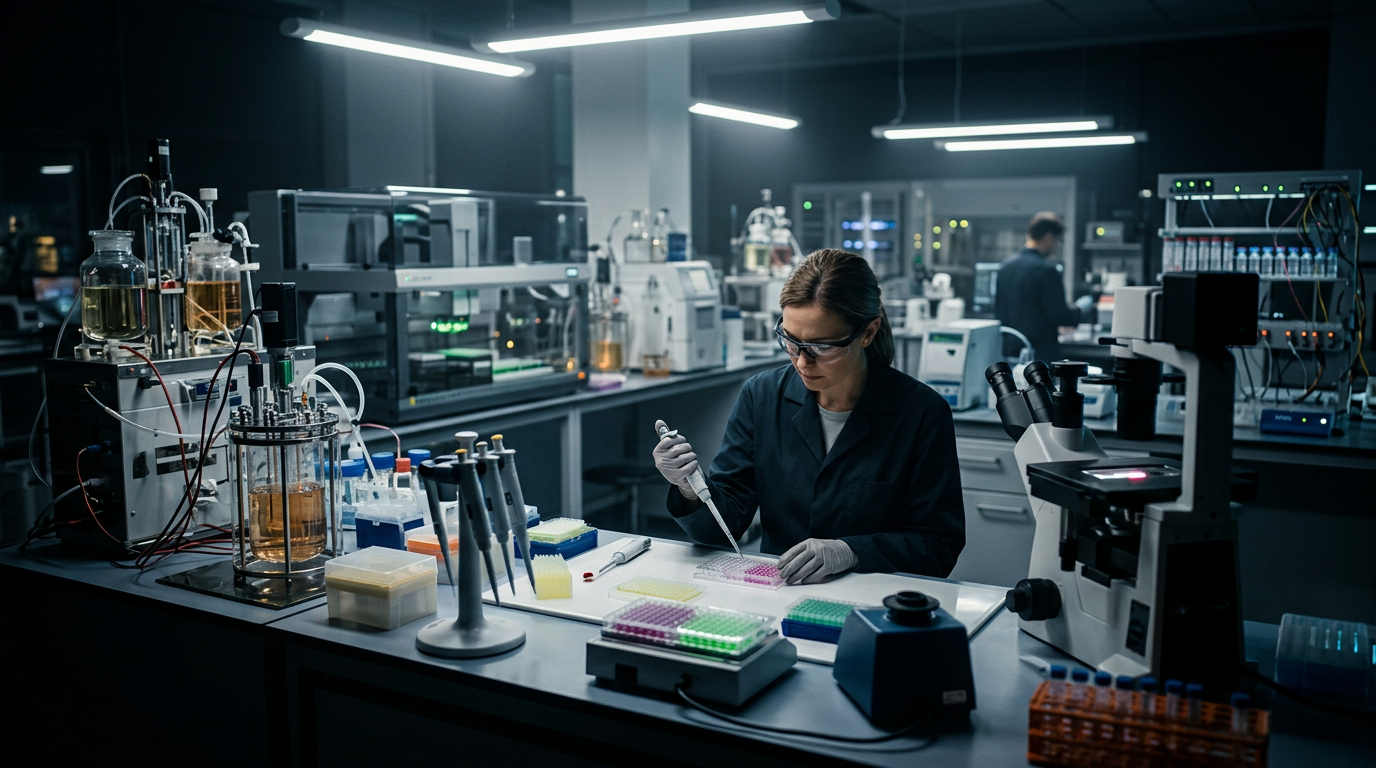 AI-generated
1. Executive Summary
At a key event held yesterday for pharmaceutical executives, biotech founders, and researchers, Anthropic unveiled Claude Science, a new and significant extension of its flagship model Claude Claude 4.8 Opus. This launch marks a bold and deeply strategic foray into the realm of scientific research, promising to transform how discoveries are approached in fields as complex as medicine and biology. Anthropic's initiative is not merely a product update; it is a statement of intent that positions artificial intelligence as an indispensable partner at the forefront of human knowledge.
The relevance of Claude Science transcends mere technological advancement. Its arrival raises fundamental questions about the acceleration of innovation, ethics in AI-assisted research, and the redefinition of scientific workflows. This development is crucial for any player in the science and technology ecosystem: from large pharmaceutical companies seeking to reduce drug development costs and time, to biotech startups aiming to democratize research, to academics looking for tools to navigate the explosion of scientific data. The ability of an AI model to understand, synthesize, and generate hypotheses from vast corpora of scientific literature and experimental data could be an unprecedented catalyst for progress.
In parallel, and as a reminder of AI's omnipresence in solving complex real-world problems, the news has also highlighted the intricate "manure carbon calculation" in California. This challenge, which involves modeling and quantifying greenhouse gas emissions from agriculture, illustrates the critical need for AI that is not only powerful, but also precise, transparent, and verifiable. The juxtaposition of Claude Science with this environmental problem underscores a central theme: AI is being deployed in high-stakes domains where accuracy and reliability are paramount, and where errors can have significant economic, social, and environmental consequences. Both events, though disparate in nature, converge on the imperative demand for robust and reliable artificial intelligence.
2. Deep Technical Analysis
Claude Science is not simply a version of Claude Claude 4.8 Opus with a new name; it represents a deep specialization and significant retraining on a data corpus specifically designed for the scientific domain. While Claude Claude 4.8 Opus is already recognized for its advanced reasoning capabilities and extensive context window, Claude Science takes these capabilities to a new level, adapting them to the unique demands of scientific research. This implies an underlying architecture optimized for processing highly structured and often knowledge-dense information, such as research articles, patents, genomic databases, molecular structures, and experimental results.
The key to its differentiation lies in the training dataset. It is speculated that Anthropic has curated and utilized a massive corpus that includes the entirety of PubMed, chemical databases such as PubChem and ChEMBL, biological sequence repositories like GenBank, and a vast collection of peer-reviewed scientific literature, technical reports, and clinical trial data. This specialized training allows Claude Science not only to understand scientific terminology but also to grasp causal relationships, experimental methodologies, and the logical inferences inherent in the scientific process. Its ability to handle an exceptionally large context window (rumored to exceed one million tokens, essential for analyzing complete research articles or even multiple related documents simultaneously) is fundamental to its utility in knowledge synthesis and complex hypothesis generation.
A critical aspect for any AI in the scientific domain is accuracy and the mitigation of hallucinations. Anthropic, with its focus on "Constitutional AI," has implemented mechanisms to align the model with ethical and safety principles. In Claude Science, this translates into an emphasis on the verifiability of claims. The model is designed to cite specific sources when generating summaries or hypotheses, and to point out uncertainties or gaps in knowledge. This is vital in a field where falsehood can have serious consequences, from the loss of research time and resources to public health risks. Claude Science's ability to perform scientific reasoning, such as inferring possible drug-receptor interactions or predicting protein stability, is based on a deep understanding of the underlying principles of chemistry and biology, not just statistical correlation.
In addition to its natural language processing capabilities, Claude Science integrates functionalities that facilitate interaction with scientific tools. This could include APIs for integration with molecular modeling software, bioinformatics platforms, or laboratory information management systems (LIMS). The ability to translate natural language questions into structured queries for scientific databases or to interpret the results of complex simulations is a key differentiator. This positions it not only as a research assistant but as an active component in the discovery cycle, from ideation to result interpretation.
In contrast, the challenge of manure carbon calculation in California, though seemingly distant, highlights the universal need for robust and verifiable AI. This problem involves modeling methane and nitrous oxide emissions from livestock operations, a calculation that depends on complex variables such as
Competition in this niche will be fierce. Companies like Schrödinger, Insilico Medicine, and BenevolentAI, which already use AI for drug discovery, now face an LLM giant entering their territory with a very powerful value proposition. Anthropic's advantage could lie in the scale of its base model (Claude Claude 4.8 Opus), its general reasoning capability, and its focus on safety and interpretability, which could generate greater trust in a highly regulated sector. However, these specialized companies have deep domain expertise and proprietary datasets that should not be underestimated. The key will be integration: will Claude Science be able to integrate seamlessly into existing workflows or will it require a complete restructuring?
In the field of academic research, Claude Science has the potential to democratize access to cutting-edge research tools. Researchers in smaller labs or with limited budgets could access data analysis and hypothesis generation capabilities that were previously reserved for institutions with vast computational resources. This could accelerate literature review, identification of emerging trends, formulation of new research questions, and grant proposal writing. However, it also raises significant ethical challenges, such as the authorship of AI-assisted discoveries and the need to maintain human critical thinking in the face of the model's suggestions.
For the AI industry in general, the launch of Claude Science is a clear indicator of the next phase in the evolution of large language models: verticalization. After the race for scale and generalist capability, the focus is shifting towards specialization in high-value domains. This means we will see other major players like OpenAI (with GPT-5.5), Google (with Gemini 3.5), and Meta (with Llama) developing their own "Science", "Legal", or "Finance" versions. The demand for AI scientists with specific domain expertise will skyrocket, and collaboration between AI experts and subject matter experts will be more crucial than ever. The development and retraining costs for these specialized models will be substantial, which could further consolidate power in the hands of a few tech giants.
Finally, the regulatory implications are immense. Agencies such as the FDA (U.S. Food and Drug Administration) and the EMA (European Medicines Agency) will need to develop frameworks and guidelines for the validation and use of AI in drug discovery and development. The traceability, explainability, and auditability of AI-generated results will be non-negotiable requirements. The case of "manure carbon calculation" in California is a microcosm of this regulatory challenge
In the medium term (1-3 years), Claude Science and its counterparts will be more deeply integrated into drug development pipelines and research workflows. This could lead to a tangible reduction in the time and cost of preclinical phases and, potentially, to an optimization of clinical trials. We will see a gradual standardization of AI-assisted research methodologies, with the publication of best practice guides and the formation of consortia to share data and validate results. Regulatory frameworks, such as those from the FDA and EMA, will begin to solidify, offering greater clarity on how AI can be used in the development of regulated products. Furthermore, the application of these technologies will expand to other scientific domains, such as materials science, particle physics, and climate modeling, where data complexity and the need for new hypotheses are equally pressing.
In the long term (3-5+ years), AI will become an indispensable partner in every stage of scientific discovery. We could witness "AI-generated scientific discoveries" where the model not only assists but is the primary driver of new ideas and solutions. This will raise profound ethical debates about authorship, intellectual property, and the role of artificial intelligence in shaping the research agenda. AI's ability to process and synthesize information on a superhuman scale could lead to breakthroughs in understanding complex diseases, developing new materials with unprecedented properties, and solving global challenges like climate change. California's "manure carbon calculation," for example, could be solved with unprecedented precision and transparency thanks to advanced AI models, informing environmental policies with a much more robust and verifiable data foundation.
3. Conclusion: Strategic Imperatives
The launch of Claude Science by Anthropic is not merely a product evolution; it is a strategic milestone that redefines the role of artificial intelligence in scientific research. It represents a qualitative leap towards specialized, high-impact AI, marking a new era where large language models not only process general information but become domain experts capable of accelerating discovery and innovation. This move underscores Anthropic's vision of safe, useful AI aligned with human values, a value proposition that resonates deeply in sectors where precision and ethics are non-negotiable.
The strategic imperatives are clear and urgent. For scientific institutions and pharmaceutical companies, evaluating and piloting Claude Science and its future competitors is not an option, but a necessity to maintain competitiveness and stay at the forefront of research. Investment in hybrid talent (scientists with AI knowledge) and in the necessary infrastructure to integrate these tools will be crucial. For AI companies, the message is unequivocal: verticalization is the next frontier. Those that succeed in specializing their models with rigor and reliability in high-value domains will be the ones to dominate the market.
Finally, for policymakers and regulatory bodies, it is imperative to begin developing robust frameworks for AI in critical domains. Public trust and the widespread adoption of these technologies will depend on the transparency, explainability, and auditability of AI systems. The case of California's "manure carbon calculation" is a palpable reminder that, even in seemingly less glamorous applications, AI must be a tool of truth and precision. Claude Science not only promises to accelerate science but also compels us to reflect on how we build and govern artificial intelligence that is truly beneficial for humanity.