Español
 English
 Français
 Português
 Deutsch
 Italiano
Boston Dynamics' Atlas: the leap from humanoid robotics to semiconductor manufacturing
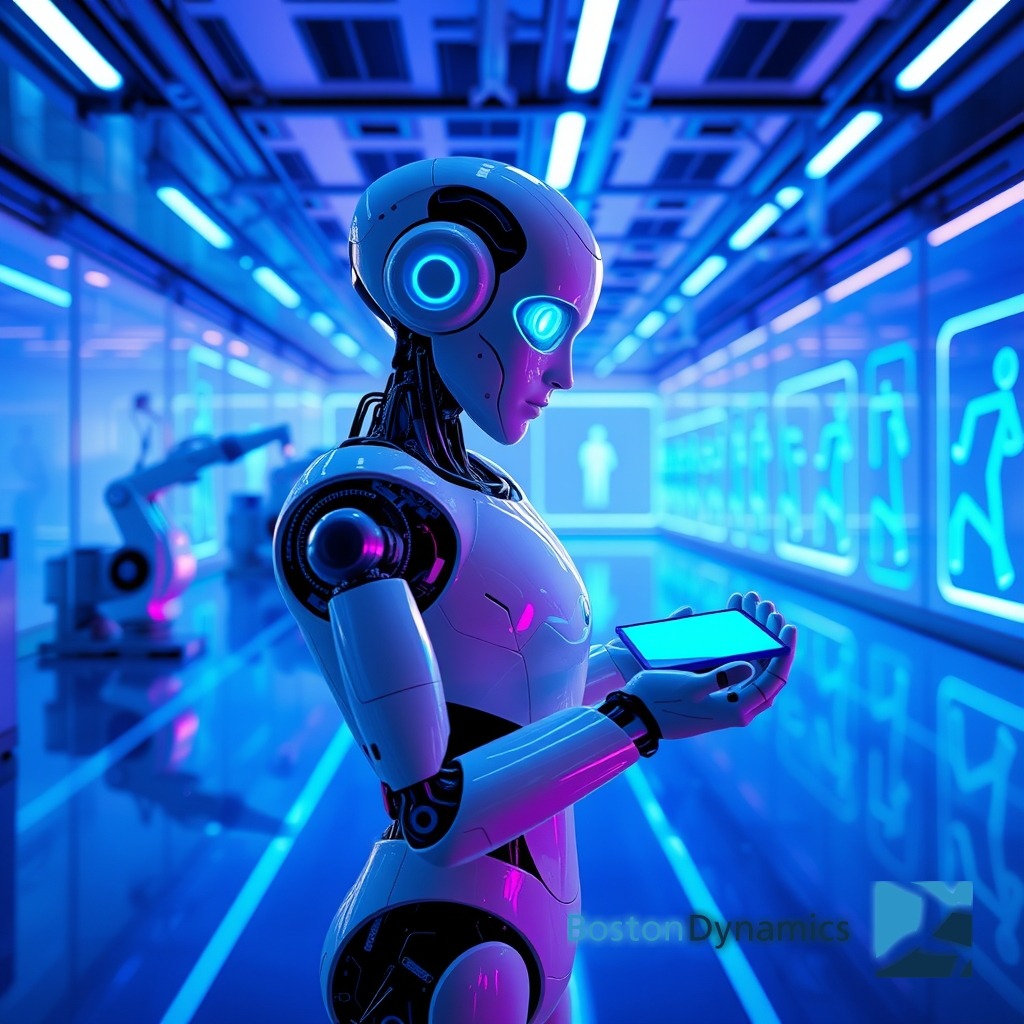 AI-generated
1. Executive Summary
Boston Dynamics has announced that its humanoid robot Atlas will begin its first trials outside the automotive sector at a major semiconductor manufacturer. This move marks a turning point in the humanoid's trajectory: for years, the dominant narrative positioned it as a "last-mile" or general-purpose manipulation solution in logistics, and now it is venturing into chip manufacturing, where the margin for error is measured in microns and particle contamination is a declared enemy. This is not a minor market expansion: it is a proof that humanoid robotics aspires to compete with specialized fixed automation in critical tasks.
For technology directors and supply chain analysts, the signal matters. The semiconductor industry is the heart of the digital economy, and its bottlenecks, specialized labor, reconfiguration times, yield per wafer, are legendary. The fact that a humanoid is attempting to enter this space suggests that flexible automation is beginning to look beyond logistics. Hardware CTOs, industrial infrastructure investors, and process engineers managing cleanrooms and high-complexity lines should pay attention. However, the announcement should be read with the coolness it demands: these are trials, not mass deployments, and the gap between a demo and a continuous three-shift operation remains enormous.
2. Deep Technical Analysis
To gauge the magnitude of the leap, we must dismantle the architecture that enables Atlas to operate in such a demanding environment. Unlike traditional industrial robotic arms, fixed and highly specialized kinematic systems, Atlas is a dynamic system with superior degrees of freedom. Its ability to navigate, manipulate objects with precision, and adapt to real-time environmental changes stems from decades of research in stability control and computer vision. The transition from automotive, where tolerances are relatively generous, to semiconductors, where contamination and sub-micron precision are vital, requires vibration control and repeatability that were previously considered the exclusive domain of high-end robotics.
The core of the innovation lies in the integration of high-fidelity sensors with refined reinforcement-learning algorithms. The AI models that govern Atlas's decision-making have evolved to handle long and complex contexts, so the robot does not merely execute a pre-programmed sequence: it interprets the line state and adjusts its behavior within milliseconds. This kind of situational reasoning is what would allow it to interact with delicate tools and components without damaging them, something a rigid robot cannot achieve without costly and slow reprogramming. It is worth emphasizing the nuance: we are talking about demonstrated capability in trials, not a guarantee of statistical repeatability in production.
Hardware also matters. The durability of Atlas's actuators, originally designed to withstand traction forces on rough terrain, has been reconfigured to prioritize smoothness and precision in fine movements. This entails re-engineering the motor control loops and extreme calibration of force sensors. Handling silicon wafers or inserting components into integrated circuits demands a delicacy that pushes the physical limits of conventional robotics. Atlas maintaining stability in those tasks is proof that the humanoid has moved beyond the prototype phase into robust industrialization, albeit with caveats that the company itself must document. Interoperability with manufacturing execution systems (MES) is another decisive technical factor. To be useful in a semiconductor fab, Atlas must communicate in real time with line-control systems: which component to process, in what order, and with which parameters. This integration requires secure, low-latency protocols and assurance that the robot does not interfere with critical processes. The maturity of this software layer is as important as the mechanics: it defines the overall operational efficiency of the system and, above all, the traceability demanded by the industry. We must avoid the temptation to read the announcement as a total replacement. Atlas does not replace all existing robots: it is positioned for tasks that are economically infeasible or technically impossible for fixed automation. Its flexibility allows it to be reassigned to different stations without reconfiguring the plant's physical infrastructure, a long-term cost saving. That versatility is its selling point against traditional arms, which require high upfront investment and deep task-specific customization. And operational safety closes the loop: a humanoid near sensitive equipment and potentially human personnel needs next-generation collision detection and emergency braking. Without that confidence, plant engineers will not accept integrating it into critical flows.
3. Industrial Impact and Market Implications
The entry of Atlas into semiconductors has direct implications for the cost structure of advanced manufacturing. The chip industry is capital-intensive and relies on specialized labor, with margins that depend on extreme efficiency. Automating repetitive, high-precision tasks with humanoids can reduce operating costs and enable production scaling without proportionally increasing the workforce. It not only improves profitability: it mitigates the risk of talent shortages in regions with high demand for manufacturing engineers.
From the supply-chain perspective, the move points to a trend toward industrial flexibility. Semiconductor fabs operate under constant pressure to switch products or adjust output according to demand. Humanoids, which are reprogrammable and versatile, allow lines to be reconfigured quickly, cutting downtime and re-engineering costs. That operational agility is a competitive advantage in a market where delivery speed and responsiveness are decisive.
The supplier ecosystem is also shifting. The adoption of humanoids in semiconductors will drive demand for high-precision components, advanced sensors, and control software. Actuator manufacturers, vision-system providers, and industrial AI platforms will benefit, and a market for flexible robotics solutions will emerge. Moreover, it will foster collaboration between robot manufacturers and system integrators, who will need to develop new implementation and maintenance methodologies. In global competitiveness, early adoption by semiconductor leaders can set a new efficiency benchmark. Those that do not adopt flexible automation could fall behind competitors that lower costs and boost productivity. This could accelerate market consolidation, favoring manufacturers that invest in digitization and advanced automation. Finally, there is a public-perception effect. Seeing a humanoid working in one of the world's most advanced industries reinforces the technology's credibility and reduces resistance to change in other sectors. That demonstration effect could catalyze adoption in pharmaceuticals or aerospace, where flexibility and precision are equally critical. However, it is important not to confuse the demonstration effect with proven deployment: the gap between the two separates a news story from a structural change.
4. Expert Perspectives and Strategic Analysis
Technical consensus indicates that this deployment is a validating milestone, but warns about scalability challenges. Moving from a controlled test environment to continuous operation in a real plant requires robustness that is still in the demonstration phase. The key to success will not only be the robot's technical capability, but the organization's ability to integrate robotics into its operational culture and maintenance processes. Training staff to work alongside robots and managing human-machine interaction will be decisive factors. Strategically, companies must evaluate not only the immediate return on investment, but the value of flexibility. Investing in humanoid robotics is a bet on operational resilience and long-term adaptability. Engineering directors should consider how integration improves product quality and reduces defects, impacting customer satisfaction and brand reputation. Industrial cybersecurity analysis streams underscore the importance of protecting these systems. Connected to the plant network and processing sensitive data, humanoids are a potential attack vector. It is imperative to implement robust security architectures, network segmentation, strong authentication, and continuous monitoring to prevent intrusions that could cripple production or compromise product integrity. Regarding acquisition strategy, a pilot-to-scale approach is recommended: start with high-value specific tasks, measure performance and costs, and scale gradually. That approach manages risk and optimizes investment, ensuring the technology aligns with strategic objectives. Collaboration with the robot manufacturer and experienced integrators is crucial to overcome initial technical and operational challenges. Finally, sustainability enters the equation. Advanced automation can help reduce energy consumption and waste, aligning with corporate responsibility goals. The energy efficiency of humanoids and their ability to optimize resource use should be considered in the strategic technology assessment.
5. Future Roadmap and Predictions
After this milestone in September 2026, the Atlas semiconductor trials are expected to conclude in the following quarters with results that determine large-scale commercial viability. If they are positive, a rapid expansion to other chip manufacturing plants worldwide is likely, especially in regions with high production density such as Asia and North America. The standardization of integration protocols and the reduction of hardware costs will drive mass adoption over the next three to five years, extending into the late 2020s and early 2030s.
In the long-term technological horizon, toward 2030, humanoid robotics could become a standard component of advanced manufacturing plants. A convergence between robotics and generative AI is anticipated, where robots not only perform tasks but also learn and continuously adapt to new production conditions. This evolution will enable massive manufacturing personalization, with lines that adjust in real time for small and customized batches without losing efficiency.
Later, toward the early 2030s, greater collaboration between robot manufacturers and AI software providers is expected, which will provide smarter and more autonomous robotics platforms. The integration of large language models into control systems will allow more natural interaction with human operators and better problem-solving capability. This synergy between hardware and software will be the engine of the next generation of industrial automation. The roadmap ultimately points toward a future where humanoid robotics is not a novelty, but a critical infrastructure for global manufacturing. Companies that prepare now for this transition will be better positioned to lead the next era of industrialization, characterized by flexibility, precision, and integrated artificial intelligence.
6. Conclusion: Strategic Imperatives
Boston Dynamics' decision to bring Atlas into the semiconductor industry is not just a product announcement: it is a statement of intent about the future of industrial robotics. The core thesis of this analysis is threefold. First, the technical leap is real but bounded: Atlas's dynamic manipulation and sensor-driven control loops represent a genuine advance over fixed automation, yet the sub-micron repeatability and contamination discipline that cleanrooms demand remain unproven at production scale. Second, the economic logic is compelling: flexible reprogrammability addresses the semiconductor industry's chronic bottlenecks of specialized labor and slow line reconfiguration, but the return only materializes if the robot survives three-shift operation without degrading yield. Third, the strategic signal outweighs the immediate deployment: a humanoid inside a chip fab validates the category in the eyes of plant engineers and supply-chain leaders far more than any logistics pilot could.
For CTOs and engineering directors, the imperative is clear: evaluate the viability of the humanoid in their own operations not as a luxury, but as a competitive necessity. The window to adopt this technology before it becomes the industry standard is limited, and inaction could translate into operational and economic disadvantage.
Immediate action must focus on identifying high-value, high-complexity tasks that are candidates for flexible automation. A gap analysis between the plant's current capabilities and those offered by humanoid robotics is recommended, in order to pinpoint where the investment would generate the greatest return. Additionally, it is crucial to establish alliances with cutting-edge technology providers to access the latest advances in hardware and software, ensuring an efficient and safe implementation. Ultimately, the success of this transition will depend on the ability of organizations to integrate the technology into their culture and processes. Humanoid robotics is not a magic solution, but a powerful tool that demands careful strategic management. Those who approach this challenge with vision, technical rigor, and a commitment to innovation will be in a privileged position to define the future of global manufacturing. And Atlas, in a semiconductor cleanroom, will be the first real test of that promise.