Español
 English
 Français
 Português
 Deutsch
 Italiano
Fire-Resistant Robot Dog Survives 1,832-Degree Fahrenheit Blaze in Extreme Testing
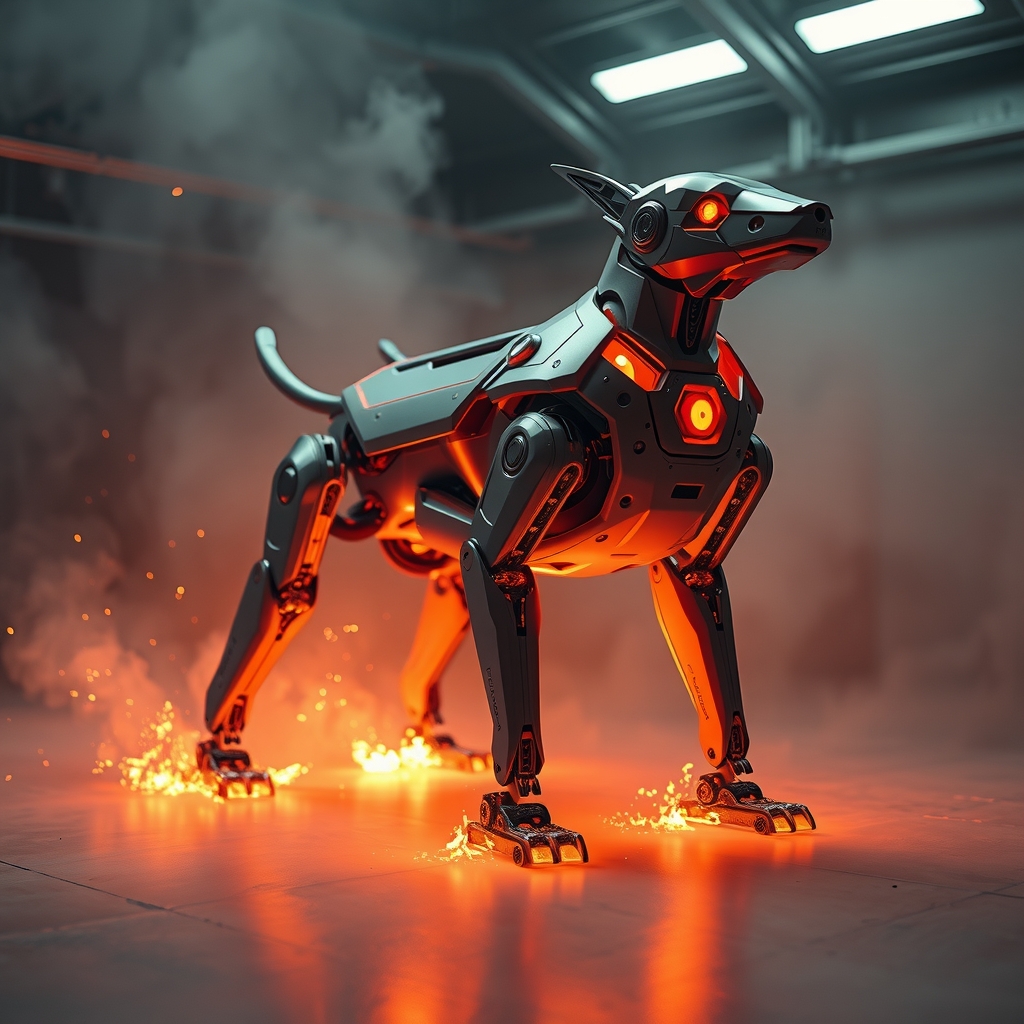 AI-generated
1. Context and Key Points
The evolution of robotics applied to extreme industrial environments has reached a critical milestone with the successful validation of a robotic dog equipped with a specialized fire-retardant suit, capable of withstanding and operating under temperatures of 1,832 degrees Fahrenheit (approximately 1,000 degrees Celsius). This extreme endurance test marks a turning point in the capacity for automated deployment in disaster mitigation, petrochemical refinery inspection, and severe structural fire management where direct human intervention is catastrophic. The convergence of refractory materials science, active thermoregulation, and robust quadrupedal locomotion opens a new paradigm in rescue engineering.
Far from being a mere conceptual exercise, the system represents the response to the most complex operational challenges in heavy industry and civil protection. With the integration of high thermal-resistance sensors and aerogel casings combined with advanced technical textiles, the device demonstrates that mobile robotics can penetrate thermal exclusion zones that would melt conventional hardware in a matter of seconds. The analysis of this technical test reveals not only the physical viability of the structure, but also the economic and operational implications for global industrial safety.
This report breaks down the critical components of the robot's thermal architecture, evaluates the impact on insurance markets and emergency operations, and examines the technological roadmap that will transform these laboratory tests into standardized commercial deployments over the coming years. For chief technology and operations officers of critical infrastructure, this breakthrough demands an immediate review of automated response protocols for thermal emergencies.
2. Key Technical Aspects
The core of the innovation lies in comprehensive thermal management, a challenge that combines materials thermodynamics and the internal dissipation of heat generated by the robot's own computational components. At 1,832 degrees Fahrenheit, thermal radiation and convective heat transfer far exceed the limits of aerospace-grade polymers and conventional aluminum alloys. To mitigate this thermal load, the engineering team implemented a multilayer composite armor utilizing silica aerogels doped with infrared opacifiers, suspended within a matrix of woven aramid and ceramic fibers.
The suit's external structure acts as a primary radiative barrier, reflecting the high-intensity heat flux, while the intermediate layers manage thermal conductivity by disrupting energy transfer microchannels. At the underlying level, the quadruped's chassis incorporates phase-change heat exchangers and circulating liquid cooling systems that protect the high-torque actuators and central processing units. Internal heat management is as critical as external insulation, given that the microprocessors and neural processing units controlling the robot's dynamic balance generate a substantial amount of internal thermal energy that must be efficiently evacuated to prevent thermal shutdown.
From a locomotion perspective, maintaining flexibility and agility on a platform carrying heavy protective cladding represents a feat of dynamic control. The robot's joints are hermetically sealed using fluorocarbon rubber bellows and flexible metallic shielding, preventing the infiltration of hot gases and glowing particles that could compromise bearings and absolute encoders. Gait control algorithms, adapted from advanced reinforcement learning architectures, constantly calibrate motor torque to compensate for the added weight and mechanical resistance of the fire-retardant suit.
Sensor integration also required a radical redesign. Conventional optical cameras and LiDAR sensors suffer catastrophic degradation or failure at elevated temperatures due to lens deformation and the saturation of image sensors by blackbody radiation. In this development, sensor arrays are protected by synthetic sapphire windows with dichroic coatings and inert gas purge systems that maintain an internal overpressure, preventing the entry of contaminated air and selectively cooling the navigation optics.
Energy performance under extreme thermal stress conditions introduces another critical variable. The solid-state batteries employed in the platform underwent rigorous testing to ensure that thermal expansion and electrochemical degradation do not trigger thermal runaway. The efficiency of the power distribution system was optimized to guarantee sufficient operational autonomy in scenarios where every minute of inspection reduces exposure to cumulative damage on printed circuit boards and data transmission lines.
3. Industry Repercussions
The validation of a quadrupedal robot capable of withstanding 1,832 degrees Fahrenheit reshapes risk calculations for industrial sectors with high exposure to fire and explosions, including oil refining, petrochemicals, steel manufacturing, and nuclear waste management. Traditionally, containing massive industrial fires required removing human personnel and applying external mitigation methods, such as fixed water cannons or remote-controlled fire trucks with severe mobility limitations in rugged terrain or collapsed structures.
In the insurance and risk management sector, the ability to deploy real-time mobile inspections inside active fire zones promises to drastically reduce operational downtime costs and collateral damage to capital assets. Insurance premiums for complex industrial facilities could adjust as insurers verify that early detection and automated intervention with these systems reduce the probability of total catastrophic losses. The ability to assess structural integrity from within a burned zone provides accurate data that optimizes the decisions of human emergency response teams.
From a supply chain perspective, the production of these systems requires close collaboration between advanced robotics manufacturers, aerospace companies specializing in thermal shields, and advanced materials suppliers. Commercial scalability will depend on optimizing the manufacturing costs of refractory components and standardizing preventative maintenance protocols after exposure to extreme temperatures. Organizations that adopt these technologies in their early stages will gain a significant competitive advantage in terms of regulatory compliance and business continuity.
Adoption in the public sector, specifically among metropolitan fire departments and urban rescue teams, will experience gradual but sustained demand. Although the initial acquisition cost is high, the return on investment is justified by the preservation of human lives and the drastic reduction of severe injuries associated with entering burning confined spaces. Municipalities and civil protection agencies are already evaluating operational models where these robots act as the reconnaissance vanguard before committing human intervention teams.
4. Market Outlook
Industry analysts agree that overcoming the 1,800-degree Fahrenheit barrier marks the transition from passive inspection robotics to active intervention in hostile environments. The convergence of heat-tolerant materials and autonomous control systems eliminates one of the greatest historical obstacles in industrial safety automation. However, experts warn that commercial deployment should not be interpreted as the total elimination of human risk, but rather as a shift toward high-precision remote supervision.
Strategic recommendations for Chief Technology Officers and industrial safety managers focus on three fundamental pillars:
- Auditing thermal vulnerabilities in current facilities to identify critical points where robotic intervention provides the greatest operational value.
- Establishing pilot integration programs that combine fire-resistant robotic platforms with artificial intelligence-based data analysis systems for structural failure prediction.
- Training operations personnel in advanced teleoperation and the maintenance of systems exposed to high thermal severity environments.
The technical consensus emphasizes that the operational success of these systems lies not only in the durability of the external hardware, but in the reliability of the communication link in environments with dense smoke clouds, electromagnetic interference, and heavy metallic shielding. Tests show that redundancy in local communication systems and onboard navigation autonomy are just as vital as the thermal insulation suit itself.
5. Next Steps
The evolution of fire-resistant robotics will follow a predictable trajectory over the coming years, driven by the demand for greater autonomy and weight reduction in protective materials. Below is the detailed chronological projection of expected developments:
| Time Horizon | Expected Technological Milestone | Operational Impact |
|---|---|---|
| Short Term (1-2 years) | Commercialization of fire-retardant retrofit kits for existing quadrupedal platforms in petrochemical plants. | Initial deployment in refineries for routine inspections of high-temperature lines and controlled-risk areas. |
| Medium Term (3-5 years) | Integration of robotic manipulation systems with thermal grippers and self-lubricating materials for emergency valve shut-off tasks. | Ability to intervene directly in flammable gas leaks and control ignition sources in confined spaces. |
| Long Term (5+ years) | Complete autonomy in coordinated robotic swarms for the mass extinguishing of complex industrial fires without direct human supervision. | Drastic reduction in the need to expose human personnel in severe industrial disaster scenarios. |
Research into new composite aerogel materials and metal matrix alloys with melting points exceeding 2,200 degrees Fahrenheit will further expand safety margins in future design iterations. The miniaturization of active cooling systems will represent the next major challenge in reducing the overall volume of thermal shielding.
6. Conclusion and Assessment
The experimental validation of this robot dog capable of withstanding a 1,832-degree Fahrenheit fire marks a milestone in the engineering of automated platforms for extreme pyrotechnic environments. By simultaneously solving the critical challenges of radiative barrier protection using advanced aerogels, hermetic joint sealing, and internal liquid cooling, the system demonstrates that mobile robotics can operate reliably where conventional hardware collapses instantly.
For chief technology officers, petrochemical plant managers, and industrial safety officers, this breakthrough demands moving away from traditional passive containment methods and adopting active robotic intervention strategies. The early integration of these platforms into emergency response protocols not only mitigates the risk of catastrophic human loss, but also redefines global standards for operational resilience and business continuity in the most demanding heavy industry sectors.