Español
 English
 Français
 Português
 Deutsch
 Italiano
I Saw the Future of AI in a Robot That Learns on the Fly: The Revolution of Robotic Improvisation
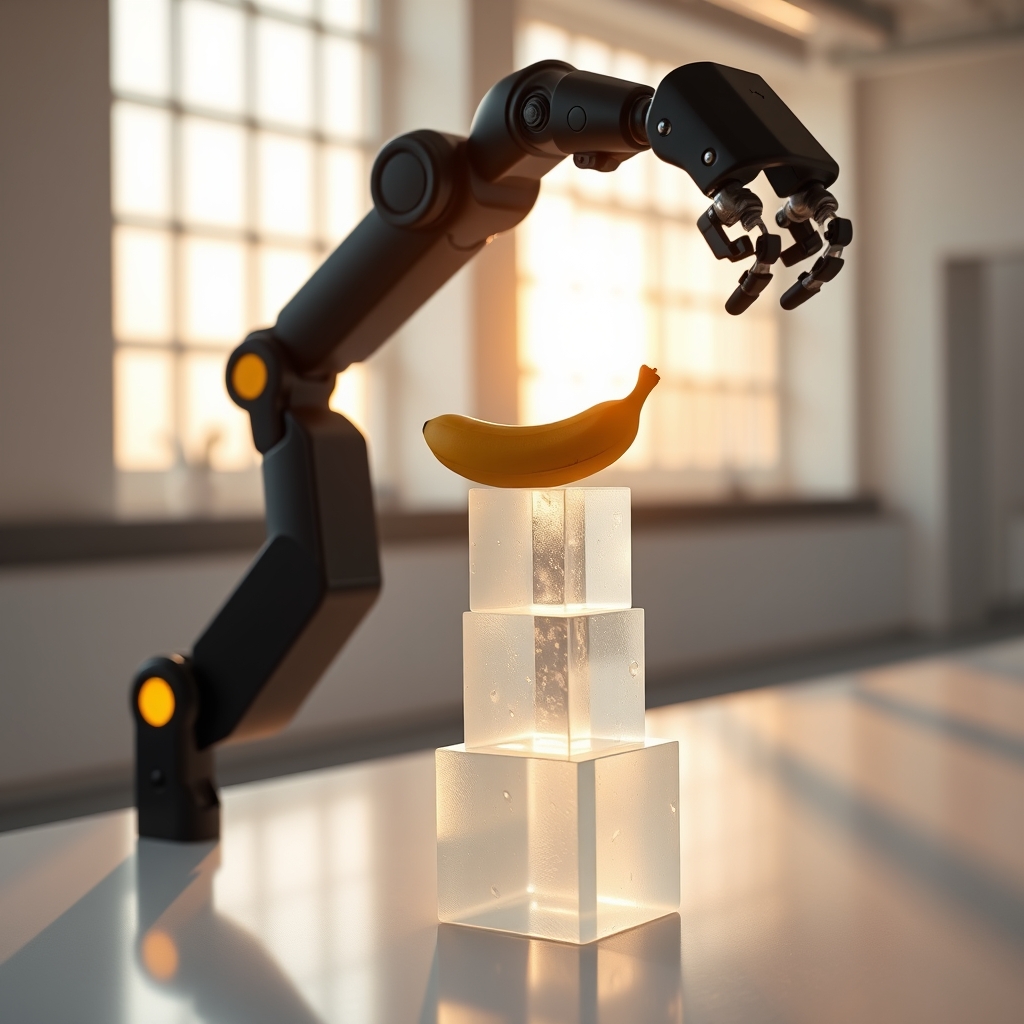 AI-generated
On August 20, 2026, at Generalist AI's facilities, I did not witness another demonstration of mechanical dexterity. I witnessed a change of era. A robotic arm, designed for generic manipulation tasks, faced a scenario that was not in its script: an unknown object (a banana) and an abstract objective (stacking an unstable object). What happened next was not a choreographed sequence, but functional improvisation. The robot, after evaluating the environment, picked up the banana, used it as a counterweight and pushing tool to stabilize a stack of blocks, and completed the task with a fluidity that defied any traditional programming logic.
This event, which might seem anecdotal, is actually the tip of the iceberg of a technological convergence we have been anticipating for years: the fusion of large language and vision models with low-latency physical robotics. We are not talking about a robot that "knows" what a banana is from a database, but about a system that understands the object's physics, its potential grip, and its usefulness as a tool in a specific context, all in real time. For business strategists, CTOs, and investors, this is not a laboratory curiosity; it is the clearest signal that AI has crossed the threshold from "perception" to "contextual action." This analysis is not a chronicle of a gadget. It is a forensic examination of an AI architecture that learns at the edge, without relying on the cloud for every decision, and that promises to reconfigure industrial automation, logistics, and services. Those who do not understand this transition will remain anchored in an era of rigid, costly-to-retrain robots, while their competitors deploy fleets of adaptive systems. Below, we break down the internal mechanics, the sectoral impact, and the roadmap that companies must chart to avoid falling behind.
1. Executive Summary
The visit to Generalist AI revealed a milestone in cognitive robotics: a system demonstrating zero-shot learning applied to physical manipulation. Unlike traditional systems that require thousands of demonstrations for each new task, this robotic arm used a multimodal foundation model (vision-language-action) to reason about a novel object and execute a creative solution. The key was not the hardware, but the control software that integrates a dynamic world model and a low-level planner operating in milliseconds.
The strategic importance is twofold. First, for the manufacturing and logistics industry, this means the end of rigid assembly lines. A robot that can improvise with makeshift tools (a banana, a box, a cable) can adapt to product variations without reprogramming costs. Second, for the services sector, it opens the door to physical assistants that operate in unstructured environments (homes, hospitals, chaotic warehouses) where variability is the norm, not the exception. Technology leaders must view this advance not as an incremental improvement, but as a qualitative leap that demands a reevaluation of their automation roadmaps.
This article is aimed at operations executives, AI architects, and market analysts who need to understand not only the "what" and the "how," but also the "when" and the "why" of this transition. We will analyze the underlying technical architecture, compare the state of the art in proprietary and open-source models (GPT-5.6 Sol, Claude Opus 5, Gemini 3.7 Flash, Llama 4, among others), and offer a critical perspective on the safety and control challenges that emerge when AI acts physically in the real world.
2. Deep Technical Analysis
The system observed at Generalist AI radically departs from the classic modular "perception-planning-action" architecture. Instead, it uses a vision-language-action (VLA) model that simultaneously processes depth camera input, joint states, and a high-level instruction ("stabilize the stack"). The critical innovation lies in the physical reasoning layer, which does not merely recognize objects, but mentally simulates the consequences of proposed interactions. In the case of the banana, the system evaluated its rigidity, friction, and shape, and determined that it could serve as a wedge or counterweight, a solution that no engineer would have explicitly coded.
The component enabling this capability is a latent world model, trained on massive data from simulated and real physical interactions. This model does not store rules, but rather learns a vector representation of object properties and their interaction dynamics. When the robot faces the banana, it does not search a database for "how to use a banana," but instead projects its latent representation into a space of action possibilities, evaluating thousands of hypothetical trajectories in milliseconds through a diffusion process accelerated by specialized hardware. This approach, known as "model-based reinforcement learning," allows the system to improve with each interaction, even without external supervision.
Latency is the other fundamental pillar. While language models like GPT-5.6 Sol or Claude Opus 5 require massive server infrastructure, this robotic system runs a distilled and quantized version of the model on an edge computing module (a custom SoC with state-of-the-art NPUs). This reduces the control loop response time to less than 50 milliseconds, an indispensable requirement for stable physical manipulation. Cloud communication is limited to telemetry and periodic model updates, but critical decision-making is 100% local, guaranteeing operation even with intermittent connectivity. Another relevant technical aspect is the "episodic memory" mechanism. The robot did not just improvise; it remembered the solution. In a second test with a similar object (a water bottle), the system retrieved the "use as counterweight" strategy and adapted it successfully. This ability to transfer skills between objects is what researchers call "compositional generalization." It is not simple data storage, but the ability to decompose a solution into abstract primitives (grasp, push, leverage) and recombine them for new scenarios. This is achieved through a transformer architecture with cross-attention between visual and tactile modalities, allowing the system to correlate an object's shape with its potential function. However, not everything is clean innovation. The system showed limitations under extreme lighting conditions and with translucent objects, where depth estimation failed. Furthermore, execution speed was notably inferior to that of a traditional industrial robot in repetitive tasks. This underscores that current technology is optimized for flexibility, not raw speed. Integrating these systems into hybrid production lines (where flexible robots handle variability and traditional robots handle repetition) appears to be the most viable immediate application. From a state-of-the-art perspective, this advance builds on the foundation models released in 2026. The spatial reasoning capability of Gemini 3.7 Flash and the causal reasoning proficiency of Claude Opus 5 are logical components that could be integrated into the high-level planning layer. Meanwhile, open-source models like Llama 4 (with its 10M token context) provide the basis for companies like Generalist AI to fine-tune their own action models without relying on proprietary APIs, reducing costs and latency. The trend is clear: advanced robotics is no longer an isolated field, but a vertical application of large multimodal models.
3. Industry Impact and Market Outlook
The implications for the manufacturing sector are profound. A robot's ability to improvise with non-standard tools directly attacks the problem of "picking" and manipulating non-uniform parts in warehouse automation. E-commerce companies handling millions of SKUs with varying shapes and fragilities could drastically reduce the cost of automation. Instead of designing custom end effectors for each product, a single arm with this AI could adapt on the fly, using boxes, packing paper, or even the product itself as an auxiliary tool. This is not a marginal improvement; it is a rewrite of the return-on-investment equation in robotics.
In the logistics sector, the vision of a robot that "learns on the fly" solves the problem of unstructured environments. Distribution centers are chaotic: fallen boxes, overlapping objects, variable lighting. Traditional vision systems fail in the face of this variability. A system with a latent world model can reason about the stability of a stack of boxes, predict the risk of collapse, and adjust its gripping strategy accordingly. This could reduce handling damage and increase storage density, as robots could stack more aggressively and safely.
The services sector is the next major battleground. Robotic assistance in the home or in hospitals has been limited by the unpredictability of tasks. A robot that can use a banana as a tool is a robot that can improvise a bandage with gauze, or use a chair to reach a high object. The barrier to mass adoption is no longer mechanical dexterity, but hardware cost and safety. As sensor and actuator costs decline, and AI becomes more robust, we will see a proliferation of these systems in high-value niches (hospitals, nursing homes) before reaching the end consumer.
From the perspective of the AI model market, this event consolidates the position of proprietary spatial reasoning models. GPT-5.6 Sol and Grok 4.6 are competing fiercely to dominate the "general physical manipulation" benchmark, a new standard that is emerging in the industry. However, the smartest strategic move is in the open-weight field. Llama 4 and Gemma 4 allow companies like Generalist AI to create specialized models without paying royalties, which accelerates innovation and reduces entry costs. The battle will not be over the smartest model, but over the ecosystem that enables the fastest and safest customization for robotics. Industry analysts point out that the real bottleneck is not AI, but actuation and tactile perception. Current robotic arms lack the haptic sensitivity of a human hand. The integration of electronic skin with high-resolution force feedback is the next major challenge. Without it, the robot cannot "feel" whether it is exerting too much pressure on the banana. Companies that master the integration of tactile sensors with action models will have an insurmountable competitive advantage. The first commercial products with this integrated capability are expected to appear by late 2026. Finally, the impact on employment is an issue that cannot be ignored. While traditional automation eliminated repetitive jobs, this new wave of flexible robots threatens roles that require a certain degree of manual dexterity and adaptation, such as fresh produce packaging or complex order preparation. However, history suggests that automation creates more jobs than it destroys, but it demands massive re-skilling. Training programs in "robotic fleet supervision" and "edge AI system maintenance" will be critical for the workforce of the next decade.
4. Expert Perspectives and Strategic Analysis
The technical consensus among robotic systems architects is that Generalist AI's demonstration validates an approach that many considered theoretical until a year ago: the use of diffusion models for real-time motion planning. The synthesis of opinions from leading engineers in the field suggests that the key to success was not a single algorithmic breakthrough, but the orchestration of multiple components: a language model for instruction understanding, a vision model for object segmentation, and a diffusion model for trajectory generation. The integration of these three elements into a single pipeline optimized for edge inference is the true achievement.
A critical strategic perspective comes from AI safety analysts. The ability to physically improvise introduces unpredictable risks. If a robot can use a banana as a tool, what prevents it from using a dangerous object inappropriately? Current safety systems rely on human supervision and emergency stop limits. However, the decision speed of these systems exceeds human reaction capability. The need for a separate "safety cortex" is being debated, an independent AI model that supervises the robot's actions and blocks them if they violate a set of ethical and physical rules. This is an emerging and critical field of research.
From an investment standpoint, venture capitalists are reorienting their portfolios. Startups focused on "AI for robotics" are receiving unprecedented valuations, while traditional robotics companies that rely on expert programming are losing appeal. The recommendation for investors is clear: seek companies that own proprietary physical interaction data, as this will be the "oil" of the future. Simulation data is useful, but real-world data, with its noise and complexity, is irreplaceable for training robust models.
For CTOs of large corporations, the recommended strategy is controlled experimentation. It is not about replacing the entire robotic fleet immediately, but about identifying high-value, low-standardization processes where this technology can offer an immediate advantage. For example, in quality inspection of artisanal products or in handling fragile materials. Implementation should be gradual, with clear success metrics and a dedicated team for system supervision and tuning. Integration with existing MES and ERP systems is a challenge that should not be underestimated. Another relevant viewpoint comes from AI ethics experts. Physical autonomy raises questions about legal responsibility. If a robot causes damage, who is liable? The hardware manufacturer, the AI model developer, or the operator who deployed it? The current legal framework is inadequate. The European Union and other jurisdictions are expected to develop specific regulations for autonomous robotics within the next 24 months. Companies must actively participate in defining these standards to avoid restrictive regulations that stifle innovation. Finally, the most important strategic recommendation is internal training. The talent shortage at the intersection of robotics and machine learning is acute. Companies must invest in upskilling programs for their automation engineers, teaching them the fundamentals of diffusion models and reinforcement learning. An organization's ability to adapt to this technology will depend more on its human capital than its financial capital. The sustainable competitive advantage will not be the robot, but the team that knows how to train, supervise, and improve it.
5. Future Roadmap and Predictions
Based on the current pace of innovation, we can chart a realistic roadmap for the coming years. In the short term, over the coming quarters, we will see the commercialization of robotic arms with this improvisation capability in specific industrial niches. The first adopters will be e-commerce logistics companies and automobile manufacturers, who already have experience with collaborative robots. The main limitation will be the cost of edge computing hardware, which is expected to decline rapidly thanks to competition among chip manufacturers such as NVIDIA and Qualcomm.
In the medium term, during the next commercial deployment phase, the integration of high-resolution tactile feedback will be the tipping point. Robots will be able to manipulate extremely fragile or deformable objects (such as ripe fruit or textiles) with dexterity comparable to humans. This will open the agriculture and food preparation sectors to automation. We will also see the first mobile robots with manipulator arms using this technology in hospital and laboratory environments, performing sample preparation tasks or assisting in minimally invasive surgery.
In the long term (2030 and beyond), convergence with next-generation language models will enable even more natural interaction. We will be able to tell a robot "organize the pantry efficiently" and the system will not only execute the task but also reason about the best arrangement of objects based on frequency of use and ergonomics. The distinction between "robot" and "intelligent assistant" will blur. The key will be the development of world models that can simulate complex scenarios with multiple agents and objects in real time, a computational challenge that will require advances in neuromorphic hardware.
However, the boldest and most likely prediction is the democratization of adaptive robotics. Just as open-source language models like Llama 4 have democratized access to generative AI, open-source action models will allow any company with a moderate budget to implement flexible robots. The barrier to entry will not be technology, but the ability to collect and curate training data specific to their domain. Companies that start collecting this data today will have an insurmountable advantage in 2030.
6. Conclusion: Strategic Imperatives
The Generalist AI demonstration is not an isolated event; it is a wake-up call for all industries that depend on physical manipulation. The era of the rigid robot, programmed for a single task, is coming to an end. The new era is dominated by systems that learn from experience, improvise with unexpected tools, and adapt to chaotic environments. Business leaders must internalize that competitive advantage is no longer built on the efficiency of repetition, but on the capacity to adapt to variability.
The first imperative is process auditing. Identify the tasks in your operation that require flexibility and are currently bottlenecks. These are the ideal candidates for implementing this technology. The second imperative is investment in data. Begin collecting physical interaction data in your production environments. This data will be the most valuable asset for training specialized models. The third imperative is talent development. Your engineers must understand the principles of diffusion models and reinforcement learning. Hiring experts in robotic AI will be one of the most critical decisions of the coming years.
Ultimately, the question is not whether this technology will reach your industry, but when and in what form. Companies that act decisively, adopting an approach of experimentation and continuous learning, will not only survive the transition but will lead the next wave of productivity. Those that wait for the technology to fully mature will find themselves at an irreversible disadvantage. The future of AI is not in the data clouds, but in the arms and hands that act upon the physical world. And that future has already begun.