Español
 English
 Français
 Português
 Deutsch
 Italiano
The Memory Revolution: DDR6 Redefines Computing Limits with 12.8 GT/s and 1 TB per Slot
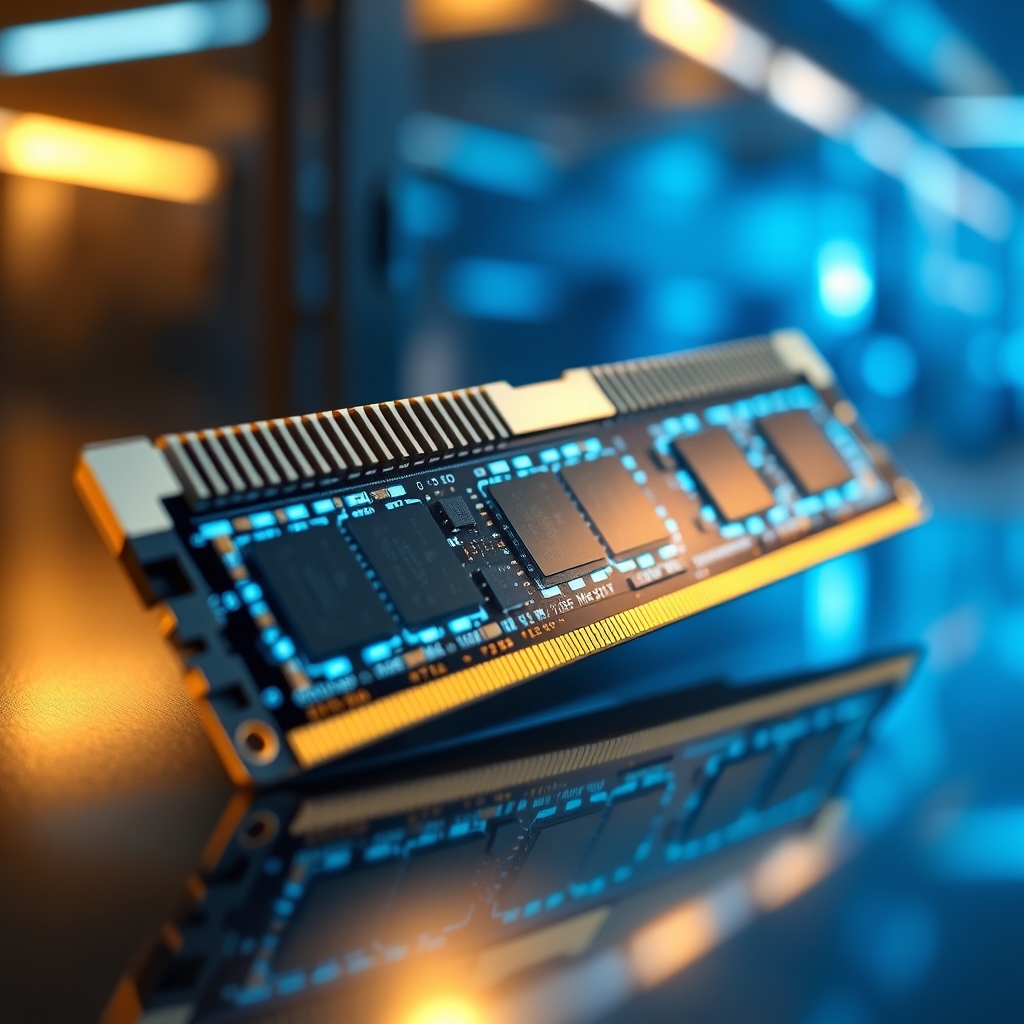 AI-generated
1. Context and Key Points
The semiconductor industry has reached a critical turning point with JEDEC's official release of the DDR6 specifications. This new standard is not a mere incremental iteration; it represents a fundamental reconfiguration of how data flows between the processor and volatile memory. By achieving a density of up to 1 terabyte per module and a transfer rate of 12.8 GT/s, DDR6 directly addresses the bottleneck that has limited the performance of the most advanced artificial intelligence systems over recent years.
For chief technology officers and system architects, the adoption of DDR6 implies an immediate reassessment of hardware strategies. The 44% reduction in the physical space occupied by the modules allows for greater compute density in server racks, while the massive increase in bandwidth provides the necessary response to feed the data voracity of models like GPT-6.2 Astra or Gemini 4 Carbon. This advancement is, essentially, the physical enabler for the next generation of local inference and distributed training.
2. Key Technical Highlights
The leap from DDR5 to DDR6 is built upon a completely redesigned data bus architecture. While DDR5 introduced independent dual 32-bit channels per module, DDR6 elevates efficiency through more robust signaling and optimized power management. The key to the 12.8 GT/s lies in improved signal integrity, enabling higher clock frequencies without compromising thermal stability, a challenge that had previously hindered scaling in earlier generations.
The 44% reduction in form factor is perhaps the most impressive engineering achievement. By integrating power management components (PMIC) more efficiently and utilizing cutting-edge lithography processes, manufacturers have managed to condense capacity without increasing the heat footprint. This is vital for liquid cooling systems in data centers, where every square millimeter of motherboard space is a strategic asset. The ability to reach 1 terabyte per slot is a game-changer for the deployment of large-scale language models. Currently, running models with massive parameters requires excessive fragmentation across multiple nodes, which introduces latency in inter-node communication. With DDR6, the ability to load complete models into the local memory of a single server drastically reduces network dependency, optimizing operational costs and improving response speed. From a memory architecture perspective, DDR6 implements advanced error correction code (ECC) techniques that are intrinsic to the design, rather than added as an external layer. This ensures that as we increase bit density, system reliability is not degraded by electromagnetic noise or long-term transistor degradation. The 12.8 GT/s bandwidth is not just a theoretical figure; it is the result of optimized synchronization of read and write cycles. By reducing CAS latency, DDR6 allows processors to keep their execution units busy for a larger percentage of the time, eliminating the wait states that have historically dragged down performance in compute-intensive tasks.
3. Industry Impact
The server market will experience an accelerated transition toward DDR6 as companies seek to maximize return on investment in their GPU and NPU clusters. The ability to consolidate workloads into fewer physical servers, thanks to higher memory density, will allow organizations to reduce their operating costs in terms of power, cooling, and data center space.
For cloud service providers, the implementation of DDR6 is a direct competitive advantage. Those who adopt this technology first will be able to offer compute instances with greater available memory, which is critical for clients running complex reasoning models or massive real-time data analysis. The ability to handle longer input contexts without resorting to slow paging techniques will be a key differentiator in the 2027 market. The semiconductor supply chain will also be affected. The transition to DDR6 requires significant investment in manufacturing and testing equipment. Manufacturers that have already optimized their processes for DDR5 will need to make a technical transition to the new packaging standards, which could lead to initial supply shortages while production capacity adjusts to the new demand. At the cost level, although the initial price per gigabyte will be higher than that of DDR5, the total cost of ownership (TCO) will benefit from energy efficiency and higher density. Companies must consider the opportunity cost of not upgrading their systems, especially when the performance of their AI models directly depends on memory access speed.
| Feature | DDR5 (Current standard) | DDR6 (New standard) |
|---|---|---|
| Maximum speed (GT/s) | Up to 8.4 | 12.8 |
| Maximum capacity per slot | 256 GB | 1 TB |
| Space efficiency | Base | 44% more compact |
| Error management | Standard ECC | Integrated advanced ECC |
4. Market Outlook
The technical consensus suggests that DDR6 is the missing piece to bridge the gap between the computing capacity of AI processors and the speed of data delivery. Industry analysts agree that, without this breakthrough, the scaling of models like Claude Mythos 5.5 or GPT-6.2 Astra would have hit an insurmountable physical ceiling in the short term.
The strategic recommendation for CTOs is clear: an immediate massive replacement is not necessary, but a lifecycle planning that prioritizes DDR6 compatibility in upcoming hardware procurements is. The infrastructure installed today must be capable of supporting the memory density that will become the standard over the next 24 months. It is crucial to observe how processor manufacturers will integrate memory controllers for DDR6. Processor architectures will need to evolve to efficiently manage the massive bandwidth offered by this new standard, preventing the processor from becoming the new bottleneck. Security also plays a relevant role. With higher memory density, the protection of data at rest within the RAM becomes more critical. DDR6 implementations include more robust memory encryption protocols, which is an essential consideration for regulated sectors such as finance or healthcare, where data integrity is non-negotiable.
5. Roadmap and Future Predictions
Mass adoption of DDR6 is expected to begin in the second quarter of 2027, initially in the high-performance server and hyperscale data center segment. As manufacturing costs stabilize, we will see a transition to professional workstations by late 2027.
By 2028, we are likely to see the emergence of DDR6 variants optimized for edge computing devices, where energy efficiency will be the determining factor. The ability to run medium-sized language models locally on devices with high-density DDR6 memory will open up new possibilities for privacy and offline inference. The natural evolution after DDR6 will be the exploration of new non-volatile memory architectures that can be integrated onto the same bus, eliminating the distinction between storage and memory. However, for now, DDR6 represents the pinnacle of volatile memory engineering and will be the dominant standard for the coming years.
6. Conclusion and Assessment
The arrival of DDR6 is a reminder that artificial intelligence software, no matter how advanced, is subject to the laws of physics and hardware engineering. The ability to move data at 12.8 GT/s and store 1 TB per slot is not just a technical upgrade; it is a competitive advantage that will allow organizations to process information with previously unattainable depth and speed.
Technology leaders must act now to audit their infrastructure roadmaps. Investment in DDR6-compatible systems should not be viewed as an expense, but as a safeguard against obsolescence. Those organizations that integrate this technology into their training and deployment clusters will be best positioned to capitalize on the next wave of innovation in language models and autonomous systems.